05_Energy
Conservation of Energy
1. The Work-Kinetic Energy Theorem
The fundamental relationship between work and kinetic energy is given by:
Rewriting this equation:
We define the negative work done by a conservative force as the change in potential energy (\(U\)):
Substituting this back into the theorem yields the Conservation of Mechanical Energy (\(\text{E}_{\text{mec}}\)):
2. Conservative Forces
For mechanical energy to be conserved, the force must be conservative.
-
Definition: A force is conservative if the total work done around any closed path (a round trip) is zero.
-
Path Independence: With a conservative force, the work done depends ONLY on the initial and final positions, not on the path taken.
-
If an object moves from point \(a\) to point \(b\) along two different paths (path-1 and path-2), then \(W_{ab, 1} = W_{ab, 2}\).
-
Proof: According to the definition, moving from \(a \to b\) along path-1 and returning \(b \to a\) along path-2 yields zero net work: \(W_{ab, 1} + W_{ba, 2} = 0\). Since work is the integral of force over displacement, reversing the path reverses the sign: \(W_{ba, 2} = -W_{ab, 2}\). Therefore, \(W_{ab, 1} = W_{ab, 2}\).
-
Potential Energy (\(\Delta U\))
1. General Computation
Because \(\Delta U\) only depends on the initial and final states, it is consistent with the definition of a conservative force. It is computed as:
2. Gravitational Potential Energy
For an object moving vertically near the Earth's surface:
This gives the general form:
Notes on Gravitational Potential Energy:
-
\(C\) is an arbitrary constant that remains fixed during a specific calculation. By convention, it is often set to \(C = 0\).
-
There is no dependence on horizontal displacement.
-
This assumes the Earth is static (\(M_{\text{earth}} \gg m_{\text{object}}\)) and the object is close to the surface (constant \(g\)).
Example (Free Fall):
An object is dropped from height \(H\) at rest.
-
Initial State (\(t=0\)): \(y_i = H, v_i = 0 \Rightarrow K_i = 0, U_i = mgH\). Initial energy \(E_{\text{mec}}^{(i)} = mgH\).
-
Final State (just before impact): \(y_f = 0, v_f = \sqrt{2gH} \Rightarrow K_f = \frac{1}{2}m(\sqrt{2gH})^2 = mgH, U_f = 0\). Final energy \(E_{\text{mec}}^{(f)} = mgH\).
-
Result: \(E_{\text{mec}}^{(i)} = E_{\text{mec}}^{(f)}\). Energy simply transforms from potential (\(U\)) to kinetic (\(K\)). The opposite process (throwing an object upward) transforms \(K\) into \(U\).
3. Elastic Potential Energy
For a spring obeying Hooke's Law (\(F = -kx\)):
Assuming \(C=0\) convention:
-
\(U(0) = 0\) corresponds to the undeformed state.
-
\(U(x \neq 0) > 0\) corresponds to a deformed state where positive energy is stored.
Relating Force and Potential Energy
If the potential energy \(U(x)\) is known, the corresponding conservative force can be found by taking the negative derivative:
-
Check 1 (Gravity): \(U(x) = mgx \Rightarrow F(x) = -\frac{d}{dx}(mgx) = -mg\)
-
Check 2 (Spring): \(U(x) = \frac{1}{2}kx^2 \Rightarrow F(x) = -\frac{d}{dx}(\frac{1}{2}kx^2) = -kx\)
Higher Dimensions:
In 3D space, force is the negative gradient of potential energy:
In Cartesian coordinates, the gradient operator is \(\nabla \equiv \frac{\partial}{\partial x}\hat{i} + \frac{\partial}{\partial y}\hat{j} + \frac{\partial}{\partial z}\hat{k}\), so:
Pendulum and Dynamics Example
Consider a pendulum of mass \(m\) and length \(L\) released from an angle \(\theta\) (Point A) and swinging to the bottom (Point B).
1. Velocity at Bottom (Point B):
Using energy conservation from \(A\) to \(B\):
2. Dynamics at Point A (Release):
Analyzing the forces in the frame aligned with the string (y'-axis along string, x'-axis perpendicular):
-
Tension: \(T_A - mg\cos\theta = m\frac{0^2}{L} = 0 \Rightarrow T_A = mg\cos\theta\)
-
Tangential Acceleration: \(-mg\sin\theta = ma_A \Rightarrow a_A = -g\sin\theta\)
(Note: In standard horizontal/vertical xy-coordinates, the acceleration components are \(a_A^x = -g\sin\theta\cos\theta\) and \(a_A^y = -g\sin\theta\sin\theta\).)
3. Dynamics at Point B (Bottom):
-
Centripetal Acceleration: \(a_B = \frac{v_B^2}{L} = \frac{2gL(1-\cos\theta)}{L} = 2g(1-\cos\theta)\)
-
Tension: \(T_B - mg = ma_B \Rightarrow T_B = mg(3 - 2\cos\theta)\)
(Note: \(T_A < T_B\) for \(0 < \theta \leq \frac{\pi}{2}\).)
Application (Wedge Problem):
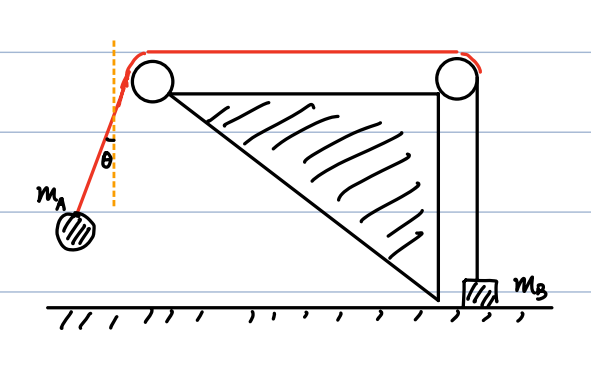
Suppose the pendulum \(m_A\) is attached to a pivot on a block \(m_B\) resting on the ground. What is the maximal release angle \(\theta\) such that \(m_B\) does not lift off the ground?
-
The schematic diagram is from the hand-written notes of Mr. ztWang
-
The maximal upward tension from the pendulum on the block occurs at the bottom (\(T_B\)).
-
For \(m_B\) to stay on the ground, the upward tension must be less than or equal to its weight: \(T_B \leq m_Bg\).
\[ m_Ag(3 - 2\cos\theta) \leq m_Bg \Rightarrow 3 - 2\cos\theta \leq \frac{m_B}{m_A} \]\[ \Rightarrow \cos\theta \geq \frac{3m_A - m_B}{2m_A} \]
Equilibrium
Equilibrium occurs where the net force is zero, which corresponds to the extrema of the potential energy curve (\(\frac{dU}{dx} = 0\)).
1. Stable Equilibrium
-
Occurs at a minimum of \(U(x)\).
-
Conditions: \(\frac{dU}{dx} = 0\) and \(\frac{d^2U}{dx^2} > 0\).
-
Example: \(U(x) = \frac{1}{2}kx^2\). Near \(x=0\), \(F(x) = -kx\) (force points toward the equilibrium position, acting as a restoring force).
2. Unstable Equilibrium
-
Occurs at a maximum of \(U(x)\).
-
Conditions: \(\frac{dU}{dx} = 0\) and \(\frac{d^2U}{dx^2} < 0\).
-
Example: \(U(x) = -\frac{1}{2}kx^2\). Near \(x=0\), \(F(x) = kx\) (force points away from the equilibrium position).
3. Example: Lennard-Jones Potential
Models the potential energy of two neutral atoms in a molecule:
-
Finding the stable equilibrium position:
\[ \frac{dU}{dx} = 0 \Rightarrow -12\frac{\sigma^{12}}{x^{13}} + 6\frac{\sigma^6}{x^7} = 0 \Rightarrow x = \sqrt[6]{2}\sigma \] -
Verifying stability: Taking the second derivative \(\frac{d^2U}{dx^2}\) and evaluating it at \(x = \sqrt[6]{2}\sigma\) yields:
\[ 36\sqrt[3]{4} \frac{\epsilon}{\sigma^2} > 0 \Rightarrow \text{Stable equilibrium} \]
Non-Conservative Forces & Total Energy
1. Non-Conservative Forces
Forces that do NOT satisfy the definition of a conservative force (e.g., kinetic friction, air drag). Work done by these forces is path-dependent.
-
Friction Example: A block moves from a high point \(a\) to a low point \(b\).
-
Path 1 (Free fall straight down): \(W_{\text{friction}} = 0\). Mechanical energy is conserved (\(E_{\text{mec}}^a = E_{\text{mec}}^b = mgH\)).
-
Path 2 (Sliding down a curved rough ramp): \(W_{\text{friction}} = \int \vec{f}_k \cdot d\vec{r} \neq 0\). Assuming it stops at \(b\), \(E_{\text{mec}}^a = mgH\), but \(E_{\text{mec}}^b = 0\).
-
Because \(W_{ab, 1} \neq W_{ab, 2}\), friction is a non-conservative force, and mechanical energy is not conserved.
-
2. Total Energy Conservation
While mechanical energy may not be conserved in the presence of friction, Total Energy is strictly conserved in the universe:
- Thermal Energy (Internal Energy): The internal kinetic energy of atoms and molecules generated by non-conservative forces like friction.
3. Broader Contexts of Energy
-
Relativity: Mass itself is a form of energy (\(E = mc^2\)).
-
Quantum Mechanics: Energy is discretized on a microscopic scale, rather than being perfectly continuous.