Graphs and Topological Sort
1. Definitions
Basic Concepts
-
Graph \(G(V, E)\): Consists of \(V = V(G)\) (a finite nonempty set of vertices) and \(E = E(G)\) (a finite set of edges).
-
Undirected Graph: Edges have no direction. \((v_i, v_j) = (v_j, v_i)\) denotes the same edge.
-
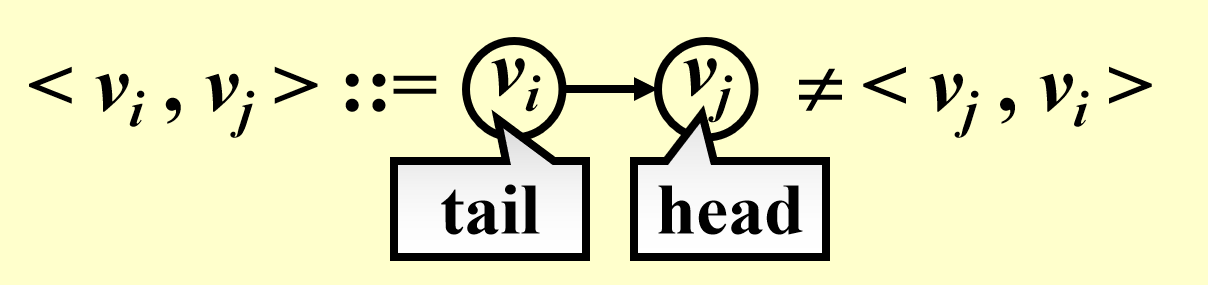
Directed Graph (Digraph): Edges have direction. \(<v_i, v_j> \neq <v_j, v_i>\). \(v_i\) is the tail, and \(v_j\) is the head.
-
schematic diagram from slides of 何钦铭
-
Restrictions in this context:
-
Self-loops are illegal.
-
Multigraphs (multiple edges between the same pair of vertices) are not considered.
-
-
Complete Graph: A graph with the maximum possible number of edges.
-
Undirected: \(e = C_n^2 = \frac{n(n-1)}{2}\)
-
Directed: \(e = P_n^2 = n(n-1)\)
-
Adjacency and Incidence
-
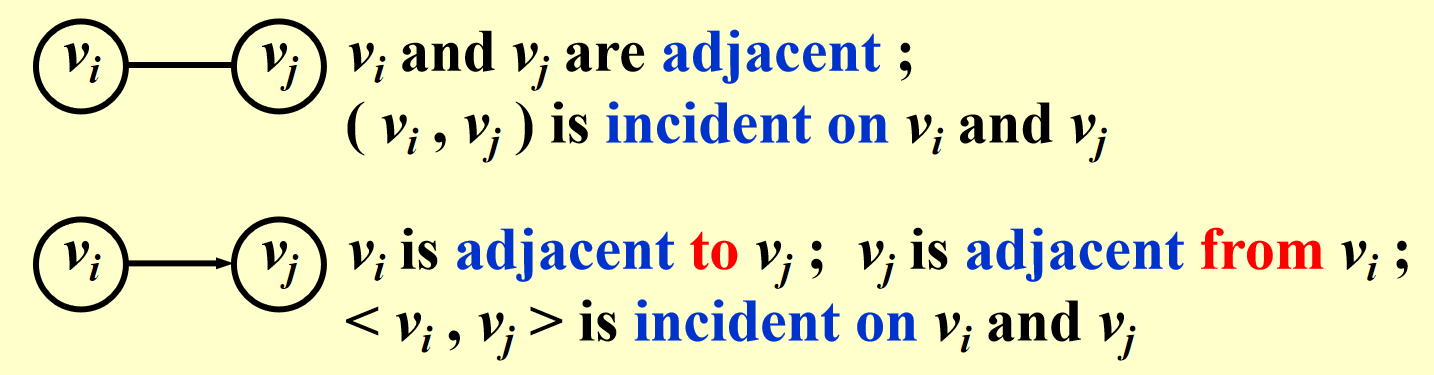
Undirected: \(v_i\) and \(v_j\) are adjacent. The edge \((v_i, v_j)\) is incident on \(v_i\) and \(v_j\).
-
Directed: \(v_i\) is adjacent to \(v_j\); \(v_j\) is adjacent from \(v_i\). The edge \(<v_i, v_j>\) is incident on \(v_i\) and \(v_j\).
Subgraphs, Paths, and Cycles
-
Subgraph: \(G' \subset G\) if \(V(G') \subseteq V(G)\) and \(E(G') \subseteq E(G)\).
-
Path: A sequence of vertices from \(v_p\) to \(v_q\) connected by edges. The length of a path is the number of edges on it.
-
Simple Path: A path where all vertices (\(v_{i1}, v_{i2}, \dots, v_{in}\)) are distinct.
-
Cycle: A simple path where the start and end vertices are the same (\(v_p = v_q\)).
Connectivity
-
Connected (Undirected): Two vertices \(v_i\) and \(v_j\) are connected if there is a path between them. A graph is connected if every pair of distinct vertices is connected.
-
Connected Component: The maximal connected subgraph of an undirected graph.
-
Tree: A graph that is connected and acyclic.
-
DAG: Directed Acyclic Graph.
-
Strongly Connected (Directed): For every pair of \(v_i, v_j\), there are directed paths from \(v_i\) to \(v_j\) and from \(v_j\) to \(v_i\).
-
Weakly Connected (Directed): Connected only if the direction of the edges is ignored.
-
Strongly Connected Component: The maximal strongly connected subgraph.
Degrees
-
Degree(\(v\)): The number of edges incident to \(v\).
-
For directed graphs: \(\text{Degree}(v) = \text{in-degree}(v) + \text{out-degree}(v)\).
-
Edge Formula: Given a graph \(G\) with \(n\) vertices and \(e\) edges:
\[ e = \left( \sum_{i=0}^{n-1} d_i \right) / 2 \quad \text{where } d_i = \text{degree}(v_i) \]
2. Representation of Graphs
2.1 Adjacency Matrix
-
A 2D array
adj_mat[n][n], whereadj_mat[i][j] = 1if an edge exists between \(v_i\) and \(v_j\), and0otherwise. -
For undirected graphs, the matrix is symmetric (space can be saved by storing only half).
-
Degree Calculation: Computed by summing the row (out-degree) or column (in-degree).
#define MAX_VERTICES 100

typedef struct {
    int adj_mat[MAX_VERTICES][MAX_VERTICES];
    int num_vertices;
    int num_edges;
} GraphMatrix;
2.2 Adjacency Lists
-
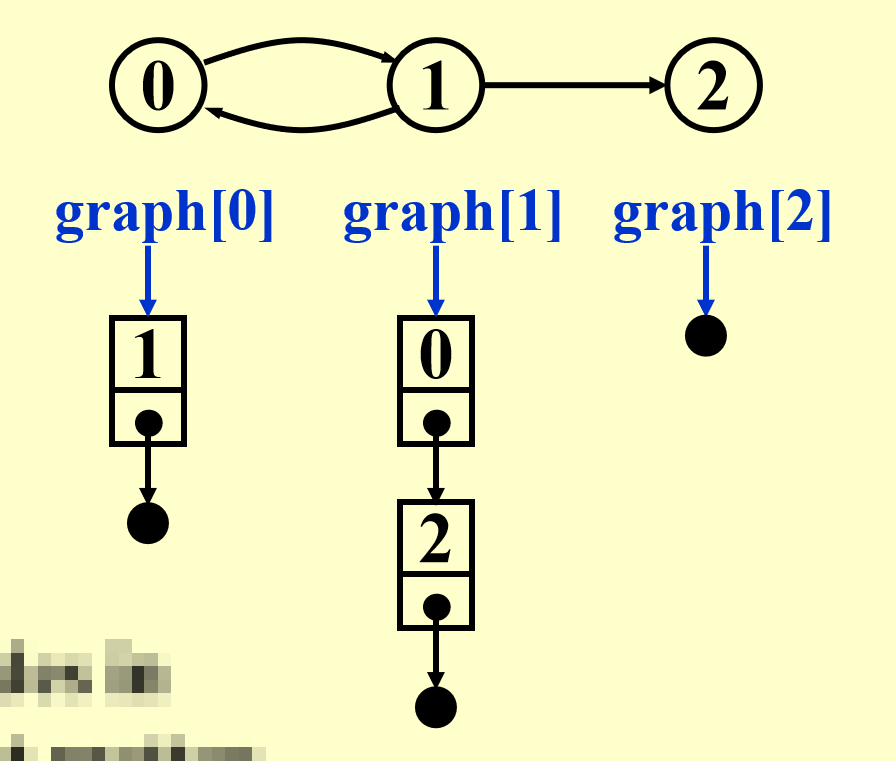
Replaces each matrix row with a linked list of adjacent nodes. Order of nodes in the list does not matter.
-
Space Complexity (Undirected): \(S = n \text{ heads} + 2e \text{ nodes} = (n + 2e) \text{ pointers} + 2e \text{ ints}\).
-
Issue for Directed Graphs: Finding in-degree is inefficient.
-
Solution 1: Add Inverse Adjacency Lists.
-
Solution 2: Use Adjacency Multilists.
-
// Node for the linked list representing an edge
typedef struct AdjListNode {
    int dest;                 // The adjacent vertex
    int weight;               // Edge weight (optional)
    struct AdjListNode* next; // Pointer to the next adjacent vertex
} AdjListNode;

// Array of adjacency lists
typedef struct {
    AdjListNode* head[MAX_VERTICES]; // Array of pointers to linked list heads
    int num_vertices;
    int num_edges;
} GraphList;
2.3 Adjacency Multilists
-
In standard adjacency lists for undirected graphs, an edge \((i, j)\) is stored twice (once in \(i\)'s list, once in \(j\)'s). Multilists combine these into a single node.
-
Node structure:
[mark | v1 | v2 | next_v1 | next_v2]. -
Advantage: Makes edge operations (like marking an edge after examining it) much easier without needing to search through a second list.
// Node structure for Adjacency Multilists
typedef struct MultilistNode {
    int mark;                       // 0 for unexamined, 1 for examined
    int v1;                         // First vertex of the edge
    int v2;                         // Second vertex of the edge
    struct MultilistNode* next_v1;  // Pointer to the next edge incident on v1
    struct MultilistNode* next_v2;  // Pointer to the next edge incident on v2
    int weight;                     // Edge weight (optional)
} MultilistNode;
2.4 Weighted Edges
-
Matrix: Replace the
1with the edge weight. -
Lists/Multilists: Add a
weightfield to the list node.
3. Topological Sort
AOV Network (Activity On Vertex)
-
A digraph where vertices represent activities (e.g., courses) and edges represent precedence relations (e.g., prerequisites).
-
Terms: If path exists from \(i\) to \(j\), \(i\) is a predecessor of \(j\). If \(<i, j>\) is an edge, \(i\) is an immediate predecessor, and \(j\) is an immediate successor.
-
Partial Order: A precedence relation that is both transitive and irreflexive.
-
Rule: A feasible project/AOV network MUST be a DAG (Directed Acyclic Graph) to prevent cyclic dependencies.
Topological Sort Algorithm
-
Definition: A linear ordering of vertices such that if \(i\) is a predecessor of \(j\), \(i\) precedes \(j\) in the ordering. Note: Topological orders are not necessarily unique.
-
Goal: Test an AOV network for feasibility (check for cycles) and generate a topological order.
-
Basic Implementation: Repeatedly find a vertex with an in-degree of 0, output it, and reduce the in-degree of its adjacent vertices. Time complexity is \(O(|V|^2)\).
-
Improved Implementation (Using Queue/Stack):
-
Store all unassigned vertices with an in-degree of 0 in a Queue.
-
While the queue is not empty, dequeue a vertex \(V\), assign it to the sorted output, and increment a counter.
-
For each adjacent vertex \(W\), decrement its in-degree. If \(W\)'s in-degree reaches 0, enqueue \(W\).
-
If the final counter \(\neq\) total number of vertices, report an error ("Graph has a cycle").
-
Time Complexity: \(T = O(|V| + |E|)\).
-
// Assuming Queue functions (CreateQueue, MakeEmpty, Enqueue, Dequeue, IsEmpty, DisposeQueue)
// and GraphList G are already defined. Array indegree[] stores the in-degree of each vertex.

void Topsort(GraphList* G, int indegree[]) {
    Queue Q;
    int counter = 0;

    Q = CreateQueue(G->num_vertices);
    MakeEmpty(Q);

    // Step 1: Enqueue all vertices with an initial in-degree of 0
    for (int v = 0; v < G->num_vertices; v++) {
        if (indegree[v] == 0) {
            Enqueue(v, Q);
        }
    }

    // Step 2: Process the queue
    while (!IsEmpty(Q)) {
        int v = Dequeue(Q);

        // Output the vertex or assign topological number here
        // TopNum[v] = ++counter;
        counter++;

        // Step 3: Decrease the in-degree of all adjacent vertices
        AdjListNode* curr = G->head[v];
        while (curr != NULL) {
            int w = curr->dest;
            if (--indegree[w] == 0) {
                Enqueue(w, Q); // If in-degree drops to 0, enqueue it
            }
            curr = curr->next;
        }
    }

    // Step 4: Check for cycles (Feasibility test)
    if (counter != G->num_vertices) {
        // If not all vertices were processed, the graph is not a DAG
        printf("Error: Graph has a cycle!\n");
    }

    DisposeQueue(Q); // Free memory
}