08_Sound Wave
1. Elasticity
Solids are NOT perfectly rigid. They undergo deformation when subjected to external forces.
Core Definitions
-
Stress: The deforming force applied per unit area.
-
Strain: The unit deformation (ratio of change in dimension to original dimension).
-
Modulus of Elasticity: For small stresses, the relationship is linear:
\[ \text{Stress} = \text{Modulus} \times \text{Strain} \]
Types of Stress and Strain
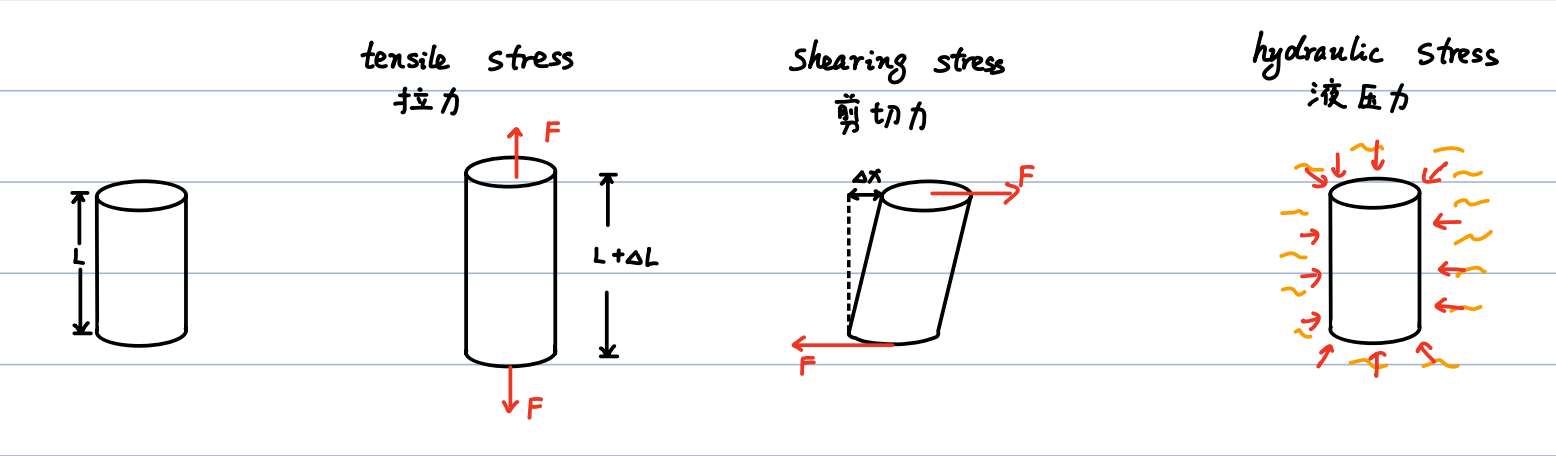
-
schematic diagram from the hand-written notes of Mr. ztWang
-
Tension & Compression (Tensile Stress)
-
Stress: \(F / A\)
-
Strain: \(\Delta L / L\)
-
Young's Modulus (\(E\)): \(\frac{F}{A} = E \frac{\Delta L}{L}\)
-
-
Shearing (Shearing Stress)
-
Stress: \(F / A\)
-
Strain: \(\Delta x / L\)
-
Shear Modulus (\(G\)): \(\frac{F}{A} = G \frac{\Delta x}{L}\)
-
-
Hydraulic Stress
-
Hydraulic Stress: Pressure \(P\)
-
Strain: \(\Delta V / V\)
-
Bulk Modulus (\(B\)): \(P = B \frac{\Delta V}{V}\)
-
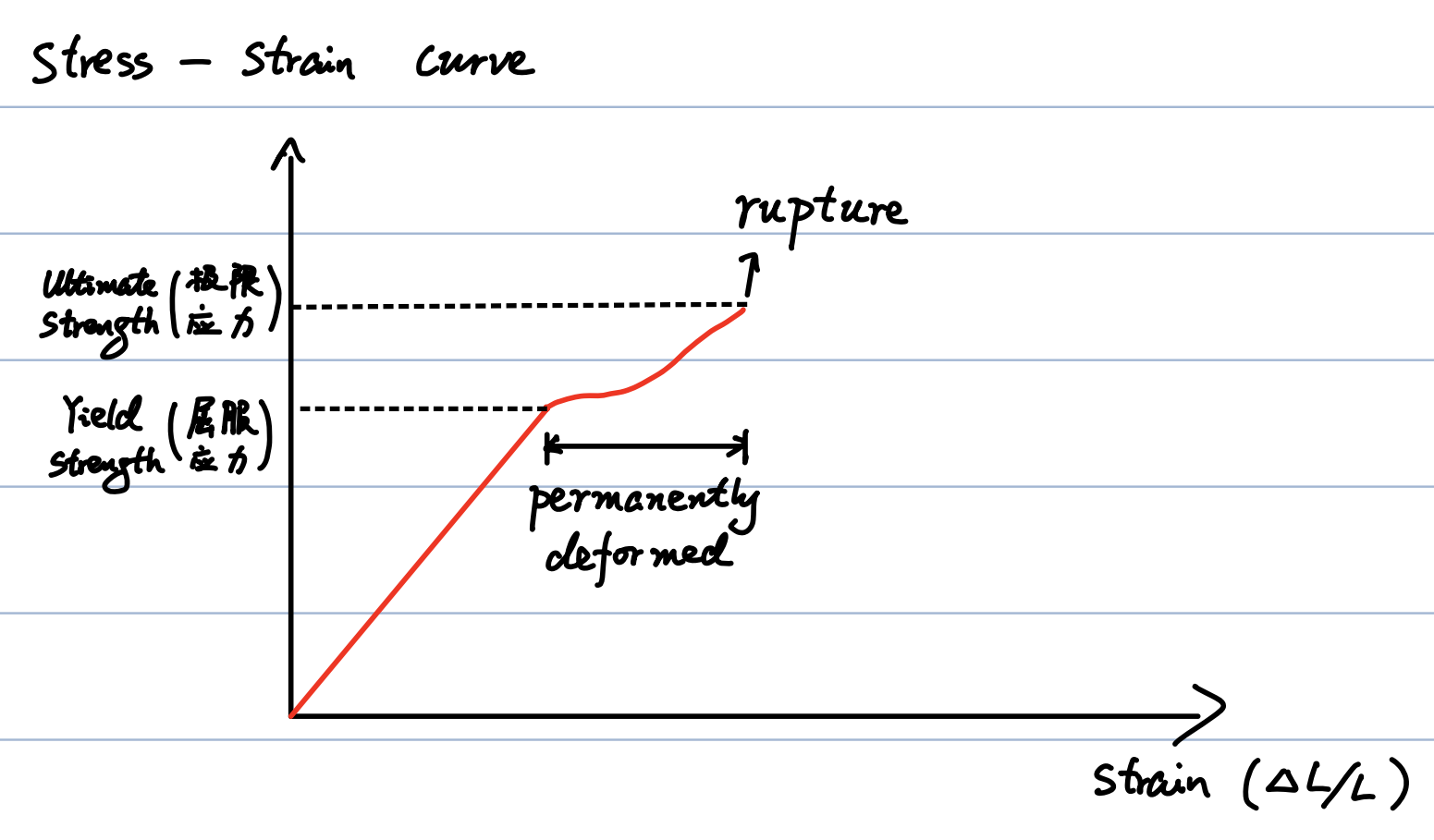
Stress-Strain Curve
The relationship between stress and strain (\(\Delta L/L\)) generally follows these stages:
-
Linear Region: Proportional elastic deformation.
-
Yield Strength: The point beyond which the material becomes permanently deformed.
-
Ultimate Strength: The maximum stress the material can withstand.
-
Rupture: The point where the material breaks.
2. Sound Waves
Definition: Any mechanical longitudinal waves.
- They propagate via wavefronts expanding outward from a source along rays.
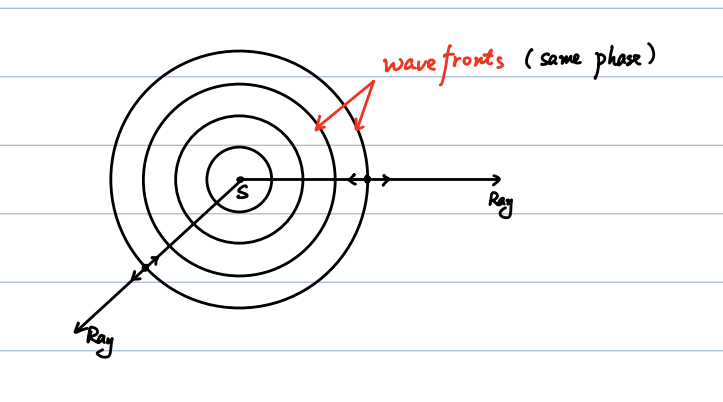
Speed of Sound
-
In solids (phonon model): \(v = a\sqrt{\frac{K}{m}}\) (derived from \(\frac{\partial^2 u}{\partial t^2} = v^2 \frac{\partial^2 u}{\partial x^2}\)).
-
In fluids (e.g., air, via compression/expansion):
\[ v = \sqrt{\frac{B}{\rho}} \]
Comparison: Speed of Sound in Air vs. Water
-
Density: \(\rho_{\text{water}} \approx 10^3 \text{ kg/m}^3\), \(\rho_{\text{air}} \approx 1.3 \text{ kg/m}^3\). Naively, lower density might suggest \(v_{\text{air}} \gg v_{\text{water}}\). However, this is incorrect.
-
Bulk Modulus: \(B_{\text{water}} \approx 2.1 \times 10^9 \text{ Pa}\) (highly incompressible), whereas \(B_{\text{air}} \approx 1.4 \times 10^5 \text{ Pa}\).
-
Conclusion: Because water is vastly more incompressible than air, \(v_{\text{water}} \gg v_{\text{air}}\) (\(\sim 1450 \text{ m/s}\) in water vs. \(\sim 330 \text{ m/s}\) in air).
Derivation of \(v = \sqrt{B/\rho}\)
Consider a volume of air \(V = \Delta x \cdot A = (v \Delta t) A\) being compressed:
-
Apply Newton's Second Law (\(F=ma\)):
$$-\Delta p A = (\rho \Delta x A) \frac{\Delta v}{\Delta t} $$
Since $\frac{\Delta x}{\Delta t} = v$, this simplifies to:

$$
-\Delta p = \rho v \Delta v $$
-
Relate to Volume Change:
$$\frac{\Delta V}{V} = \frac{A \Delta v \Delta t}{A v \Delta t} = \frac{\Delta v}{v} $$
-
Substitute and Solve for \(v\):
\[ -\Delta p = \rho v^2 \left(\frac{\Delta V}{V}\right) \implies \rho v^2 = -\frac{\Delta p}{\Delta V / V} = B \]\[ v = \sqrt{\frac{B}{\rho}} \]
3. Sound Intensity and Sound Level
Intensity (\(I\))
Intensity is the energy transfer rate (\(P\)) per unit area (\(A\)):
For a sinusoidal sound wave with longitudinal displacement \(s(x,t) = s_m \cos(kx - \omega t)\):
Proof:
For a slice of air with thickness \(dx\) and area \(A\):
-
Kinetic energy: \(dK = \frac{1}{2} (\rho \, dx \, A) v_s^2\)
-
Particle velocity: \(v_s = \frac{\partial s(x,t)}{\partial t} = \omega s_m \sin(kx - \omega t)\)
-
Substitute \(v_s\): \(dK = \frac{1}{2} \rho \, A \, dx \cdot \omega^2 s_m^2 \sin^2(kx - \omega t)\)
-
Rate of change: \(\frac{dK}{dt} = \frac{1}{2} \rho A v \omega^2 s_m^2 \sin^2(kx - \omega t)\) (since \(dx/dt = v\))
-
Time average over a cycle: \(\left(\frac{dK}{dt}\right)_{\text{avg}} = \frac{1}{4} \rho A v \omega^2 s_m^2\)
-
Assuming energy equipartition without proof: \(\left(\frac{dU}{dt}\right)_{\text{avg}} = \left(\frac{dK}{dt}\right)_{\text{avg}}\)
\[ I = \frac{d(K+U)/dt}{A} = 2 \times \frac{\frac{1}{4} \rho A v \omega^2 s_m^2}{A} = \frac{1}{2} \rho v \omega^2 s_m^2 \]
Point Source:
For a source emitting isotropically (assuming energy conservation):
Sound Level (\(\beta\))
Measured in decibels (dB):
-
\(I_0 \equiv 10^{-12} \text{ W/m}^2\) (hearing threshold; at \(I=I_0\), \(\beta = 0\)).
-
Note: \(\beta_2 - \beta_1 = 10 \iff I_2 / I_1 = 10\).
Typical Sound Levels:
-
Bedroom at night: \(\sim 30 \text{ dB}\)
-
Conversation: \(\sim 60 \text{ dB}\)
-
Rock concert: \(\sim 110 \text{ dB}\)
-
Pain threshold: \(\sim 120 \text{ dB}\)
Frequency Spectrum:
Sound level is independent of sound frequency.
-
Infrasound: \(< 20 \text{ Hz}\)
-
Audible frequencies: \(20 \text{ Hz} \sim 20 \text{ kHz}\)
-
Ultrasound: \(> 20 \text{ kHz}\)
4. The Doppler Effect
The apparent change in frequency due to the relative motion of the source and the detector.
-
\(v\): speed of sound in the medium.
-
\(v_D\): speed of the detector (relative to medium).
-
\(v_S\): speed of the source (relative to medium).
Sign Convention Rule:
-
If D & S move towards each other: \(f' > f\) (use \(+\) in numerator, \(-\) in denominator).
-
If D & S move away from each other: \(f' < f\) (use \(-\) in numerator, \(+\) in denominator).
Example Application
Problem: A train passes a station. An observer at the station hears the siren fluctuating such that \(1000 \text{ Hz} \le f \le 1200 \text{ Hz}\). Given \(v = 330 \text{ m/s}\), what is the speed of the train?
Solution:
Divide the two equations:
(Note: Cosmological redshift (\(\lambda \uparrow, f \downarrow\)) relies on a similar principle, indicating galaxies are moving away from us, supporting the "Big Bang" theory).
5. Supersonic Speeds & Shock Waves
When the source speed equals or exceeds the speed of sound (\(v_S \ge v\)):
-
\(v_S = v\): Wavefronts bunch up completely at the leading edge (\(\lambda - v_S T = 0\)).
-
\(v_S > v\) (Shock Waves): The source outpaces the wavefronts. The envelope function of the wavefronts forms a Mach Cone.
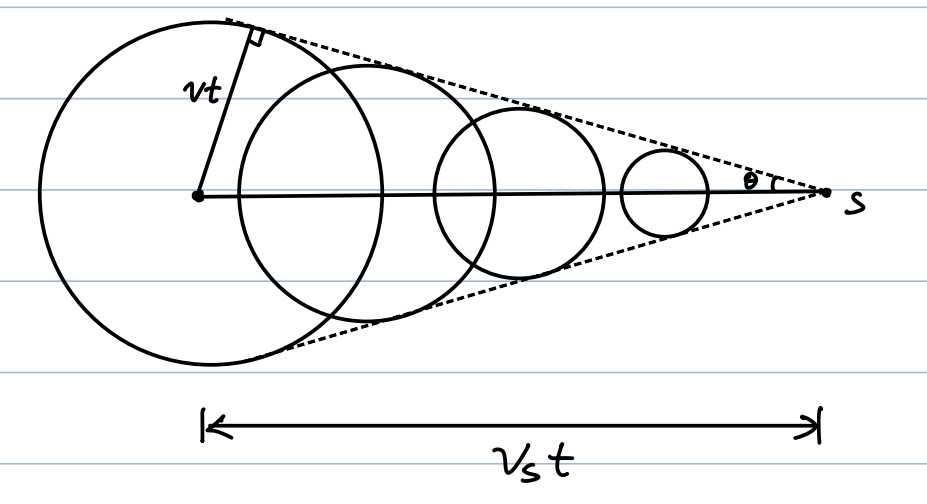
Mach Cone Geometry:
-
Mach cone angle (\(\theta\)):
\[ \theta = \arcsin\left(\frac{v t}{v_S t}\right) = \arcsin\left(\frac{v}{v_S}\right) \] -
Mach Number: \(\frac{v_S}{v}\)
Examples of objects generating shock waves: jets, bullets, boats (wake).