Lecture 3: Inverted File Index(倒排索引)
主线:term → documents(词项定位文档)→ scalable indexing(可扩展建索引)→ relevance evaluation(相关性评价)。 Search trees/hash tables locate dictionary entries; posting lists identify matching documents.
Course overview(课程信息) · HW3: Document Distance(文档距离)
1. Structure and Boolean retrieval(结构与布尔检索)
1.1 From scanning to an inverted index(从扫描到倒排)
A search engine has three broad stages: crawl(爬取)→ index(整理并建索引)→ query service(检索服务). A spider / crawler(爬虫) collects pages; indexing prepares them for repeated queries.
| Approach | Representation | Cost / limitation |
|---|---|---|
| Scan every page(逐页扫描) | Search raw text for each query. | Query work scales with the whole collection's text size. |
| Term-document incidence matrix(词项—文档关联矩阵) | \(A[t,d]=1\) iff document \(d\) contains term \(t\). | Boolean operations are easy, but a dense \(V\times N\) matrix wastes space on zeros. |
| Inverted file index(倒排文件索引) | Dictionary entry → list of documents containing the term. | Store nonzero associations; process relevant postings rather than every page. |
\(V\) = vocabulary size(词汇表规模), \(N\) = document count(文档数). Incidence rows can be bitsets(位集); sparsity motivates postings, but a frequent term can also suit a bitmap representation.
Index(索引): a mechanism for locating a term in text. Forward index(正排索引): document → terms. Inverted index(倒排索引): term → documents/occurrences. Posting list(倒排列表/出现记录表): the records associated with one term; pointers can be document IDs, offsets or positions, not necessarily memory addresses or linked-list nodes.
WK3 T/F4: “Inverted file contains a list of pointers to all occurrences of a term in the text.” True, by the definition; a document-only index stores document references, and a positional index adds exact occurrence locations.
1.2 Course example, positions and frequencies(课件例子、位置与频率)
| Document | Original text |
|---|---|
| D1 | Gold silver truck |
| D2 | Shipment of gold damaged in a fire |
| D3 | Delivery of silver arrived in a silver truck |
| D4 | Shipment of gold arrived in a truck |
For this example only: case folding(大小写归一化), no stemming or stop filtering; positions start at 1 in the original token sequence.
| Term(词项) | Incidence D1–D4 | \(df\) | Positional postings: docID: positions |
|---|---|---|---|
| a | 0111 | 3 | 2:6; 3:6; 4:6 |
| arrived | 0011 | 2 | 3:4; 4:4 |
| damaged | 0100 | 1 | 2:4 |
| delivery | 0010 | 1 | 3:1 |
| fire | 0100 | 1 | 2:7 |
| gold | 1101 | 3 | 1:1; 2:3; 4:3 |
| of | 0111 | 3 | 2:2; 3:2; 4:2 |
| in | 0111 | 3 | 2:5; 3:5; 4:5 |
| shipment | 0101 | 2 | 2:1; 4:1 |
| silver | 1010 | 2 | 1:2; 3:3,7 |
| truck | 1011 | 3 | 1:3; 3:8; 4:7 |
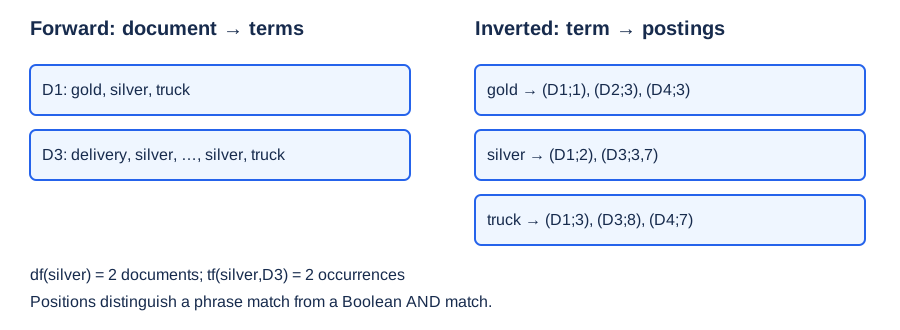
- Document frequency, \(df(t)\)(文档频率): number of documents containing \(t\); posting-list length when one record is stored per document.
- Term frequency, \(tf(t,d)\)(词频): occurrence count of \(t\) within document \(d\). For silver, \(df=2\), but \(tf(\text{silver},D3)=2\) and total occurrences = 3.
- The slide's “Times” uses \(df\), not total occurrence count. “低频更重要”和“先处理短列表”中的频率主要指 \(df\)。
Discussion: how to print matching sentences and highlight words? Keep positions(词位置)and access to original text; character offsets/sentence boundaries(字符偏移/句界)help reconstruct snippets(摘要片段)and highlights(高亮). A list of document IDs alone cannot locate the matched sentence. Preserve original positions when filtering tokens if phrase/proximity queries(短语/邻近查询)are required.
1.3 Query operations and processing order(查询运算与处理顺序)
- AND(与): intersect document sets.
silver AND truck:1010 & 1011 = 1010→ D1, D3. - OR(或): union document sets; NOT(非) / exclusion: difference against a specified collection or candidate set.
- Phrase query(短语查询): after finding common documents, require compatible positions. “silver truck” needs a truck at position \(p+1\) after silver; D3 matches at positions 7,8, not 3,8. Boolean AND alone does not enforce adjacency.
- Sorted lists of lengths \(a,b\) can be intersected by two pointers in \(O(a+b)\) time: advance the smaller docID, emit equal IDs, stop when either list ends. Skip pointers(跳跃指针)can bypass ranges that cannot match. Intersection reference.
Discussion: why keep frequency? For a conjunctive query, start with the smallest \(df\) to reduce intermediate candidates(中间候选集). truck AND silver AND delivery: lengths 3,2,1; start with delivery's [D3], then check the other two → D3. Frequency also informs ranking; list length and within-document frequency serve different roles.
2. Index construction and modules(构建与模块)
2.1 Generator pipeline(索引生成流程)
For each document D:
    parse tokens; normalize them into terms
    apply the selected stop filter
    for each retained term T and original position p:
        find T in the dictionary; insert it if absent
        get T's posting list
        create/update D's posting: frequency + positions
write the inverted index to disk
Repeated occurrences in a document update that document's posting; do not accidentally increase \(df\) on every occurrence. Building an index and scoring a query are different stages.
| Module | Responsibility(职责) |
|---|---|
| Token analyzer(分词/词元分析器) + stop filter(停用词过滤器) | Parse text, normalize forms, decide retained terms. |
| Vocabulary scanner(词汇表查找器) | Find the dictionary entry for a term. |
| Vocabulary inserter(词汇表插入器) | Create an entry/posting list for a new term. |
| Memory management(内存管理) | Buffer index data, flush to disk, merge partial indexes. |
Quiz 3.1 / WK3 MC2: which is NOT an index-building step?
- A. Read strings and parse words.
- B. Use stemming and stop filtering to obtain terms.
- C. Check the dictionary and insert missing terms.
- D. Get each term's posting list and calculate precision.
Answer: D. Getting/updating postings is part of construction; precision requires query results and relevance judgments(相关性标注), not just the index.
2.2 Tokenization, stemming and stop words(分词、词干提取与停用词)
Tokenization(分词): identify token boundaries. English whitespace/punctuation are useful cues; Chinese needs segmentation(词语切分)because boundaries are not explicit. The offline name-search example illustrates that matching the characters “陈越” inside an unrelated phrase is not equivalent to identifying a person's name.
Stemming(词干提取): map morphological variants(词形变体)to a common stem. process / processing / processes / processed → process is the course example. Apply the same normalization to indexed documents and queries(索引端与查询端规则一致).
词干不一定是字典中的完整词。 The slide's say / says / said / saying → say expresses the desired grouping; regular suffix stripping alone need not recognize said. Lemmatization(词形还原)uses vocabulary/morphology; Porter stemming is a suffix-based heuristic, not a general irregular-verb dictionary. Stemming versus lemmatization.
Stop words(停用词): very common words, e.g. a, the, it, often have little discriminative value(区分能力)and huge postings. Filtering saves space/work; it is a configurable policy, not a claim that those words never matter. In the offline example, a dictionary article specifically explaining “a” should remain retrievable. Context, phrase support and the application determine retention; “remove” here means exclude from indexing, not destroy source documents.
Quiz 3.2 Q3 / WK3 T/F1: “Word stemming eliminates commonly used words.” False: that describes stop filtering. HW3 explicitly retains stop words; do not reuse the lecture's optional filter blindly.
2.3 Dictionary access(词典访问)
| Method | Strength | Limitation / qualification |
|---|---|---|
| B/B+ trees(多路搜索树) | Ordered traversal and efficient term ranges; page-oriented layout. | Exact lookup traverses the tree; constants depend on layout. |
| Tries(字典树/前缀树) | Branch on characters; natural prefix access. | Memory/layout and alphabet size matter. |
| Hashing(哈希) | Expected fast exact-word access with suitable hashing/load control. | No lexical order; range scan generally needs examining many entries or an extra ordered index. |
For a large disk-resident dictionary, the course favors page-oriented B/B+ trees over binary AVL/RBT layouts. Its “RBT is 10–20% faster than AVL with many updates” is a workload-dependent observation, not an asymptotic guarantee; layout, caching and scale determine practical speed.
MOOC 3.2.2 discussion: hashing versus search trees? Faster for a single word in the course's expected-cost model, but expensive for range search. Hash lookup still processes the key and can suffer collisions; “faster” is not a worst-case or universal timing guarantee.
| Source | Statement | Answer |
|---|---|---|
| Quiz 3.2 Q1 / WK3 T/F2 | B+ dictionary range searches are expensive. | False: ordered keys/leaf links support efficient range access. |
| Quiz 3.2 Q2 | Hashing is faster than search trees for term access. | True in the course's ideal/expected exact-lookup model, with the qualifications above. |
| HW3 T/F4 | Hash-based dictionary range searches are expensive. | True without an additional ordered structure. |
Misspelling suggestions(拼写纠错)need candidate generation and similarity checking. Ordered/prefix structures help generate candidates; 字典序相邻不等于编辑距离最小. Hashing can also be combined with separate correction indexes. The offline narrow-domain example motivates tuning hashing for a small vocabulary, not assuming every dictionary must use a B+ tree.
2.4 Memory-limited construction(内存受限构建)
Build an in-memory block index(分块索引); when capacity is near its limit, sort/write it to disk, free buffers, and continue. Flush the final nonempty block(别漏最后未满的一块). Merge sorted blocks by term and docID; combine duplicate document postings, frequencies and positions as appropriate.
blocks = []
for each parsed occurrence:
    if the next update would exceed memory: flush current block
    update the in-memory dictionary/postings
flush the remaining block
merge all sorted blocks into the final index
Sorted order permits sequential merging; blocking bounds working memory instead of requiring the whole index in RAM. Terms appearing across blocks must map to the same final term; do not treat unrelated block-local IDs as globally unique.
3. Scaling, updates and compression(扩展、更新与压缩)
3.1 Distributed indexing(分布式索引)
A cluster node(集群节点)stores an index of part of the collection. Two partition directions:
| Strategy | Local contents | Query / scaling tradeoff |
|---|---|---|
| Term-partitioned(按词项划分) | A subset of dictionary terms, each with its complete postings. | Route a single term to its owner; multi-term queries may span nodes. Hot terms/list sizes cause skew(负载倾斜)and difficult rebalancing. |
| Document-partitioned(按文档划分) | A subset of documents and postings restricted to those docIDs. The lecture models a full term dictionary at every node. | Broadcast to document shards(文档分片), then merge/rank results; add shards for new documents. |
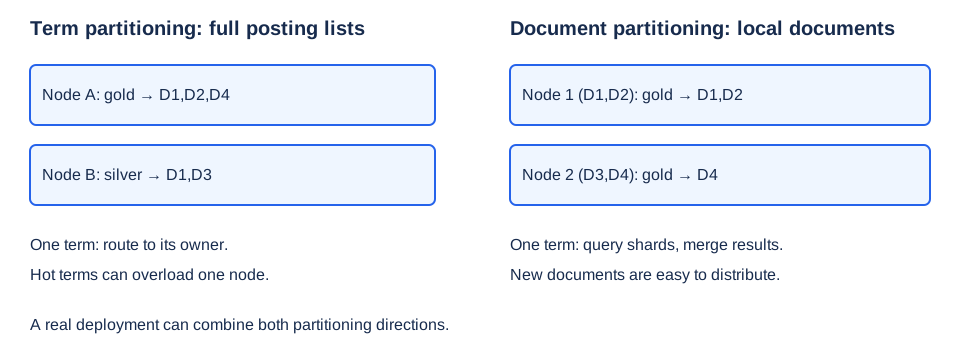
Real systems may combine both. A shard can omit absent terms physically while retaining the logical vocabulary; a “node” here means a machine/service, not a tree node.
Quiz 3.3 Q1 / WK3 T/F13 / WK4 T/F8: each document-partitioned node contains a subset of documents within a specified index range. True: “index” means document ID range(文档编号区间) here.
HW3 T/F1: document partitioning stores all documents containing terms in a certain term range at each node. False: this describes term partitioning's allocation by vocabulary, not by docID.
3.2 Dynamic indexing(动态索引)
New documents require updates to existing postings and insertion of new terms; documents can also change or be deleted. Rewriting large sorted postings on every arrival is expensive.
Maintain a large main index(主索引) and small auxiliary index(辅助/增量索引). Write incoming changes to the auxiliary index; queries consult both, merge results and filter deleted documents. Periodically merge the auxiliary into the main index in the background and publish a consistent new version.
Offline discussion: when to re-index and how to delete? Balance auxiliary size/query overhead against merge cost and freshness(新鲜度). A deletion bitmap/tombstone(删除位图/墓碑标记)can hide obsolete docIDs immediately; later merging physically removes their postings. These are implementation options beyond the slide's open questions.
辅助索引不是查询缓存。 It contains new index data; a cache stores prior results or frequently used data. Searching only the recent auxiliary can be a deliberate approximation, but complete retrieval must also cover the main index. Distributed arrival order and updates to existing IDs can require insertion in the middle of a posting list even when newly assigned IDs are monotone.
3.3 Dictionary and posting compression(词典与倒排列表压缩)
Dictionary: fixed-width string slots waste space when term lengths differ. Pack term bytes into one concatenated string and store start offsets plus lengths/boundaries(起始偏移与长度/边界). Filtering optional stop terms reduces entries but is separate from lossless encoding(无损编码).
Gap / delta encoding(差分编码): for sorted docIDs \(d_1<\cdots<d_p\), store
Example: 2,15,47,…,58879,58890,… → 2,13,32,…,11,…. Small gaps need fewer bits when combined with variable-length coding(变长编码), such as variable-byte or gamma codes; storing every gap in the same fixed-width integer does not by itself save bytes. Rare-term gaps can still be large; “fewer than 20 bits” is an example observation, not a universal bound. Absolute restart IDs must remain representable. Postings compression.
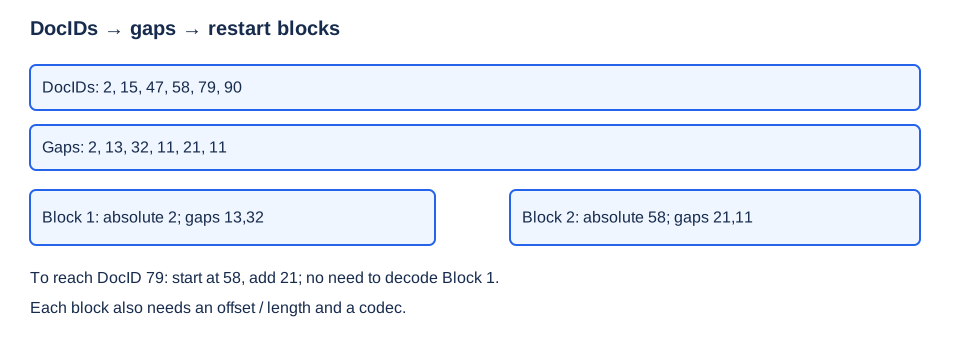
3.4 Offline discussion: compression tradeoffs(压缩的代价与方案)
Question: what serious problems does gap encoding introduce, and how can we mitigate them?
| Problem | Idea / limitation |
|---|---|
| Random access(随机访问)needs prefix decoding/accumulation | Store absolute restart points(重启点) every block; an offset directory locates the compressed block. With \(B\) entries/block, decode at most \(O(B)\) entries after choosing the block. |
| A wrong gap shifts later decoded IDs; corrupted variable-length boundaries can desynchronize decoding | Independent blocks/checksums limit error spread. |
| Mid-list insertion/deletion plus packed variable-length storage causes movement | Buffer updates in the auxiliary index; rebuild compressed blocks during merging. |
| Dense skip metadata can erase space savings | Tune block/skip density to query and update patterns. |
关键区分:数学差值更新 ≠ 整段编码移动。 Insert \(x\) between \(a<b\): replace gap \(b-a\) by \(x-a\) and \(b-x\); all later adjacent-ID gaps are unchanged if IDs are stable. Deleting \(x\) merges these two gaps. Packed bytes may shift; fixed “every fourth entry” skip/restart positions may need rebuilding. The instructor clarified this distinction in the post-class discussion. Renumbering IDs is a separate source of widespread changes.
Other class proposals:
- Block-base offsets(块基值偏移): store one absolute base and each entry's offset from it. Direct decoding within a located fixed-width block is easy, but offsets may exceed adjacent gaps; layout/codec determine access cost.
- Multilevel skips / skip lists(多级跳跃/跳表): express lanes reduce traversal. Storing \(\log p\) jump fields at every posting costs \(O(p\log p)\) fields, plus their bit widths; it is not \(O(\log p)\) total space. Sparse/randomized levels reduce overhead. Exact fixed-position skips and probabilistic skip lists have different update behavior; expected bounds are not per-operation worst-case guarantees.
- Hot-term policy(热词策略): use smaller blocks, more restart points, or uncompressed/bitmap representations for frequently accessed/updated terms; tune total byte cost as well as operation count.
- “取对数存大 ID” cannot be lossless just by storing a rounded exponent: many IDs share that exponent. Preserve all identifying bits or a reversible encoding; compression must reconstruct exact docIDs.
列表顺序不可混用:gap compression and merge intersection assume docID order; the dictionary is in term order; displayed hits are in score/rank order. Ranking postings by score may make docID differences negative and invalidate this positive-gap codec. Keep ranked access as a separate representation/processing step when needed.
3.5 Thresholding(阈值截断)
| Type | Course strategy | Consequence |
|---|---|---|
| Document thresholding(文档截断) | Rank documents by weight; retain only top \(k\). | Can lose relevant results. Truncating individual term lists before AND does not preserve exact Boolean results. |
| Query thresholding(查询截断) | Sort query terms by increasing \(df\); use only an initial fraction. | Saves work by retaining discriminative terms, but changes the original query. |
Example: ten query terms → try 20%, 40%, 80%; compare answer sets. Offline incremental example: 10,000 candidates → 5,000 after another term → little change after the next; stop when change is small enough. 结果稳定只是启发式停止条件,不保证完整查询的答案或相关性。 For AND, dropping terms broadens the candidate set; do not confuse this with merely reordering all terms, which preserves the exact answer.
MOOC 3.3.4 Q1: given high- and low-frequency words, which is generally more important? Choices A high / B low / C unrelated / D unknown. Answer: B under the course's discriminativeness heuristic: low document frequency distinguishes fewer documents. WK3 T/F9: very long posting lists are generally less important than short ones — True in this sense; rarity alone does not prove semantic relevance.
Quiz 3.3 Q2 / WK3 T/F3: “Thresholding for query retrieves top \(k\) documents by weight.” False: that is document thresholding; query thresholding selects terms. 中文是“阈值”,不是“阀值”。
4. Evaluation(评价)
4.1 System performance versus relevance(系统性能与相关性)
| Measure | Meaning |
|---|---|
| Indexing throughput(建索引吞吐量) | Documents/hour. |
| Query latency(查询延迟) | Response time as a function of index size, with comparable query/workload conditions. |
| Query-language expressiveness(查询语言表达能力) | Complex needs, e.g. apple NOT company, phrases, combinations; also speed on complex queries. |
| User happiness(用户满意度) | In this lecture, efficient correct retrieval plus relevant results. |
Data retrieval(数据检索): establish correctness of exact matching, then measure response time/index space. Information retrieval, IR(信息检索): also evaluate relevance(相关性)to the information need. red and apple occurring together can mean a red balloon outside Apple Inc., not a red fruit.
HW3 T/F2: measuring answer-set relevance is important for data retrieval performance — False in the course's terminology; that extra criterion distinguishes IR. Do not read this as “relevance is unimportant to search engines.”
HW3 MC2: which is NOT among the stated search-engine measures? A indexing speed; B search speed; C interface friendliness; D answer relevance. Answer: C for this lecture's list. Interface usability can matter in broader product evaluation; the question's scope is the stated technical measures.
4.2 Precision and recall(查准率与查全率)
Evaluation needs a benchmark collection(基准文档集), a query suite(查询集), and binary relevance judgments(相关/不相关标注)for each query–document pair.
| Relevant(相关) | Irrelevant(不相关) | |
|---|---|---|
| Retrieved(检出) | \(TP=RR\) | \(FP=IR\) |
| Not retrieved(未检出) | \(FN=RN\) | \(TN=IN\) |
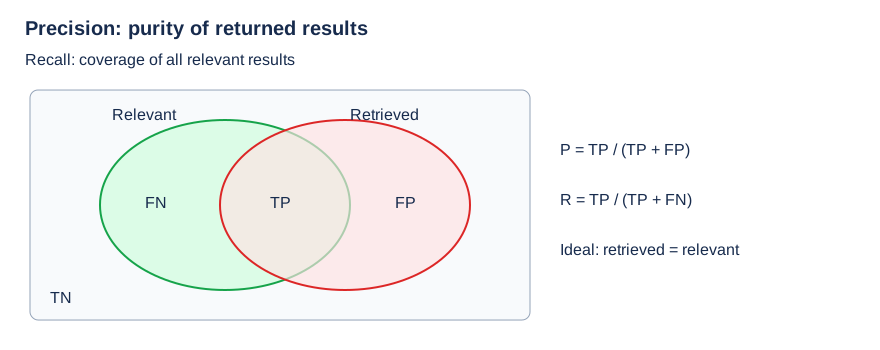
P 问“返回的有多准”,R 问“该找的找全了吗”。 Precision is not accuracy(准确率,分类中通常指 \((TP+TN)/\text{total}\)). Empty denominators need an explicit evaluation convention; do not silently divide by zero.
| Behavior | Precision | Recall |
|---|---|---|
| Return one relevant document while many relevant ones exist | 100% | Low |
| Return the entire collection | Relevant fraction of collection | 100% if relevant documents exist |
| Return exactly the relevant set | 100% | 100% |
The slide's precision–recall curve illustrates a tradeoff, not an identity forcing one metric to decrease whenever the other increases.
WK3 T/F5: “Precision measures the quality of all retrieved documents.” True: it measures the relevant fraction of that returned set.
Quiz 3.4 Q2 / WK3 T/F12: high precision, low recall means most relevant documents are returned but many irrelevant ones are included. False: that describes high recall, low precision.
HW3 MC1 / WK4 MC4: high precision and low recall mean which?
- A. Most relevant documents retrieved, but too many irrelevant ones returned.
- B. Most retrieved documents relevant, but many relevant documents missed.
- C. Most relevant documents retrieved, but benchmark too small.
- D. Most retrieved documents relevant, but benchmark too small.
Answer: B. These metrics do not establish benchmark adequacy.
4.3 Priorities and improving relevance(指标取舍与相关性改进)
Offline discussion: when is precision or recall more important? Define the positive class(正类) and compare the costs of false positives(误报) and false negatives(漏报).
- Prioritize precision when unwanted returned/flagged items are costly: avoid blocking legitimate mail; show a small, useful set of recommendations rather than many irrelevant ones.
- Prioritize recall when omissions are costly: evidence gathering, exhaustive code/paper search, initial screening of suspicious items. HW3 T/F3: precision is more important than recall for airport explosive detection — False in the question's scenario; detecting dangerous positives is the priority.
- A two-stage pipeline(两阶段流程)can seek broad recall first, then verify/rank candidates to improve precision. WK4 T/F7: recall is more important than precision for cheating detection in an Online Monitor System — True in the stated initial-alert scenario. Broad detection is followed by human verification; an automatic alert is not a final misconduct judgment. The class also contrasts broad initial screening with later confirmation: priority depends on the stage and error costs.
Shopping/paper-search debate: information density or corpus size alone does not choose the metric. A comprehensive literature search may emphasize recall; top recommendations may emphasize precision. Personalization(个性化/用户画像)can improve relevance for a particular user, with evaluation tied to that need.
MOOC 3.4.2 discussion: how to improve relevance? The course names PageRank(网页链接重要性排序) and Semantic Web(语义网). Add context/meaning and user preferences to distinguish senses such as fruit/company. PageRank is an importance signal, not proof of query relevance; keyword overlap alone does not capture meaning. Evaluate improvements against the same relevance benchmark.
5. Integrated exercises(综合题)
5.1 Spam detection(垃圾邮件检测)· Quiz 3.4 Q1
Dataset: 7,981 legitimate and 2,019 spam emails. A flags 200 legitimate + 1,800 spam; B flags 160 legitimate + 1,500 spam. If keeping important legitimate mail safe is the priority, which choice is correct?
A precision, A better; B recall, B better; C precision, B better; D recall, A better.
Positive = spam, retrieved = flagged as spam:
| System | \(TP\) | \(FP\) | \(FN\) | Precision | Recall |
|---|---|---|---|---|---|
| A | 1800 | 200 | 219 | \(1800/2000=90\%\) | \(1800/2019\approx89.15\%\) |
| B | 1500 | 160 | 519 | \(1500/1660\approx90.36\%\) | \(1500/2019\approx74.29\%\) |
Answer: C. B has higher spam precision and also flags fewer legitimate emails in this dataset. A catches more spam. 若把普通邮件改成正类,指标名称与分母也必须重新解释,不能只凭“保护邮件”猜 recall。
WK4 MC2 (different dataset): 10,000 legitimate + 2,000 spam emails; A flags 300 legitimate + 1,600 spam, B flags 315 legitimate + 1,800 spam. Choices: A precision/A better; B recall/B better; C precision/B better; D recall/A better. Protecting important legitimate mail again selects C under the course's precision criterion:
| System | Spam precision | Spam recall | Legitimate-mail false-positive rate |
|---|---|---|---|
| A | \(1600/1900\approx84.21\%\) | \(1600/2000=80\%\) | \(300/10000=3\%\) |
| B | \(1800/2115\approx85.11\%\) | \(1800/2000=90\%\) | \(315/10000=3.15\%\) |
指标与代价要分开:B has higher precision, yet deletes 15 more legitimate messages on this fixed dataset. If “safe” means minimizing their absolute loss/false-positive rate alone, A is better. The accepted answer C follows the lecture's use of spam precision; it is not a universal guarantee of fewer false deletions. Set the operational objective explicitly rather than substituting one metric for another.
5.2 Recall calculation(查全率计算)· HW3 MC3
There are 28,000 documents:
| Relevant | Irrelevant | |
|---|---|---|
| Retrieved | 4000 | 12000 |
| Not retrieved | 8000 | 4000 |
Recall choices: A 14% / B 25% / C 33% / D 50%.
Answer: C, \(R=4000/(4000+8000)=1/3\approx33\%\). Precision is \(4000/(4000+12000)=25\%\); \(4000/28000\approx14\%\) is neither metric.
WK4 T/F2: with 100,000 documents, is precision 20%? True for the supplied table:
| Relevant | Irrelevant | |
|---|---|---|
| Retrieved | 10000 | 40000 |
| Not retrieved | 30000 | 20000 |
\(P=10000/(10000+40000)=20\%\); \(R=10000/(10000+30000)=25\%\). The whole-collection size is neither denominator.
5.3 Concept grouping(概念辨析)· WK3 MC4
Which group is not entirely related to the search-engine topics taught here?
- A. Inverted file index, stop words, precision.
- B. Word stemming, hashing, compression.
- C. Distributed index, backtracking, query.
- D. Posting list, thresholding, recall.
Answer: C. Backtracking(回溯搜索)is not one of this lesson's indexing/query modules; all other listed concepts are. This does not claim no search-related implementation could ever use backtracking.
6. Review and references(复习与来源)
复习抓手:正排/倒排方向;\(df\) 与 \(tf\);位置与短语匹配;短列表优先;stemming 与 stop filtering;分块后最终 flush;词项/文档分片;主索引+增量索引;差值局部更新与编码移动;docID/词项/排序分数三种顺序;文档/查询截断;P/R 分母、正类和误报/漏报成本。
Historical context(线下背景): the lecture traces early FTP-directory discovery (Archie), Web crawling (Wanderer), manually curated portals (Yahoo/Sohu), Tianwang, and automated engines (Google/Baidu). The technical progression is collect → organize → serve, from manual organization to scalable automatic indexing/ranking. Inverted indexing predates Web search, including patent keyword retrieval. Slide traffic rankings, index-size estimates and company anecdotes are historical examples, not current measurements or algorithm guarantees.
Sources: all supplied ~/ADS-docs/3 MOOC merged/lesson exports and manifest (units 1320673534–1320673550), 111 video captures, the 21-page courseware PDF, offline lecture-record-17/course_content.md and 24 captures, plus WK3/HW3 archives. This page covers all 11 MOOC questions and all 10 current-topic WK3 questions; duplicated questions share an explanation. WK4 supplements from ~/ADS-docs/4/[Archive] ZJUADS_cy2026_QuizWK4.md and the offline review: all five inverted-index/evaluation questions are integrated here (two new datasets and three shared explanations). HW3's seven nonprogramming questions appear here; its programming task has a separate complete problem and solution.
- ZJU MOOC, supplied term 1488053496.
- Manning, Raghavan & Schütze, Introduction to Information Retrieval: Boolean/positional indexes, construction, compression and evaluation; supplementary clarification, not an assigned page range.
- The supplied slides name
InvertedFileIndex.zip: The Google File System, Building an Inverted Index, Inverted Index Construction (ppt), Compression. That archive and its individual files are not present in the supplied directory; the notes cover the provided sources and do not imply those additional readings were inspected.
Four editable SVG figures are original diagrams. Status remains draft pending instructor/textbook review.