02_Crossprod
1. Rotational Dynamics: Atwood's Machine Examples
Example 1: Atwood's Machine with Two Pulleys
Scenario: Two masses (\(m_1\) and \(m_2\), where \(m_1 > m_2\)) are connected by a string passing over two identical pulleys (radius \(R\), moment of inertia \(I\)). We want to find the accelerations and the three string tensions (\(T_1, T_2, T_3\)).
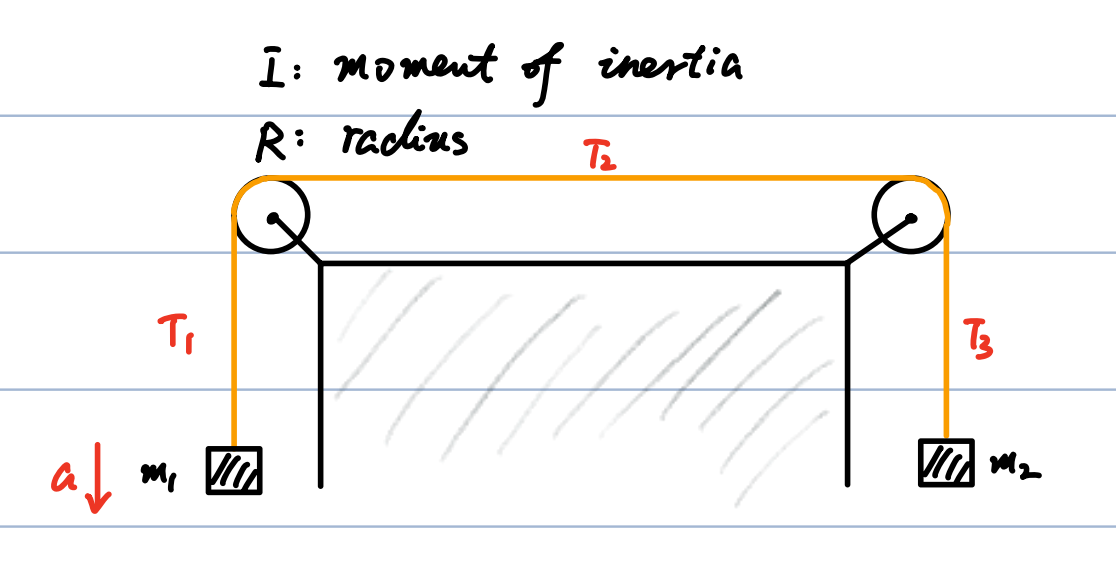
- Assumptions: Counter-clockwise rotation is defined as positive (\(\odot\hat{\omega}\) fixed by hand; choosing the opposite direction simply introduces a "-" sign, but remains physically correct).
Equations of Motion:
-
Left Pulley (\(n_1\)): \(T_1 R - T_2 R = I\alpha\)
-
Right Pulley (\(n_2\)): \(T_2 R - T_3 R = I\alpha\)
-
Mass 1 (moving down): \(m_1 g - T_1 = m_1 a\)
-
Mass 2 (moving up): \(T_3 - m_2 g = m_2 a\)
-
Kinematic Constraint: \(a = R\alpha\)
Solution:
Adding equations \((1) + (2) + (3) + (4) + (5)\) to eliminate the tensions:
Solving for linear acceleration \(a\) and angular acceleration \(\alpha\):
(Note: If \(m_1 = m_2 \implies \alpha = 0\), which is intuitively obvious.)
Example 2: Standard Atwood Machine (Energy Method)
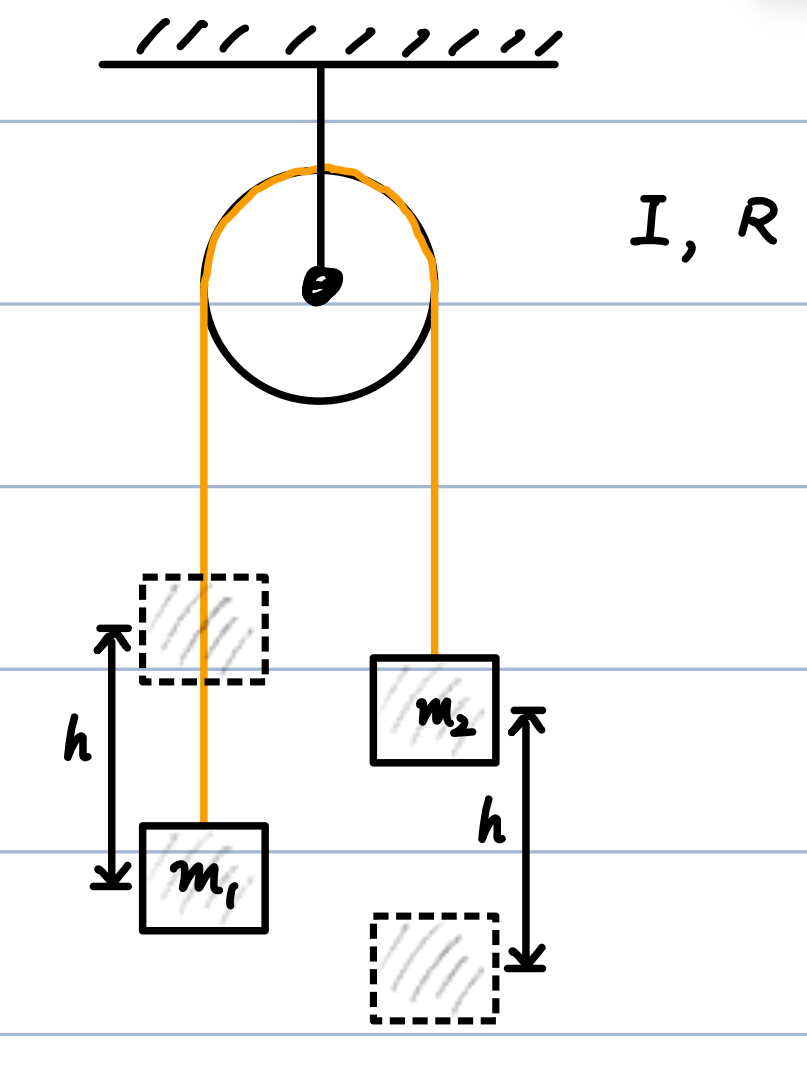
Scenario: A standard one-pulley Atwood machine (pulley \(I, R\)) is released from rest. Find the velocity \(v\) after mass \(m_1\) falls by a displacement \(h\).
Energy Conservation:
The loss in gravitational potential energy equals the gain in translational and rotational kinetic energy:
Using \(v = \omega R\):
2. The Vector Cross Product: Mathematical Foundations
Definition and Properties
For two vectors \(\vec{A}\) and \(\vec{B}\), the cross product is \(\vec{C} = \vec{A} \times \vec{B}\).
-
Orthogonality: \(\vec{C} \perp \vec{A}\) and \(\vec{C} \perp \vec{B}\)
-
Magnitude: \(C = AB\sin\theta\)
-
Direction: Determined by the Right-Hand Rule.
Key Rules:
-
If \(\vec{A} \parallel \vec{B}\) (\(\theta = 0\) or \(\pi\)), then \(\vec{A} \times \vec{B} = 0\). (Consequently, \(\vec{A} \times \vec{A} = 0\)).
-
If \(\vec{A} \perp \vec{B}\), then \(|\vec{A} \times \vec{B}| = AB\).
-
Non-commutative: \(\vec{A} \times \vec{B} = -\vec{B} \times \vec{A}\)
-
Distributive: \(\vec{A} \times (\vec{B} + \vec{C}) = \vec{A} \times \vec{B} + \vec{A} \times \vec{C}\)
Orthogonal Unit Vectors and Determinant Form
Using Cartesian basis vectors (\(\hat{i} \equiv \hat{e}_x\), \(\hat{j} \equiv \hat{e}_y\), \(\hat{k} \equiv \hat{e}_z\)):
-
\(\hat{i} \times \hat{j} = \hat{k}\)
-
\(\hat{j} \times \hat{k} = \hat{i}\)
-
\(\hat{k} \times \hat{i} = \hat{j}\)
Expanding \(\vec{A} \times \vec{B}\) component-wise yields the determinant form:
Vector Identities and Calculus
-
Time Derivative:
\[ \frac{d}{dt} (\vec{A} \times \vec{B}) = \left(\frac{d\vec{A}}{dt}\right) \times \vec{B} + \vec{A} \times \left(\frac{d\vec{B}}{dt}\right) \] -
Scalar Triple Product:
\[ (\vec{A} \times \vec{B}) \cdot \vec{C} = \begin{vmatrix} A_x & A_y & A_z \\ B_x & B_y & B_z \\ C_x & C_y & C_z \end{vmatrix} = (\vec{B} \times \vec{C}) \cdot \vec{A} = (\vec{C} \times \vec{A}) \cdot \vec{B} \] -
Vector Triple Product (BAC-CAB Rule):
\[ \vec{A} \times (\vec{B} \times \vec{C}) = (\vec{A} \cdot \vec{C})\vec{B} - (\vec{A} \cdot \vec{B})\vec{C} \]
3. Kinematics of Rigid Body Rotation
Acceleration in Fixed Axis Rotation
Taking the derivative of linear velocity \(\vec{v} = \vec{\omega} \times \vec{r}\):
-
Tangential Acceleration: \(\vec{a}_t = \vec{\alpha} \times \vec{r}\) (Magnitude: \(a_t = |\vec{\alpha} \times \vec{r}|\))
-
Radial/Centripetal Acceleration: \(\vec{a}_r = \vec{\omega} \times (\vec{\omega} \times \vec{r})\) (Magnitude: \(a_r = |\vec{\omega} \times (\vec{\omega} \times \vec{r})|\))
Rotational Kinetic Energy Derivation
Using the scalar triple product rearrangement where \((\vec{A} \times \vec{B}) \cdot \vec{C} = \vec{B} \cdot (\vec{C} \times \vec{A})\):
Applying the BAC-CAB rule:
(Where \(r_{i\perp}^2 = r_i^2 - (\vec{r}_i \cdot \hat{\omega})^2\) is the perpendicular distance from the axis).
4. Fictitious Forces and the Coriolis Effect
Inertial vs. Rotating Frames
-
Inertial Frame: Follows Newton's Laws. e.g., A mass moving in a circle requires a normal force \(F_N = m\frac{v^2}{r}\).
-
Rotating Frame: Non-inertial. Fictitious forces appear to explain motion. e.g., If the mass appears at rest in the rotating frame, \(F_{\text{fictitious}} - F_N = 0 \implies F_{\text{fictitious}} = m\frac{v^2}{r}\).
Transformation Between Frames (The Earth)
Define the position vector \(\vec{r}\) in both the fixed inertial basis \(\{\hat{e}_i\}\) and the rotating basis \(\{\hat{e}_i'\}\):
Because the basis vectors themselves are rotating with angular velocity \(\vec{\omega}\), their derivative is:
Velocity Transformation:
(The \(\vec{\omega} \times \vec{r}'\) term is the velocity due to rotation).
Acceleration Transformation:
Differentiating again and applying the same logic:
The Fictitious Forces
In the rotating frame, the apparent acceleration is \(\vec{a}'\). The forces that act on an object are the real forces plus two fictitious contributions due to rotation:
-
\(- 2m\vec{\omega} \times \vec{v}'\): Coriolis Force (depends on the velocity of the object in the rotating frame).
-
\(- m\vec{\omega} \times (\vec{\omega} \times \vec{r}')\): Centrifugal Force (points outward from the rotation axis).
Application: Typhoons (Cyclones)
When air rushes inward toward a central region of low pressure:
-
Northern Hemisphere: The Coriolis force deflects the moving air to the right relative to its direction of motion. This forces the air into a counter-clockwise spiral.
-
Southern Hemisphere: The Coriolis force deflects the air to the left, creating a clockwise spiral.