06_Waves
1. Introduction to Waves
Three Main Types of Waves
-
Mechanical Waves: Require a medium (e.g., water, sound, seismic waves).
-
Electromagnetic Waves: Do not require a medium (e.g., visible light, radio waves).
-
Matter Waves: The quantum mechanical view of fundamental particles.
Classification by Direction of Propagation (\(\vec{v}\))
-
Transverse Wave: The displacement is perpendicular to the direction of wave travel (\(\Delta\vec{y} \perp \vec{v}\)).
- Example: A wave on a string attached to a wall.
-
Longitudinal Wave: The displacement is parallel to the direction of wave travel (\(\Delta\vec{y} \parallel \vec{v}\)).
- Example: A stretched and compressed spring attached to a wall.
Requirements for Mechanical Waves
To generate and propagate a mechanical wave, three conditions must be met:
-
A source of disturbance.
-
A medium.
-
A physical connection between adjacent portions of the medium.
Basic Variables of Periodic Waves
Similar to simple harmonic motion, periodic waves are described by:
-
Amplitude (\(A\))
-
Frequency (\(f\))
-
Angular Frequency (\(\omega\))
-
Period (\(T\))
-
Wavelength (\(\lambda\)): The distance between points whose oscillations differ by \(2\pi\).
2. 1D Travelling Waves and Superposition
Mathematical Description
For a 1D travelling wave, the displacement \(y\) is a function of both position \(x\) and time \(t\):
-
Right-moving pulse: \(y = f(x - vt)\)
-
Left-moving pulse: \(y = f(x + vt)\)
-
\(v\): Wave speed (波速 / 相位速度).
Principle of Superposition
Linear waves are waves that obey the superposition principle. When waves overlap, they add up algebraically:
-
Interference: The phenomenon of combining waves.
-
Constructive Interference (相长干涉 / 建设性干涉): Pulses with the same sign add together to create a larger amplitude.
-
Destructive Interference (相消干涉 / 破坏性干涉): Pulses with opposite signs add together to momentarily cancel each other out.
-
3. Reflection and Transmission
Reflection (Upon Change of Medium)
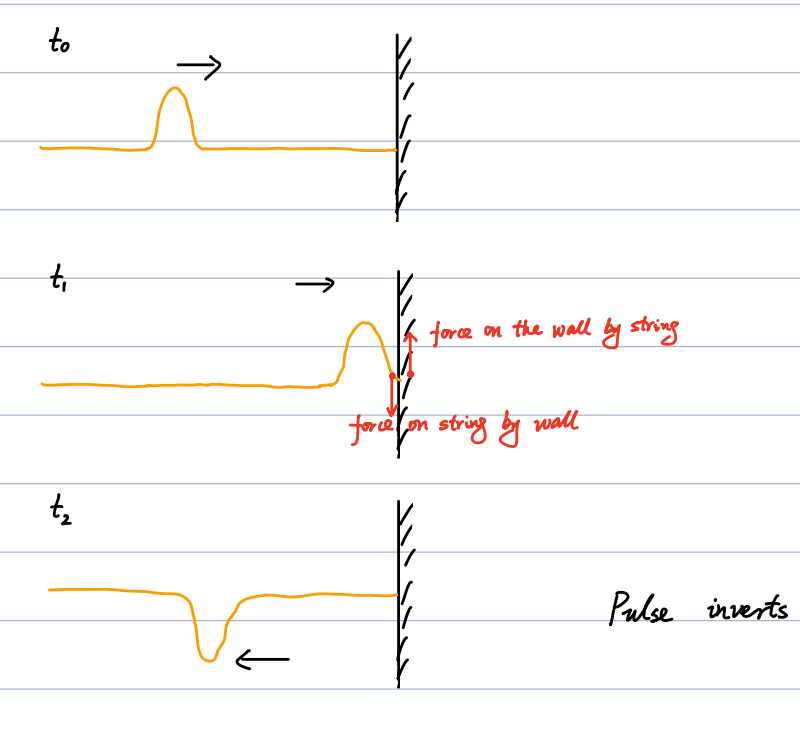
- Fixed Boundary: When a wave pulse hits a fixed wall, it exerts a force on the wall, and the wall exerts an equal and opposite downward force on the string (Newton's Third Law). As a result, the pulse inverts upon reflection.
-
schematic diagram from the hand-written notes of Mr. ztWang
-
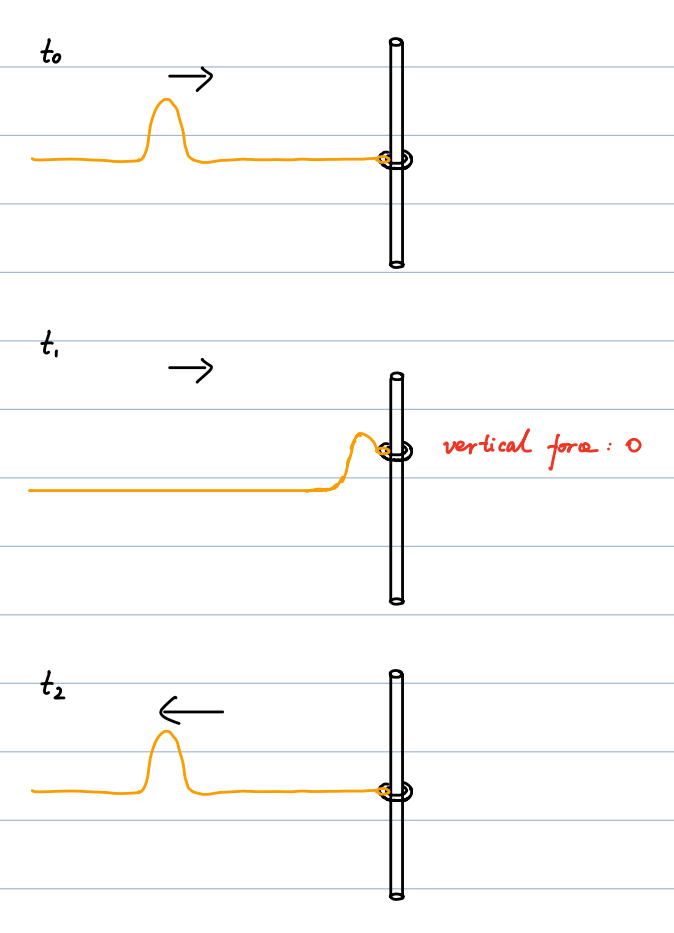
Free Boundary: When a string is attached to a ring that slides freely on a frictionless vertical rod, the vertical force is zero. The pulse does not invert upon reflection.
Transmission Between Different Media
-
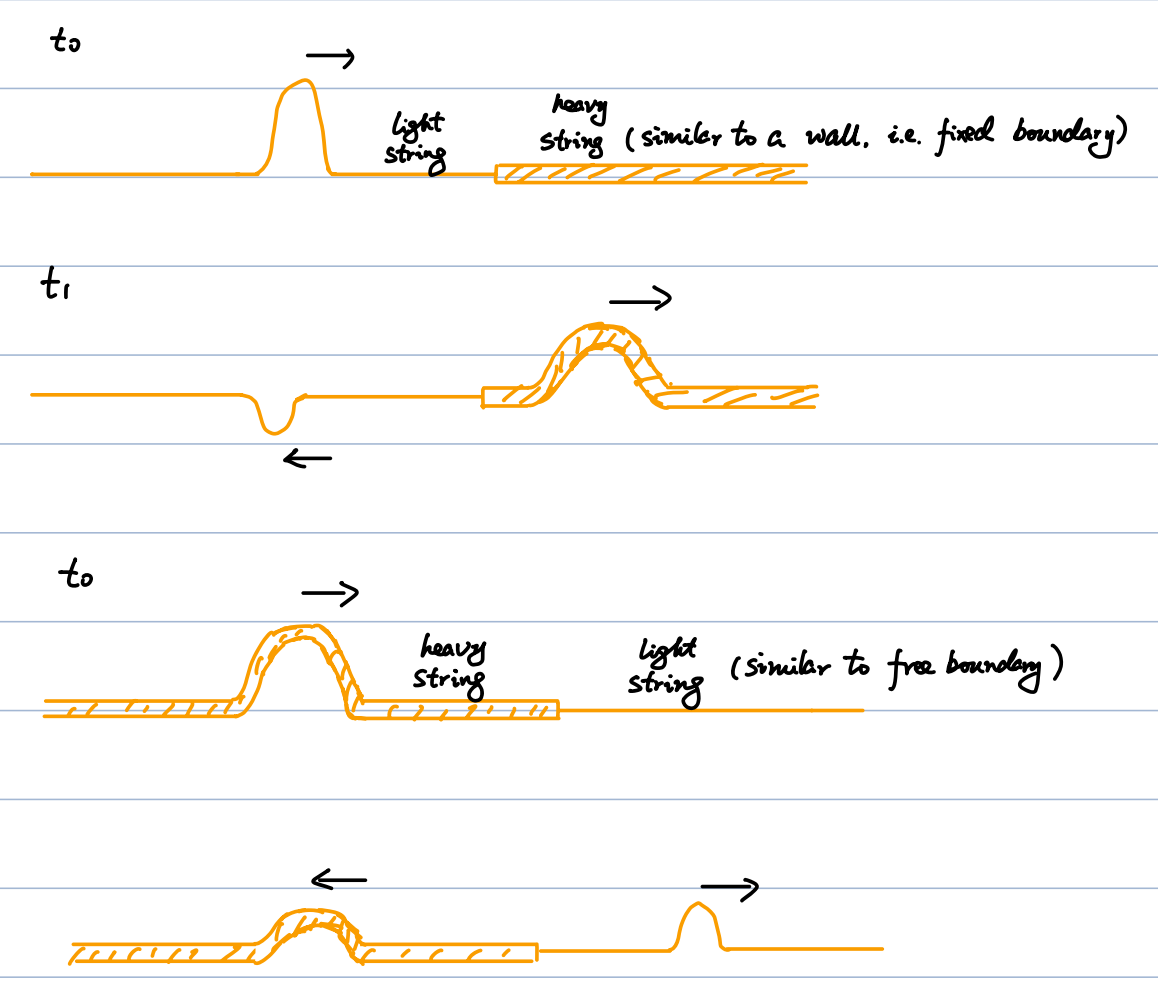
Light string to Heavy string: Behaves similarly to a fixed boundary. The transmitted pulse is upright (but slower/shorter), and the reflected pulse is inverted.
-
Heavy string to Light string: Behaves similarly to a free boundary. The transmitted pulse is upright (faster/longer), and the reflected pulse is upright.
4. The Linear Wave Equation
Derivation 1: Mechanical Waves in a Monoatomic Crystal (Phonon)
Consider atoms in a crystal with an equilibrium lattice spacing \(a\).
-
Equilibrium position: \(X_n = na\)
-
Deviation from equilibrium: \(u_n = x_n - X_n\)
Modeling nearest neighbor interaction (potential energy) with a spring constant \(K\):
Using Newton's Second Law for the \(n\)-th atom (\(F_n = m\ddot{u}_n\)):
Taking the continuum limit as \(a \to 0\):
This yields the wave equation:
Note on Continuum Limit: > The physical meaning of the limit \(a \to 0\) is \(\lambda \gg a\) (wavelength is much larger than the lattice spacing), or equivalently \(k \ll \frac{2\pi}{a}\).
Derivation 2: Wave on a String (Small Amplitude)
For a string with mass per unit length \(\mu\) and tension \(T\):
Applying Newton's second law to a small segment \(\Delta x\):
The General Linear Wave Equation
The generalized form applies to various physical systems:
-
Sound wave: \(y\) = displacement of air molecule.
-
Wave on a string: \(y\) = vertical displacement.
-
Electromagnetic wave: \(y\) = electric or magnetic field.
Verifying Solutions
The obvious solutions are \(y = f(x - vt)\) (right-moving) and \(y = f(x + vt)\) (left-moving).
To check \(f(x - vt)\):
-
Time derivatives: \(\frac{\partial y}{\partial t} = -vf'(x - vt) \implies \frac{\partial^2 y}{\partial t^2} = v^2 f''(x - vt)\)
-
Spatial derivatives: \(\frac{\partial y}{\partial x} = f'(x - vt) \implies \frac{\partial^2 y}{\partial x^2} = f''(x - vt)\)
Substituting these back verifies the equation: \(\frac{\partial^2 y}{\partial t^2} = v^2 \frac{\partial^2 y}{\partial x^2}\).