04_Harmonic
1. Equilibrium Overview
Conditions for Equilibrium
For a system to be in equilibrium, both its linear momentum (\(\vec{P}\)) and angular momentum (\(\vec{L}\)) must remain constant.
-
Translational Equilibrium: Net force must be zero.
$$\sum \vec{F}_{net} = 0 \implies \vec{P} = \text{constant} $$
-
Rotational Equilibrium: Net torque must be zero, measured from any arbitrary point.
\[ \sum \vec{\tau}_{net} = 0 \implies \vec{L} = \text{constant} \]
Static Equilibrium is a special case where the system is completely at rest:
Proof: Independence of Torque Origin in Equilibrium
If a system is in translational equilibrium (\(\sum \vec{F}_i = 0\)) and rotational equilibrium about an origin \(O\) (\(\sum \vec{\tau}_{i, O} = 0\)), then the net torque about any other arbitrary point \(O'\) is also zero.
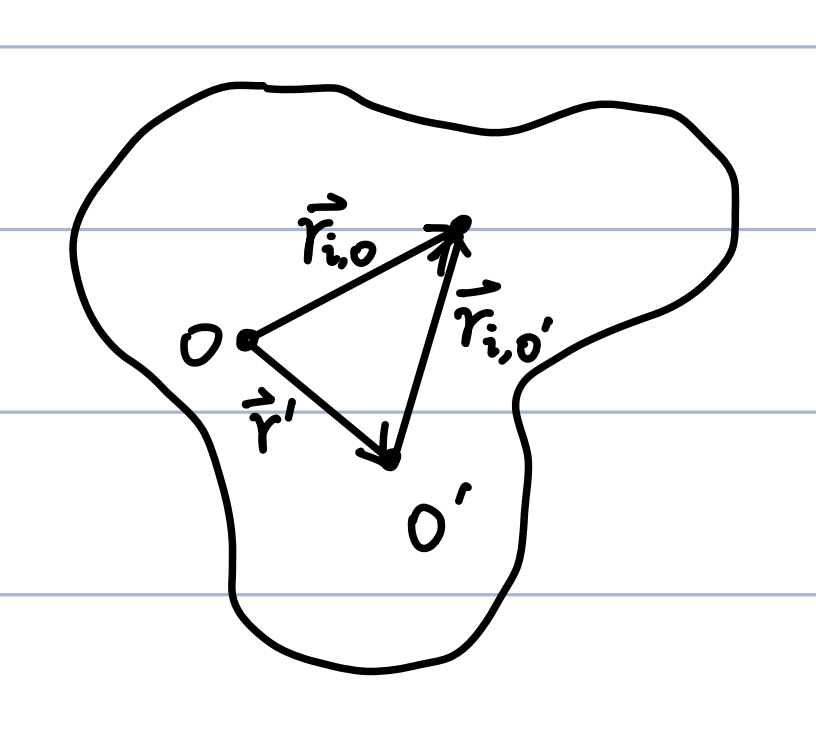
- schematic diagram from the hand-written notes of Mr. ztWang
Proof:
Let the position vector of point \(O'\) relative to \(O\) be \(\vec{r}'\). The position of the \(i\)-th force relative to \(O'\) is \(\vec{r}_{i, O'}\). Thus, the position relative to \(O\) is \(\vec{r}_{i, O} = \vec{r}' + \vec{r}_{i, O'}\).
Since \(\sum_i \vec{F}_i = 0\), the first term vanishes:
2. Center of Gravity (COG)
Definition: The point at which the total gravitational force \(\vec{F}_g\) effectively acts on a body.
Theorem: Under uniform gravity, the Center of Gravity (COG) coincides with the Center of Mass (COM).
Proof:
The actual net torque due to gravity on all individual mass elements is:
The effective torque acting at the COG is:
For uniform gravity (\(\vec{g}_i = \vec{g}\)):
If we set \(\vec{r}_{cog} = \vec{r}_{com} = \frac{\sum m_i \vec{r}_i}{M}\):
Therefore, we can treat the entire gravitational force \(M\vec{g}\) as acting at a single point (the COG/COM) to calculate net torque.
3. Static Equilibrium Examples
Example A: Standing on a Supported Beam
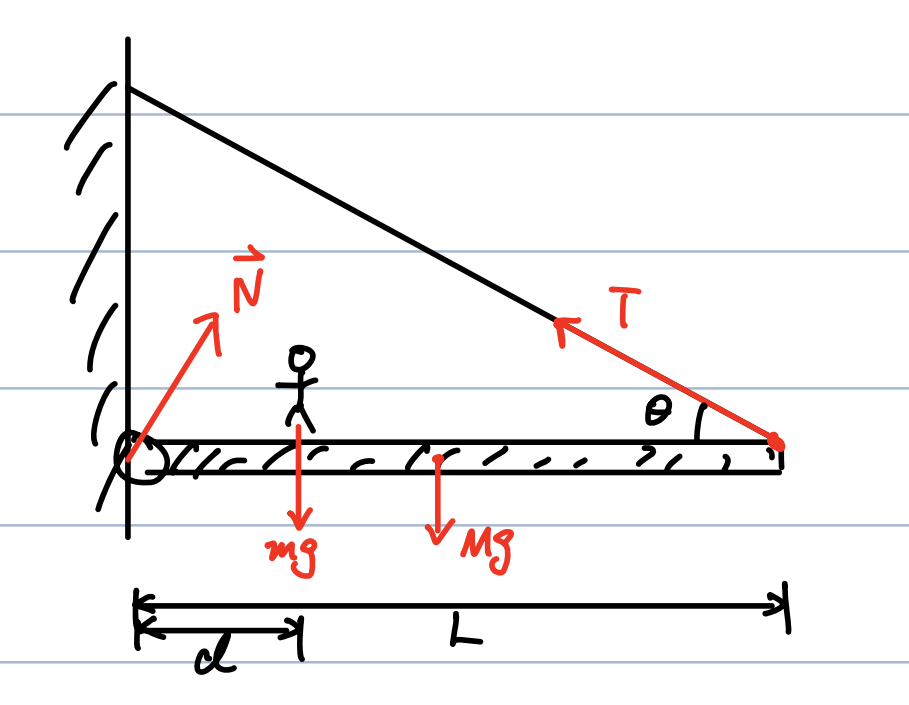
A uniform beam of length \(L\) and mass \(M\) is hinged to a wall and supported by a wire at an angle \(\theta\). A person of mass \(m\) stands at a distance \(d\) from the wall.
-
Torque Balance (around the hinge):
$$mgd + Mg\frac{L}{2} = TL\sin\theta \implies T = \frac{mgd + Mg\frac{L}{2}}{L\sin\theta} $$
-
Force Balance:
-
Horizontal: \(N_x = T\cos\theta\)
-
Vertical: \(N_y = mg + Mg - T\sin\theta\)
-
Example B: A Leaning Ladder
A uniform ladder of length \(L\) and mass \(M\) leans against a perfectly smooth wall. What is the minimal angle \(\theta\) with the floor required to maintain static equilibrium without slipping?
-
Method 1 (Standard Torque Balance):
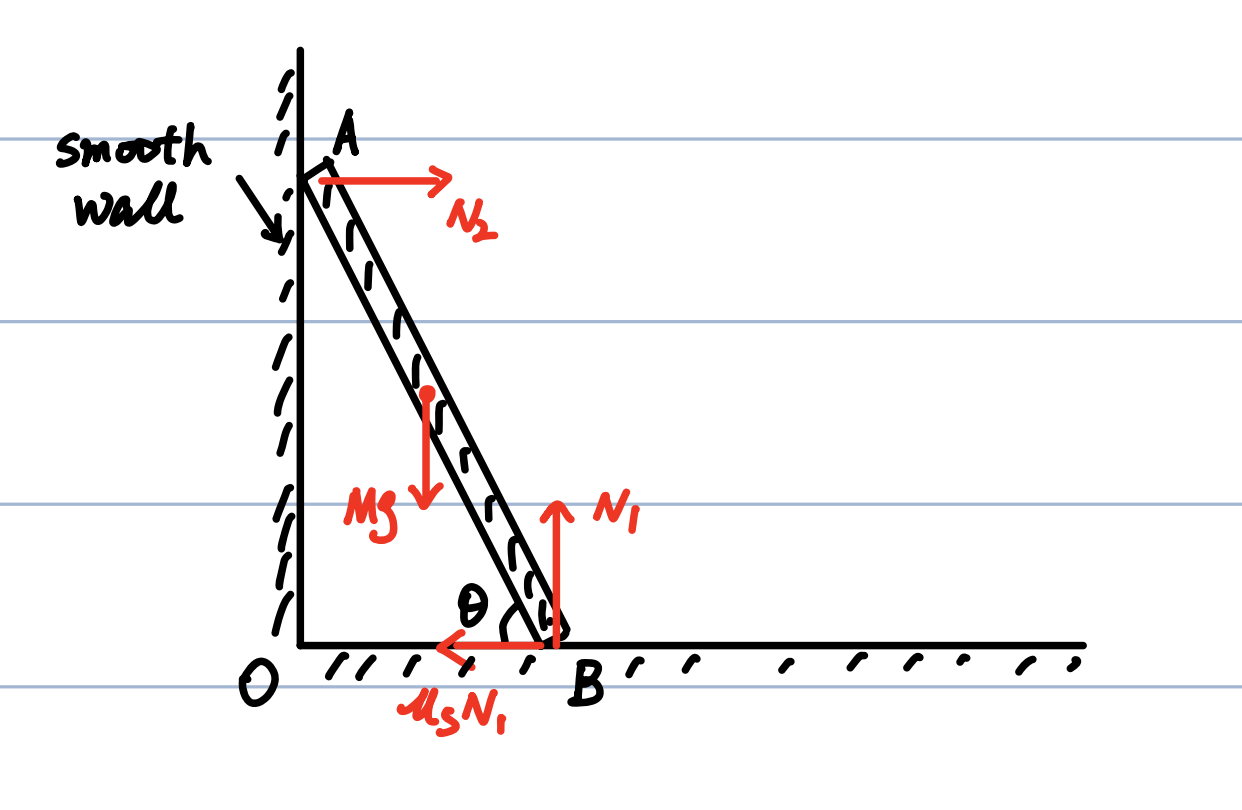
Take the torque around the top of the ladder (point A). The forces at the bottom are the normal force \(N_1\) and static friction \(\mu_s N_1\). The normal force from the wall is \(N_2\).
-
Vertical Forces: \(N_1 = Mg\)
-
Horizontal Forces: \(N_2 = \mu_s N_1 = \mu_s Mg\)
-
Torque around top: \(Mg \frac{L}{2} \cos\theta + \mu_s N_1 L \sin\theta = N_1 L \cos\theta\)
Substitute \(N_1 = Mg\):
\[ \mu_s Mg L \sin\theta = \left(Mg L - Mg \frac{L}{2}\right) \cos\theta \]\[ \mu_s \sin\theta = \frac{1}{2} \cos\theta \implies \tan\theta = \frac{1}{2\mu_s} \]
-
-
Method 2 (Concurrent Forces):
For a body in equilibrium under three non-parallel forces (Gravity, Wall Normal Force, and the Total Floor Reaction), their lines of action must intersect at a single point \(D\).
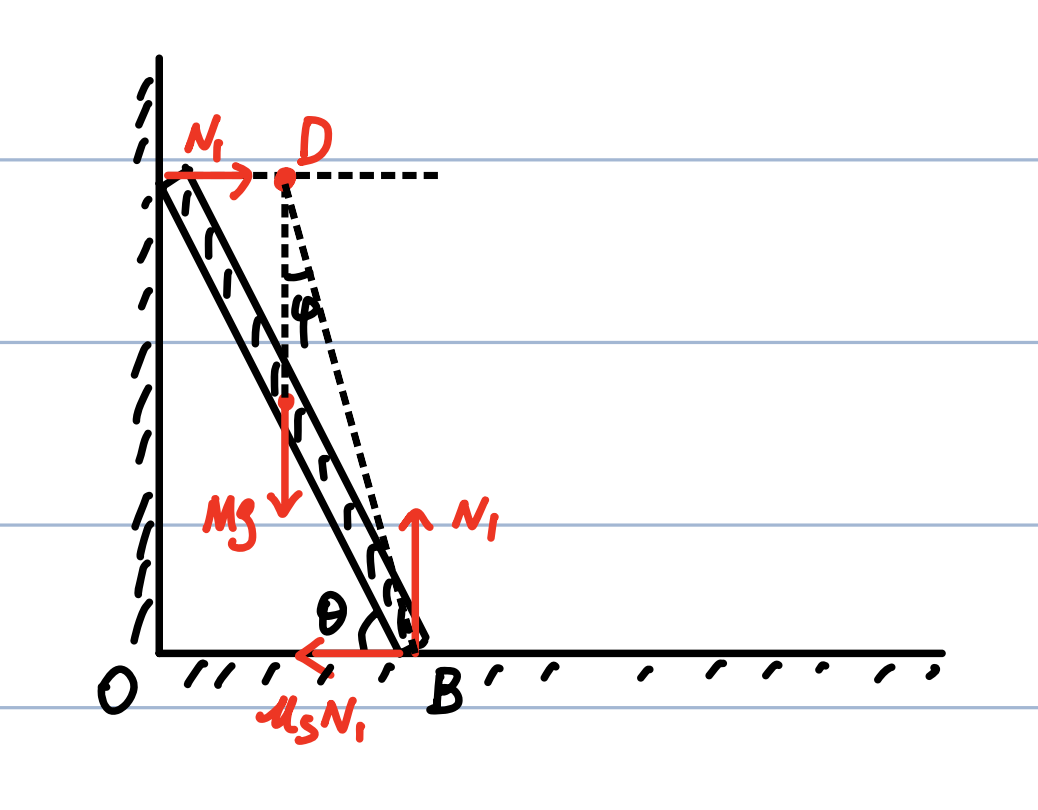
Let \(\varphi\) be the angle of the floor reaction force.
\[ \tan\varphi = \frac{\mu_s N_1}{N_1} = \mu_s \]From the geometry of the intersection point \(D\):
\[ \tan\varphi = \frac{\frac{L}{2} \cos\theta}{L \sin\theta} = \frac{1}{2}\cot\theta \]Equating the two:
\[ \mu_s = \frac{1}{2}\cot\theta \implies \tan\theta = \frac{1}{2\mu_s} \]
Example C: Wheel over a Step
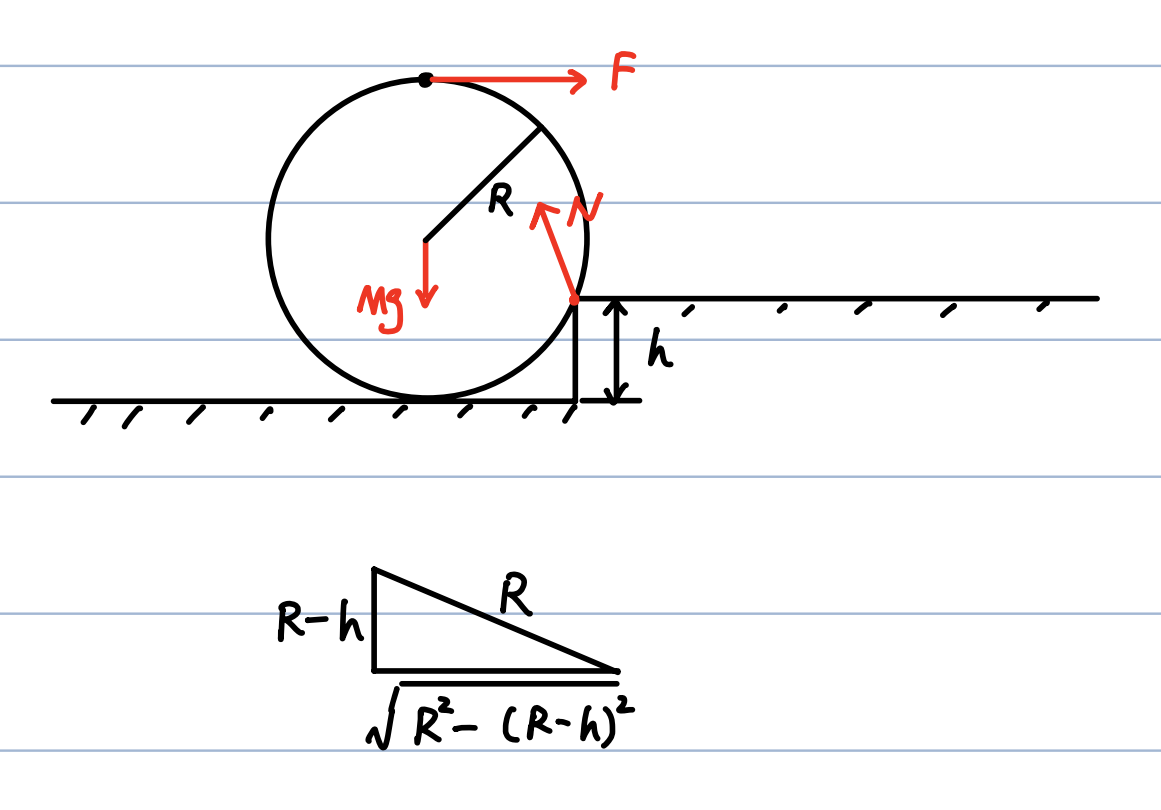
A wheel of radius \(R\) and mass \(M\) is pulled by a horizontal force \(F\) at the top to overcome a step of height \(h\).
-
Q1: Minimal \(F\)? Take the torque around the corner of the step.
The lever arm for \(F\) is \((2R - h)\). The lever arm for gravity is determined by the Pythagorean theorem: \(\sqrt{R^2 - (R-h)^2}\).
\[ F(2R - h) = Mg \sqrt{R^2 - (R-h)^2} \implies F = Mg\frac{\sqrt{R^2 - (R-h)^2}}{2R - h} \]
-
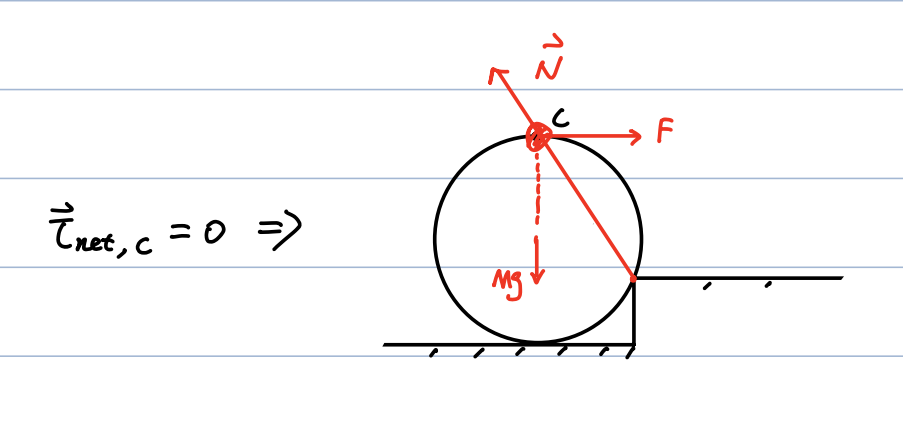
Q2: Direction of normal force \(\vec{N}\) at the corner?
For \(\vec{\tau}_{net, c} = 0\), the line of action of the normal force \(\vec{N}\) must pass through the intersection of the applied force \(F\) and gravity \(Mg\) (Concurrent forces theorem).
4. Simple Harmonic Motion (SHM)
Stable Equilibrium and Taylor Expansion
A system is in stable equilibrium if:
-
\(F = -\frac{dU}{dx} = 0\) (Equilibrium state)
-
\(\frac{d^2U}{dx^2} > 0\) (Stable; corresponds to a minimum in the potential energy \(U(x)\))
For any potential energy function \(U(x)\) near a stable equilibrium point \(x_0\), we can apply a Taylor expansion:
Since \(\frac{dU}{dx} = 0\) at equilibrium, for small displacements (\(x \sim x_0\)):
This represents a universal family of motion: Simple Harmonic Motion.
Equation of Motion
The restoring force is linear:
Kinematic Solutions
The general solution to this differential equation is:
-
Angular Frequency: \(\omega \equiv \sqrt{\frac{k}{m}}\)
-
Amplitude: \(A\)
-
Period: \(T \equiv \frac{2\pi}{\omega}\)
-
Frequency: \(f \equiv \frac{1}{T} = \frac{\omega}{2\pi}\) (Units: \(\text{s}^{-1}\) or Hertz, Hz)
-
Phase Constant: \(\phi\)
By taking derivatives, we find velocity and acceleration:
-
Velocity: \(v = -\omega A \sin(\omega t + \phi) = \omega A \cos(\omega t + \phi + \frac{\pi}{2})\)
-
Acceleration: \(a = -\omega^2 A \cos(\omega t + \phi) = \omega^2 A \cos(\omega t + \phi + \pi)\)
Key Kinematic Notes:
-
\(a = -\omega^2(x-x_0)\) (Acceleration is strictly proportional to displacement, opposite in sign).
-
\(\{x, v, a\}\) share the same frequency \(\omega\) but have different phases (shifted by \(\pi/2\) increments).
Energy in SHM
-
Kinetic Energy:
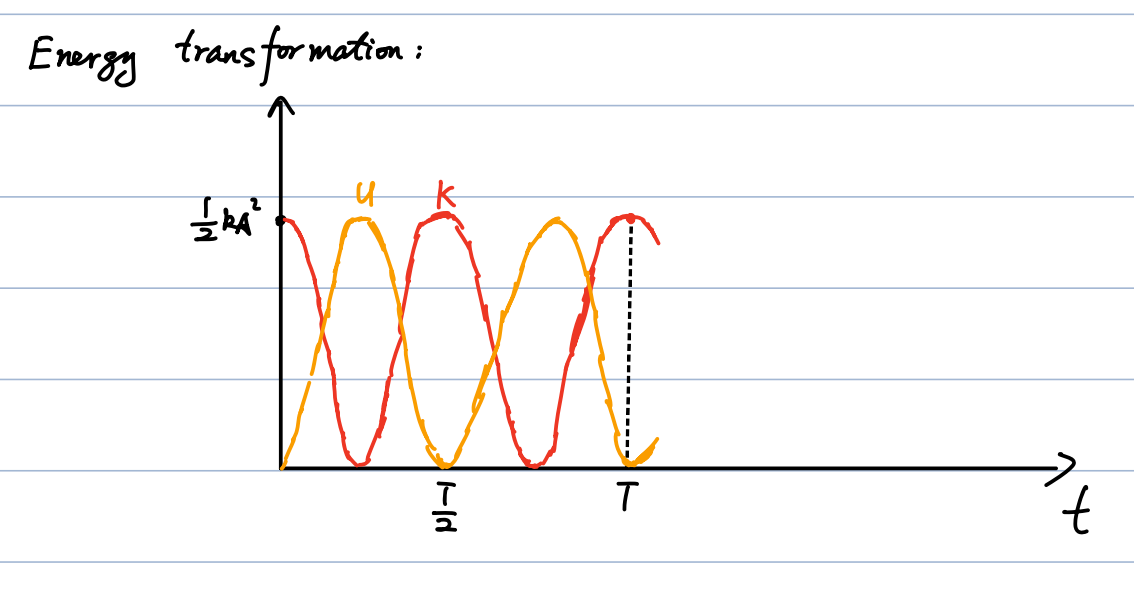
\[ K = \frac{1}{2}mv^2 = \frac{1}{2}m\omega^2 A^2 \sin^2(\omega t + \phi) = \frac{1}{2}kA^2 \sin^2(\omega t + \phi) \] -
Potential Energy:
\[ U = \frac{1}{2}k(x-x_0)^2 = \frac{1}{2}kA^2 \cos^2(\omega t + \phi) \] -
Total Mechanical Energy:
\[ E = K + U = \frac{1}{2}kA^2 \]
Energy Frequency (Double Angle Identity):
Using trigonometric identities, we can rewrite the energy terms:
Note: The kinetic and potential energies oscillate with a frequency of \(2\omega\) (twice the frequency of the position/velocity oscillation), transforming completely into one another twice every full period \(T\).