05_2nd-law
1. The Carnot Cycle (Sadi Carnot, 1824)
The Carnot cycle is an idealized thermodynamic cycle consisting of four reversible processes: two isothermal and two adiabatic.
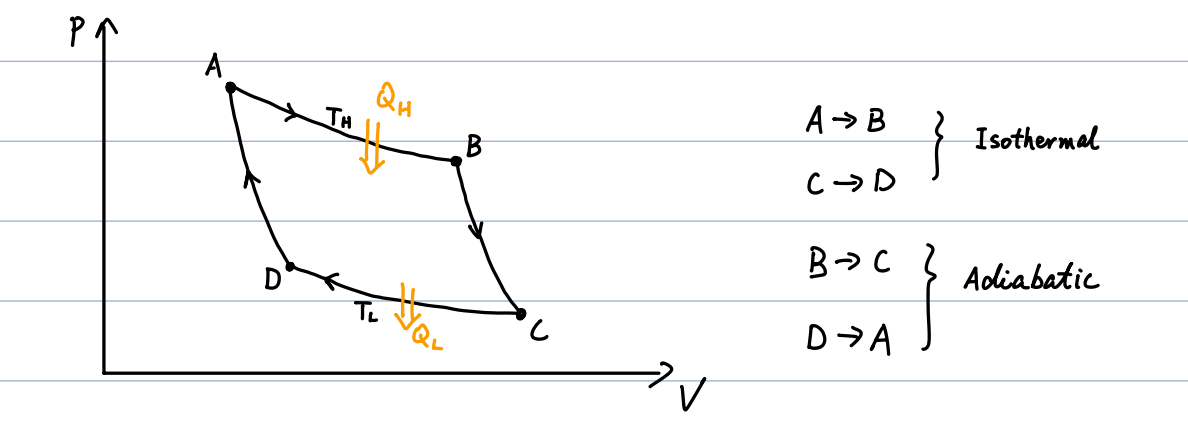
Deriving Carnot Efficiency (\(\varepsilon_{\text{Carnot}}\)):
For the isothermal expansion (\(A \rightarrow B\)), the change in internal energy \(\Delta U = 0\), so the heat absorbed equals the work done:
Similarly, for the isothermal compression (\(C \rightarrow D\)), the heat released is:
The efficiency of the cycle is defined as:
To simplify, we use the adiabatic relations for processes \(D \rightarrow A\) and \(B \rightarrow C\):
Equating these gives \(\frac{V_A}{V_D} = \frac{V_B}{V_C}\), which rearranges to \(\frac{V_C}{V_D} = \frac{V_B}{V_A}\). This cancels out the logarithmic terms in the efficiency equation.
Final Carnot Efficiency:
Note: Efficiency depends only on the ratio of the reservoir temperatures.
-
Example 1: If \(T_L =\) 303 K (30°C) and \(T_H =\) 503 K (230°C), then \(\varepsilon_{\text{Carnot}} \approx\) 40%.
-
Example 2: If \(T_L / T_H \approx\) 0, then \(\varepsilon_{\text{Carnot}} \approx\) 1 (100% efficiency, which is practically unattainable).
2. Reverse Carnot Cycle (Refrigerator)
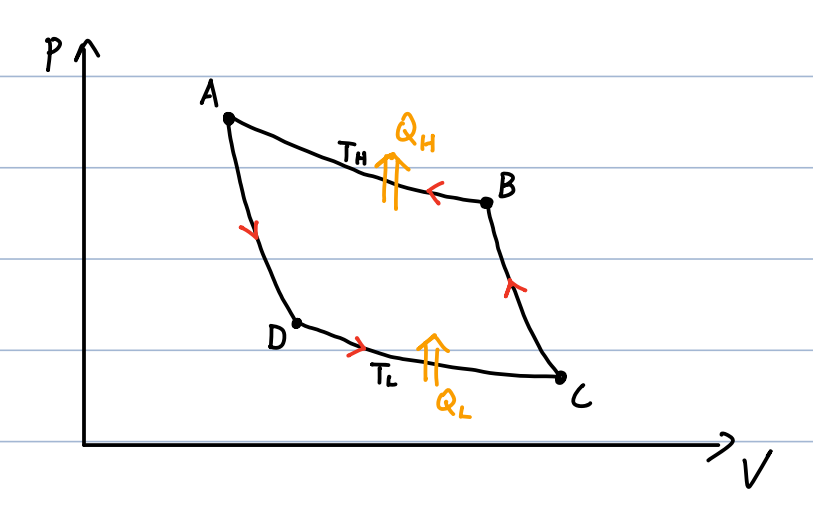
Operating the Carnot cycle in reverse creates an ideal refrigerator.
-
Work (\(W\)) is done TO the system.
-
The system absorbs heat (\(Q_L\)) FROM the low-\(T\) reservoir and releases heat (\(Q_H\)) TO the high-\(T\) reservoir.
Coefficient of Performance (COP / \(\varepsilon^{(r)}\)):
For a reverse Carnot cycle specifically:
Reversible vs. Irreversible Processes:
-
Reversible process: A process where the direction of both the system and its surroundings can be exactly reversed (e.g., a frictionless quasi-static process).
-
Irreversible process: All natural processes are irreversible (e.g., quasi-static processes with friction, adiabatic free expansion, a cooling cup of hot water).
3. The Second Law of Thermodynamics
The Second Law can be expressed through two functionally equivalent statements:
1. Clausius Statement (No perfect refrigerator):
Heat can never pass from a colder to a warmer body without some other change, connected with it, occurring at the same time.
2. Kelvin-Planck Statement (No perfect heat engine):
It is impossible to construct a heat engine that, operating in a cycle, produces no effect other than the absorption of energy from a reservoir and the performance of an equal amount of work.
Equivalence of the Statements:
-
If Kelvin-Planck is violated: A "perfect" engine converts heat \(Q_0\) entirely into work (\(W = Q_0\)). This work can be used to drive a regular refrigerator that moves heat \(Q\) from \(T_L\) and dumps \(Q_0 + Q\) into \(T_H\). The net effect is heat \(Q\) moving from \(T_L\) to \(T_H\) with no external work input—violating the Clausius statement.
-
If Clausius is violated: A "perfect" refrigerator moves heat \(Q_0\) from \(T_L\) to \(T_H\) without external work. A regular heat engine can then take \(Q_0 + Q\) from \(T_H\), do work \(W=Q\), and dump \(Q_0\) back to \(T_L\). The net effect is converting heat \(Q\) from \(T_H\) entirely into work \(W\) without any other effect—violating the Kelvin-Planck statement.
4. Carnot's Theorem
Carnot's theorem dictates the upper limits of thermodynamic efficiency based on two core postulates:
-
For heat engines working between two constant-\(T\) reservoirs, the efficiency of an irreversible engine (\(\varepsilon_I\)) is always lower than that of a reversible engine (\(\varepsilon_R\)).
-
For all reversible engines working between the same two constant-\(T\) reservoirs, the efficiencies are identical.
Proof of Postulate 1 (By Contradiction):
Assume an irreversible engine (\(I\)) is more efficient than a reversible engine (\(R\)), meaning \(\varepsilon_I > \varepsilon_R\).
-
Given \(\varepsilon_I = \frac{W'}{Q_1}\) and \(\varepsilon_R = \frac{W}{Q_1}\), this assumption implies \(W' > W\).
-
Design a combined process: Run engine \(I\) forward and run engine \(R\) in reverse (as a refrigerator) using a portion of the work from \(I\).
-
Engine \(I\) absorbs \(Q_1\) from \(T_H\) and produces work \(W'\). Engine \(R\) uses work \(W\) to return \(Q_1\) to \(T_H\).
-
Net Effect: The high-temp reservoir (\(T_H\)) experiences zero net heat change (\(Q_1 - Q_1 = 0\)). The combined system absorbs net heat (\(Q_2 - Q_2'\)) from the low-temp reservoir (\(T_L\)) and converts it entirely into net work (\(W' - W\)).
-
This directly violates the Kelvin-Planck statement of the Second Law. Therefore, the assumption is false, proving that \(\varepsilon_I \leq \varepsilon_R\).
(Postulate 2 is proven using identical logic by pitting two reversible engines against each other, yielding \(\varepsilon_{R1} \leq \varepsilon_{R2}\) and \(\varepsilon_{R2} \leq \varepsilon_{R1}\), dictating they must be equal).
Corollary of Carnot's Theorem:
For heat engines working between two constant-temperature reservoirs, the efficiency of any irreversible engine is strictly bounded by the Carnot efficiency: