07_3rd-law
1. The Third Law of Thermodynamics
Nernst Statement
For any isothermal process, the change in entropy approaches zero as the temperature approaches absolute zero:
Mathematically, for any state variable \(x\):
This implies that as \(T \to 0\), the entropy of a system approaches a constant value, \(S_0\), regardless of the path taken or the specific values of other state variables.
The Ideal Gas "Exception"
For an ideal gas, the entropy change during an isothermal expansion is given by:
This expression is entirely independent of \(T\), which appears to violate the Third Law (since \(\Delta S\) does not go to 0 as \(T \to 0\)). However, this is not a true violation; rather, the "ideal gas model" is simply too "idealized" and physically breaks down before reaching temperatures near absolute zero.
2. The Unattainability Principle
Definition
It is impossible for any process, no matter how idealized, to reduce the entropy of a system to its absolute-zero value in a finite number of operations.
Relationship with the Third Law
The Third Law and the Unattainability Principle are deeply connected. We can visualize this using a \(T\)-\(S\) diagram detailing alternating isothermal and adiabatic steps (a "zigzag" path used to cool a system):
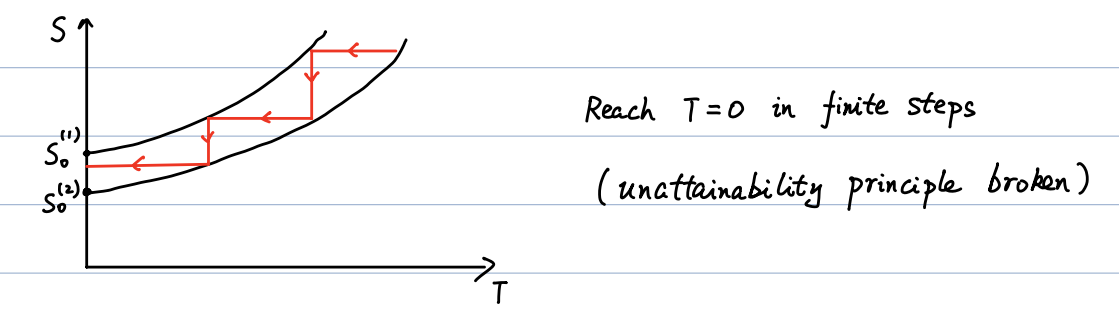
- If the 3rd Law is Violated: Entropy at \(T=0\) is not a well-defined single constant. Different parameter paths would hit the \(T=0\) axis at different entropy values. In this scenario, a system could theoretically reach \(T=0\) in a finite number of cooling steps, which directly breaks the Unattainability Principle.
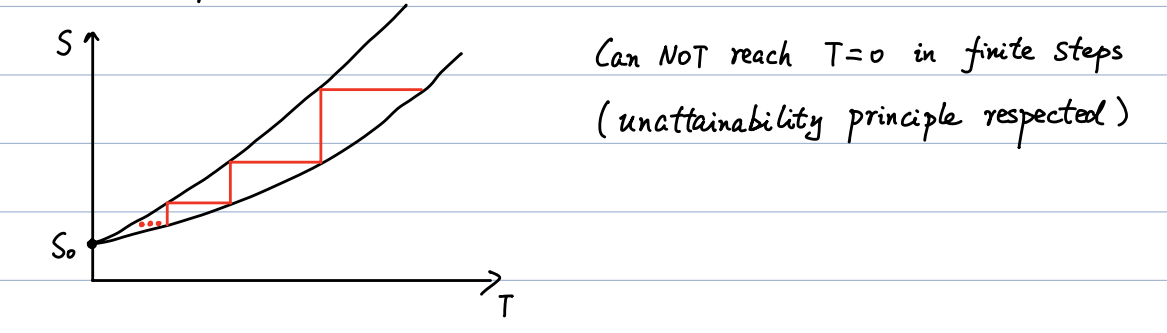
- If the 3rd Law is Respected: All parameter paths converge to the exact same entropy value (\(S_0\)) at \(T=0\). Because the curves converge, the alternating cooling steps become infinitely smaller. Consequently, it requires an infinite number of steps to reach \(T=0\), strictly upholding the Unattainability Principle.
3. Statistical View of Entropy (Ludwig Boltzmann, 1877)
Boltzmann's Entropy Formula
Entropy can be defined microscopically by the equation:
-
\(k_B\): Boltzmann constant.
-
\(W\): Multiplicity (the number of microscopic ways/configurations to achieve a specific macroscopic state).
Calculating Multiplicity (\(W\))
If you have \(N\) total particles distributed into two halves of a box, with \(n\) particles in the left half and \(N-n\) in the right half, the number of possible configurations is:
Example: Adiabatic Free Expansion of a Gas
If a gas undergoes free expansion to double its initial volume (\(V_f / V_i = 2\)), the macroscopic thermodynamic calculation gives \(\Delta S = nR \ln 2\). We can prove this exactly using the statistical view:
-
Initial State (\(S_i\)): All particles (\(N\)) are confined to one half of the box.
$$W_i = \frac{N!}{N!0!} = 1 \implies S_i = k_B \ln 1 = 0 $$
-
Final State (\(S_f\)): Particles are evenly distributed across both halves (\(N/2\) per half).
$$W_f = \frac{N!}{(N/2)!(N/2)!} $$
$$S_f = k_B \ln N! - 2k_B \ln(N/2)! $$
-
Applying Stirling's Approximation: For very large numbers (\(N \gg 1\)), \(\ln N! \approx N \ln N - N\).
$$S_f \approx k_B(N \ln N - N) - 2k_B\left(\frac{N}{2} \ln\frac{N}{2} - \frac{N}{2}\right) $$
The $-N$ terms cancel out cleanly:

$$
S_f = N k_B \ln N - N k_B \ln\frac{N}{2} $$
$$S_f = N k_B \ln 2 $$
-
Final Result: Using the relationship \(R = N_A k_B\) (where total particles \(N = nN_A\)):
\[ S_f = nR \ln 2 \]Therefore, \(\Delta S = S_f - S_i \approx nR \ln 2\). This statistical derivation perfectly matches the macroscopic thermodynamic result.