03_Angular Momentum
1. Pure Rotation (Moving Axis)
When extending rotational kinematics from a fixed axis to a moving axis (e.g., a rolling object), we analyze the Center of Mass (CM).
-
Kinematics of Pure Rolling:
For an object of radius \(R\) rolling without slipping, the arc length \(s = R\theta\).
-
Velocity of CM: \(v_{cm} = \frac{ds}{dt} = R\frac{d\theta}{dt} = R\omega\)
-
Acceleration of CM: \(a_{cm} = \frac{dv_{cm}}{dt} = R\alpha\)
-
-
Energy Conservation:
When the point of contact remains static (no slipping), static friction does no work in pure rotation. Therefore, mechanical energy is conserved.
-
Total Kinetic Energy (König's Theorem):
Total kinetic energy \(K\) is the sum of translational kinetic energy of the CM and rotational kinetic energy relative to the CM:
\[ K = K_{cm} + K' = \frac{1}{2} Mv_{cm}^2 + \frac{1}{2} I_{cm} \omega^2 \]For pure rotation (\(v_{cm} = \omega R\)), this simplifies to:
\[ K = \frac{1}{2}\left(M + \frac{I_{cm}}{R^2}\right) v_{cm}^2 \]
2. Torque and Angular Momentum
Recall the linear Impulse-Momentum Theorem: \(\vec{I} = \vec{P}_f - \vec{P}_i\). We can define a rotational analogue.
Definitions
-
Torque: \(\vec{\tau} = \vec{r} \times \vec{F}\)
-
Angular Momentum: \(\vec{L} = \vec{r} \times \vec{p}\)
Derivation of Rotational Dynamics
Taking the time derivative of angular momentum:
Since \(\frac{d\vec{r}}{dt} \times \vec{p} = \vec{v} \times (m\vec{v}) = 0\), we get the rotational analogue to Newton's Second Law:
Key Notes:
Both \(\vec{\tau}\) and \(\vec{L}\) depend on the choice of origin.
The origin for calculating \(\vec{\tau}\) and \(\vec{L}\) must be the same.
Any chosen origin is mathematically valid.
System of Particles
For a system of particles, total angular momentum is \(\vec{L} = \sum_i \vec{L}_i\) and total external torque is \(\vec{\tau}_{ext} = \sum_i \vec{\tau}_{i, ext}\).
Note: Internal torques cancel out. For example, the internal torque between two particles is \(\vec{\tau}_{int} = \vec{r}_1 \times \vec{F}_{12} + \vec{r}_2 \times \vec{F}_{21} = (\vec{r}_1 - \vec{r}_2) \times \vec{F}_{12} = 0\) (since the distance vector is parallel to the force vector). Only external forces need to be considered.
3. The Moment of Inertia Tensor
For a rigid body rotating around a fixed axis:
Applying the vector triple product expansion:
By expanding the vectors into Cartesian components \(\vec{\omega} = (w_x, w_y, w_z)^T\) and \(\vec{r}_i = (x_i, y_i, z_i)^T\), we can express this as a matrix multiplication:
This establishes the relationship \(\vec{L} = I \vec{\omega}\), where \(I\) is the Moment of Inertia Tensor:
(Note: \(\vec{A} \otimes \vec{B}\) denotes the dyadic/direct product where \((\vec{A} \otimes \vec{B})_{mn} \equiv A_m B_n\).)
Example: Uniform Ball
For a uniform sphere, the diagonal elements are all \(I_0 = \frac{2}{5} MR^2\).
The off-diagonal elements (e.g., \(I_{xy} = \int dx dy dz (-xy) \rho\)) integrate to zero due to odd symmetry in \(x\) and \(y\).
Thus, if the z-axis is fixed, \(L_z = I_0 \omega_z\).
4. Conservation of Angular Momentum
When net external torque is zero (\(\vec{\tau}_{ext} = 0\)), then \(\frac{d\vec{L}}{dt} = 0\), meaning \(\vec{L}\) is constant.
Example: Kepler's Second Law
A planet orbits the Sun under a central gravitational force \(\vec{F}_g\).
The area swept by \(\vec{r}\) in unit time is \(dA = \frac{1}{2} |\vec{r} \times \vec{v} dt|\).
5. Dynamics in the Center of Mass (CM) Frame
-
\(\vec{r} = \vec{r}_{cm} + \vec{r}'\):
-
Torque Separation:
\[ \vec{\tau}_{ext} = \vec{r}_{cm} \times \left(\sum_i \vec{F}_{i,ext}\right) + \sum_i \vec{r}_i' \times \vec{F}_{i,ext} \]This splits torque into the torque from all external forces acting on the CM, plus the torques relative to the CM. (Note: Torque from gravity relative to CM is 0).
-
Angular Momentum Separation:
\[ \vec{L} = M\vec{r}_{cm} \times \vec{v}_{cm} + \sum_i m_i \vec{r}_i' \times \vec{v}_i' \]This splits angular momentum into the orbital angular momentum of the CM, plus the spin angular momentum relative to the CM.
Combined Formalism:
For any closed, isolated system, the following are strictly conserved:
-
Energy: \(K_i + U_i = K_f + U_f\)
-
Linear Momentum: \(\vec{P}_i = \vec{P}_f\)
-
Angular Momentum: \(\vec{L}_i = \vec{L}_f\)
6. Comprehensive Examples
A. The Rolling Ball on an Incline
Find the CM acceleration (\(a_{cm}\)) of a ball rolling down an incline of angle \(\theta\).
-
Method 1: Momentum & Relative Angular Momentum
-
Translation: \(Mg \sin\theta - f_s = M a_{cm}\)
-
Rotation: \(f_s R = I_{cm} \alpha\)
-
Constraint (pure rotation): \(a_{cm} = \alpha R\)
-
Solving yields: \(a_{cm} = \frac{g \sin\theta}{1 + I_{cm}/(MR^2)}\)
-
-
Method 2: Parallel Axis Theorem
Take the torque about the bottom contact point (where normal force \(\vec{n}\) and friction \(\vec{f}_s\) exert no torque).
-
\(\tau_{ext} = Mg R \sin\theta\)
-
\(I = I_{cm} + MR^2\)
-
\(Mg R \sin\theta = (I_{cm} + MR^2) \frac{a_{cm}}{R} \implies a_{cm} = \frac{g \sin\theta}{1 + I_{cm}/(MR^2)}\)
-
B. Elastic Collision (Ball and Stick)
A ball (mass \(m_b\), initial velocity \(v_{bi}\)) strikes a freely pivoting stick (mass \(M\)) at distance \(r\) from the pivot. Find final velocities \(v_{bf}\) (ball), \(v_s\) (stick CM), and \(\omega\) (stick angular velocity).
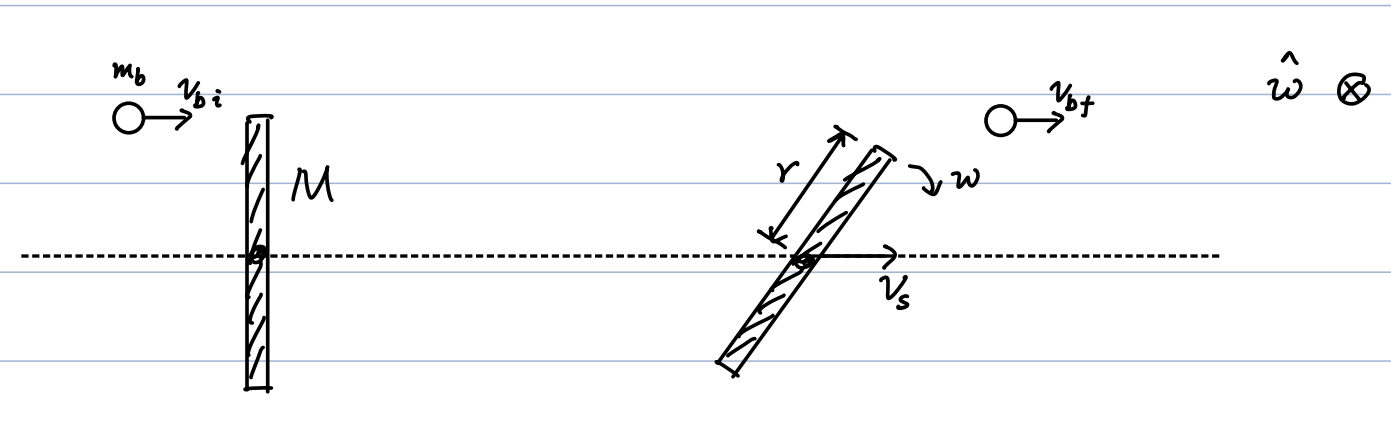
- schematic diagram from the hand-written notes of Mr. ztWang
Set up a system of three conservation equations:
-
Momentum: \(m_b v_{bi} = m_b v_{bf} + M v_s\)
-
Angular Momentum: \(m_b v_{bi} r = m_b v_{bf} r + I \omega\)
-
Kinetic Energy: \(\frac{1}{2} m_b v_{bi}^2 = \frac{1}{2} m_b v_{bf}^2 + \frac{1}{2} M v_s^2 + \frac{1}{2} I \omega^2\)
C. Rotation with Slipping
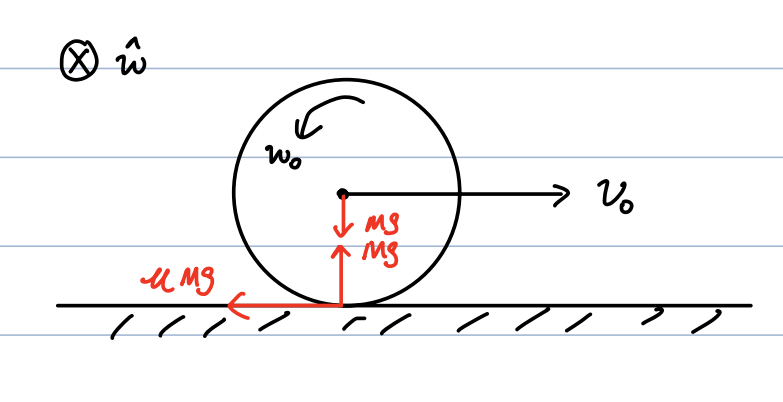
A solid cylinder (\(I = \frac{1}{2}MR^2\)) is placed on a surface with initial forward velocity \(V_0\) and initial backspin \(\omega_0\). Kinetic friction \(\mu Mg\) acts to normalize the motion. Find the time \(t\) when slipping stops, and the final pure-rolling velocity \(V_{cm}\).
-
Linear deceleration: \(V_{cm} = V_0 - \mu gt\)
-
Angular acceleration: \(\omega = -\omega_0 + \frac{\mu MgR}{I} t\)
-
Pure rolling condition: \(V_{cm} = \omega R\)
Solving the system:
D. Precession of a Gyroscope
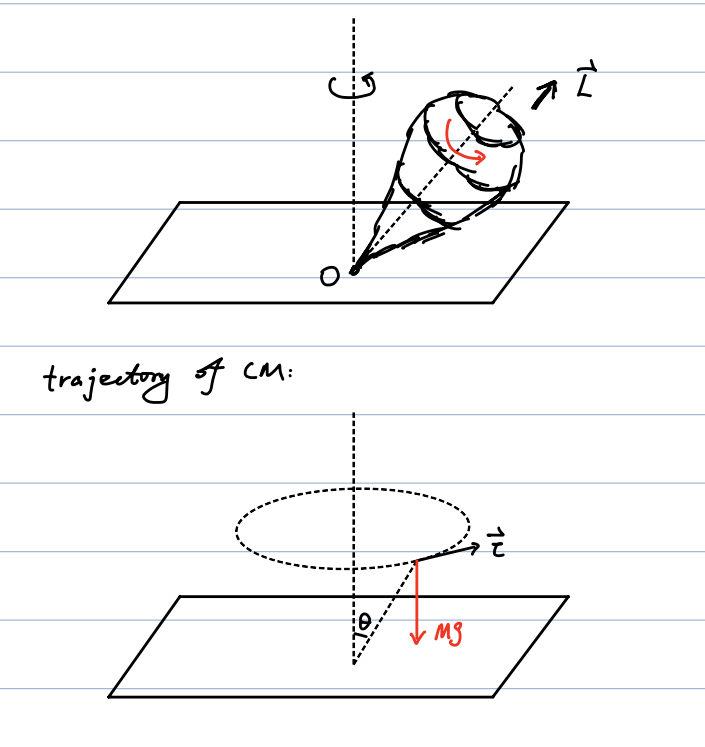
A fast-spinning gyroscope tilted at angle \(\theta\) experiences a gravitational torque.
-
Angular momentum is dominated by the fast spin: \(\vec{L} \approx \sum_i \vec{r}_i' \times \vec{p}_i'\) (CM orbital term \(\vec{r}_{cm} \times \vec{p}_{cm} \approx 0\)).
-
Torque: \(\vec{\tau} = \vec{r}_{cm} \times M\vec{g} \implies \tau = Mg r \sin\theta = \frac{dL}{dt}\)
-
From geometry, a small change in angle \(d\phi\) means \(dL = L \sin\theta d\phi\).
-
Substituting: \(Mg r \sin\theta = L \sin\theta \frac{d\phi}{dt}\)
-
Precession angular velocity: \(\frac{d\phi}{dt} = \frac{Mgr}{L}\)