04_General
1. Special Relativity: Kinematics Example
Problem Setup
Consider a spaceship (reference frame \(K'\)) of length \(L_0\) moving at a constant speed \(v\) relative to the Earth (reference frame \(K\)). Inside the spaceship, a ball moves from the left end to the right end at a speed \(u_0\).
- Question: What is the time interval (\(\Delta t\)) of the ball reaching the other end, as measured by an observer on Earth (frame \(K\))?
Analysis and Derivation
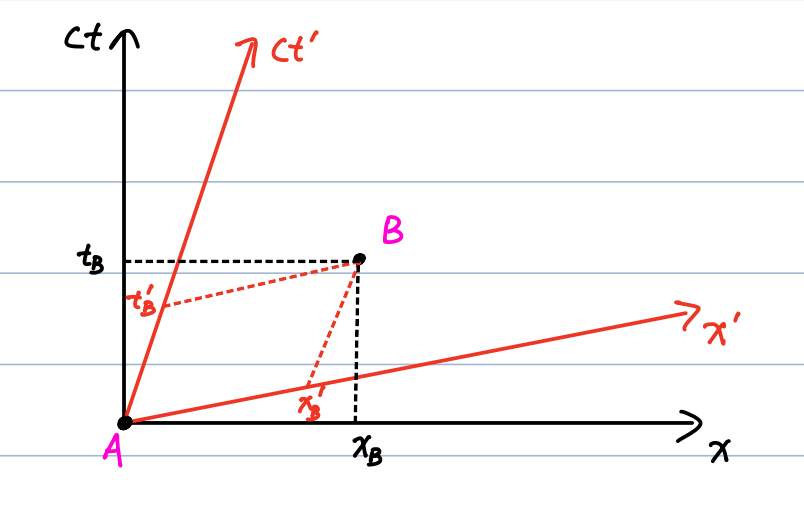
We define two key events in the Minkowski diagram:
-
Event A: Ball starts at the left end.
-
Event B: Ball hits the right end.
In the spaceship frame (\(K'\)):
-
Position of B: \(x'_B = L_0\)
-
Time of B: \(t'_B = \frac{L_0}{u_0}\)
To find the time and position in the Earth frame (\(K\)), we apply the Lorentz Transformation:
The time interval in frame \(K\) is \(\Delta t = t_B - t_A\). Assuming \(t_A = 0\), we get:
We can also verify the relativistic velocity addition formula by calculating the ball's speed \(u\) in frame \(K\):
Important Pitfall: Do not blindly apply the time dilation formula to get \(\Delta t = \gamma \frac{L_0}{u_0}\). This is incorrect because the time dilation formula \(\Delta t = \gamma \Delta t_0\) only applies to a clock that is strictly stationary with respect to the moving frame (\(K'\)). The ball is moving in \(K'\).
2. General Relativity: Introduction
General Relativity shifts the focus from inertial frames to non-inertial frames, redefining gravity not as a force, but as the curvature of space and time (described by Riemann Geometry).
Mass and the Principle of Equivalence
-
Gravitational Mass (\(m_g\)): The mass responsible for gravitational attraction (\(F = m_g g\)).
-
Inertial Mass (\(m_i\)): The mass representing resistance to acceleration (\(F = m_i a\)).
Empirically, \(m_g = m_i \equiv m\). This implies a deep connection between gravity and acceleration (\(g \sim a\)).
The Principle of Equivalence: At any local space-time point, an arbitrary gravitational field is physically equivalent to an accelerated reference frame.
- Example: An observer standing on the Earth's surface feels a downward force \(f = mg\). An observer in a rocket accelerating upwards at \(g\) in free space feels the exact same force.
Gravitational Deflection of Light
Imagine a free-falling elevator near the Earth's surface.
-
Elevator Frame: The gravitational force and the non-inertial fictitious force perfectly cancel out. To an observer inside, light propagates in a straight, horizontal line.
-
Earth Frame: Because the elevator is accelerating downward, an observer on Earth sees the light beam bend downwards. Gravity effectively bends light.
3. Predictions and Experimental Verification
Gravitational Deflection of Starlight
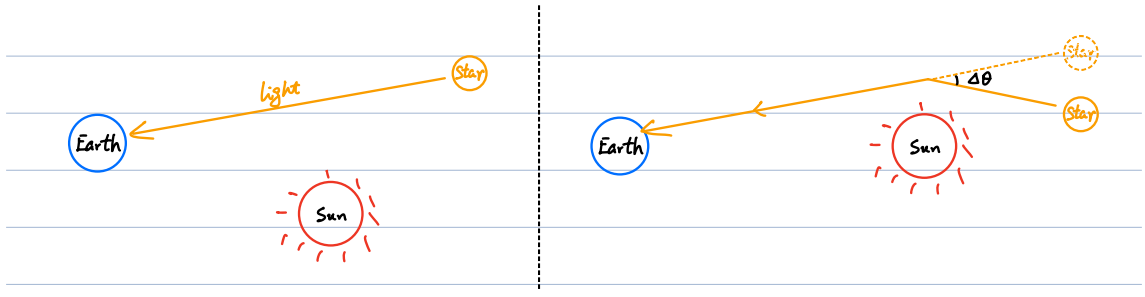
General relativity predicts that light from a distant star grazing the Sun will be deflected by an angle \(\Delta\theta\):
(Where \(M_{\odot}\) is the mass of the Sun and \(R_{\odot}\) is the radius of the Sun).
This calculation yields a deflection of 1.75'' (arcseconds, where 1° = 60' and 1' = 60''). This was famously confirmed by Arthur Eddington and his collaborators during a solar eclipse in 1919.
Gravitational Time Dilation
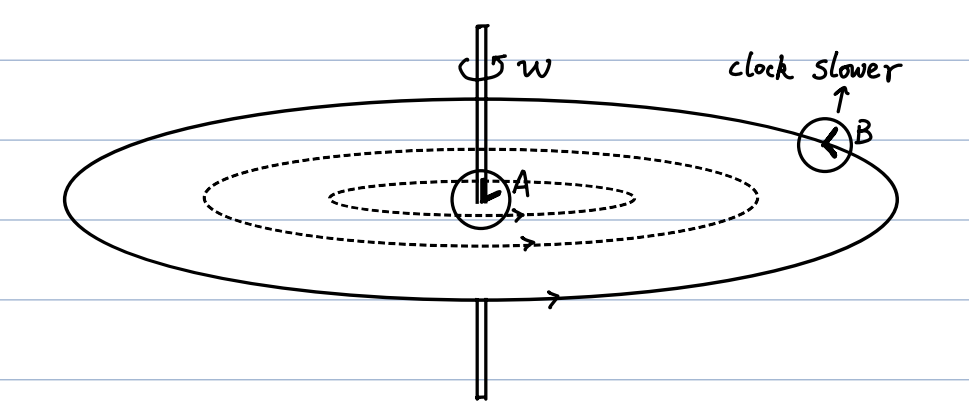
Consider a rotating disk with angular velocity \(\omega\) to simulate a gravitational field via fictitious forces.
-
In the rotating frame, the non-inertial centrifugal force is \(F_{\text{non-ine}} = m r \omega^2\).
-
This corresponds to an effective gravitational potential \(\varphi\):
\[ \varphi = - \int_0^r r'\omega^2 dr' = -\frac{1}{2}\omega^2 r^2 = -\frac{1}{2}v^2 \]
Using Special Relativity, we know a moving clock slows down: \(\Delta t = \gamma \Delta t_0\). Substituting velocity with potential:
Because \(\varphi < 0\), the denominator is less than 1, meaning \(\Delta t > \Delta t_0\).
Conclusion: A clock deeper in a gravitational field runs slower.
4. Real-World Applications and Evidence
Global Navigation Satellite Systems (GPS)
Systems like GPS (USA), Beidou (China), GLONASS (Russia), and Galileo (EU) rely heavily on precise timing (\(\Delta S = c\Delta t\)). The clocks on satellites experience competing relativistic effects:
-
Special Relativity Effect: Because the satellite is moving fast relative to Earth, its clock is slowed by 7 μs/day.
-
General Relativity Effect: Because gravity is weaker at the satellite's altitude, its clock is boosted (speeds up) by 46 μs/day.
Gravitational Redshift
When light escapes a massive object, its period \(T_0\) increases to \(T = \gamma T_0\), meaning its frequency \(\nu\) decreases (shifting toward the red end of the spectrum).
- Energy Perspective: A photon must expend energy to overcome the gravitational pull and escape. Since photon energy is \(E = h\nu\), a loss of energy directly results in a lower frequency \(\nu\). (Note: \(\nu\) is the Greek letter "nu" for frequency, not velocity \(v\)).
Spacetime Curvature Evidence
Massive objects curve spacetime, dictating how matter and energy move. Key evidence includes:
-
Light travels along "null geodesics" (the shortest possible path in curved spacetime).
-
The anomalous perihelion precession of Mercury's orbit.
-
The detection of Gravitational Waves (confirmed by LIGO in 2016, awarded the Nobel Prize in 2017).