2 · Continuous Charge and Gauss's Law
Course index · Previous: charge and fields · Next: electric potential
Main results(核心结论)
A continuous source is handled by adding the fields of infinitesimal charge elements. Gauss's law instead relates the total signed flux through a closed surface to enclosed charge. It always holds, but determines a field directly only when symmetry sufficiently constrains that field.
The classroom contrasts 化整为零 (divide a source into elements and integrate) with 化零为整 (use a global flux law). Neither method removes the need to reason about symmetry.
1. Charge densities and the Coulomb integral
| Distribution | Charge element | Total charge |
|---|---|---|
| Line | \(dq=\lambda\,d\ell\) | \(Q=\int\lambda\,d\ell\) |
| Surface | \(dq=\sigma_s\,dA\) | \(Q=\int\sigma_s\,dA\) |
| Volume | \(dq=\rho_q\,d\mathcal V\) | \(Q=\int\rho_q\,d\mathcal V\) |
Densities are signed and can depend on position. Let \(\mathbf r'\) locate a source element and \(\mathbf r\) the observation point. Then
Do not mix the source coordinate \(\mathbf r'\) with the observation coordinate \(\mathbf r\). The separation vector changes as the source element moves through the integral.
A reliable sequence is: choose \(dq\) → write the separation vector → project into components → use symmetry → integrate the surviving components → check limits.
2. Uniformly charged ring: field on its axis
Consider a ring of radius \(R\), lying in the \(xy\) plane and carrying total charge \(Q\) uniformly. At \(P=(0,0,z)\), every element is at the same distance \(s=\sqrt{R^2+z^2}\). Opposite elements cancel their transverse contributions. Rotation about the axis also rules out any preferred transverse direction.
The axial component is
Integrating over the ring gives the exact axial field
For positive \(Q\), the sign of \(z\) determines which way the field points. At the center, \(\mathbf E=0\). Far away, \(\mathbf E\simeq kQ\,\mathrm{sgn}(z)\hat{\mathbf z}/z^2\), as expected for a localized source of total charge \(Q\).
A useful extremum check
For \(z>0\),
The maximum occurs at \(z=R/\sqrt2\), with \(E_{\max}=2kQ/(3\sqrt3R^2)\). The field starts at zero, increases, then decays; it cannot monotonically decrease from the ring center.
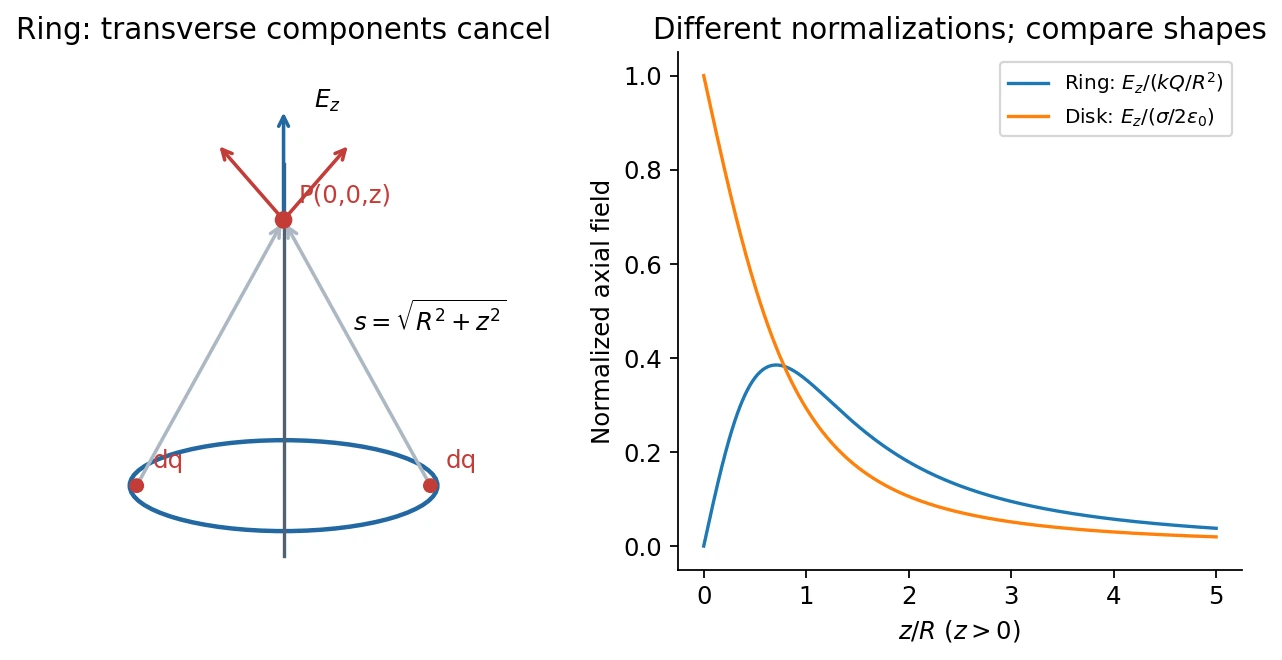
The two curves use different normalizations, as stated in the legend; the graph compares their shapes rather than equal-charge field magnitudes.
3. Uniformly charged disk: build it from rings
A disk of radius \(R\) has constant surface charge density \(\sigma_s\). A thin ring of radius \(s\) and width \(ds\) carries
For \(z>0\), insert this element into the ring result:
For either side of the disk, away from its ideal zero-thickness surface,
Three essential limits are:
- Far field, \(|z|\gg R\): expansion of the square root gives \(|E_z|\simeq k|Q|/z^2\), where \(Q=\pi R^2\sigma_s\).
- Near the center, \(z\to0^\pm\): \(E_z\to\pm\sigma_s/(2\epsilon_0)\). These are one-sided limits. Do not assign a unique continuous field to the charged ideal surface itself.
- Infinite-sheet limit, \(R\to\infty\) at fixed \(z\): the field becomes distance independent, with magnitude \(|\sigma_s|/(2\epsilon_0)\) on each side.
The field jump across a charged sheet is consistent with the general normal-boundary condition discussed in class 5.
4. Electric flux(电通量)
An oriented surface element has area vector \(d\mathbf A=\hat{\mathbf n}\,dA\). Electric flux is
For a uniform field through a flat area \(A\), \(\Phi_E=EA\cos\theta\), where \(\theta\) is the angle between the field and the normal, not the plane. Flux is a scalar and has unit N·m²/C.
For a closed surface, choose the outward normal everywhere:
Outward contributions are positive and inward contributions negative. A field tangent to a patch contributes zero flux through that patch. A Gaussian surface is an imaginary mathematical surface, not necessarily a physical object.
中文提示:“穿过多少电场线”只能帮助理解;精确定义是带方向的点积面积分。通量既可正也可负,不能把每个面的通量绝对值相加。
5. Gauss's law and why it works
In vacuum,
The field on the left is due to all charges, inside and outside. Only the net enclosed charge appears on the right.
For a point charge at the center of a sphere, \(E=kq/r^2\) and \(\Phi_E=E\,4\pi r^2=q/\epsilon_0\). The shrinking field and growing area cancel. The classroom connects this cancellation to the inverse-square law in three dimensions.
For a general closed surface, a point charge contributes
where \(d\Omega\) is the signed solid angle seen from the charge. The net solid angle is \(4\pi\) for a charge inside and zero for a charge outside. Superposition extends the result to many charges and continuous distributions. A charge exactly on the chosen surface requires special limiting treatment; choose a surface that avoids it.
What Gauss's law does not say
- \(Q_{\mathrm{enc}}=0\) implies zero net flux, not zero field. A uniform field crosses a charge-free box, entering one side and leaving another.
- External charges contribute zero net flux but can change the local field at every point on the surface.
- Knowing one number, the flux, does not determine an arbitrary vector field on a surface.
- Enclosing a dipole gives zero flux even though its surrounding field is nonzero.
6. How symmetry makes Gauss's law useful
To extract an unknown \(E\) from a flux integral, establish from the physical source and boundary conditions that \(E\) is constant on the relevant surface patches and has a known orientation. Drawing a symmetric Gaussian surface cannot create symmetry absent from the source.
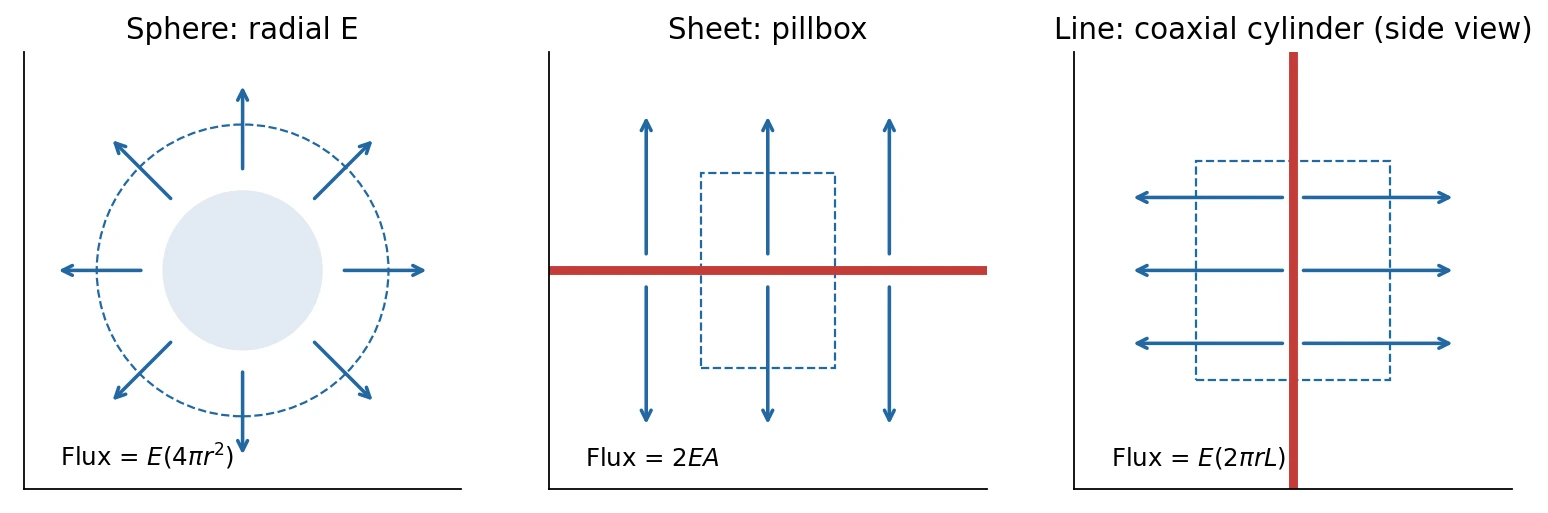
Spherical symmetry
If the charge distribution is spherically symmetric, \(\mathbf E=E_r(r)\hat{\mathbf r}\). A concentric sphere gives
For a uniformly charged solid insulating ball of radius \(R\) and total charge \(Q\),
Inside, only \(Q(r/R)^3\) is enclosed. The field increases linearly and is continuous at \(R\). A uniform thin spherical shell instead has zero field inside and the same external point-charge field. A conductor can redistribute charge; it is not the uniformly volume-charged insulating ball.
For a nonuniform spherically symmetric density,
Planar symmetry: an infinite nonconducting sheet
Uniformity under translations and rotations within the plane implies a perpendicular field of constant magnitude on each side. Reflection symmetry gives equal magnitudes on the two sides. A pillbox of cap area \(A\) has flux \(2EA\), hence
For sheets at \(z=0\) and \(z=d\) carrying \(+\sigma_s\) and \(-\sigma_s\), respectively, superposition gives \(\mathbf E=(\sigma_s/\epsilon_0)\hat{\mathbf z}\) between them and zero outside, in the infinite-sheet approximation.
Distinguish the field on one side of a single prescribed sheet from the field immediately outside a conducting surface: the latter uses \(E_n=\sigma_s/\epsilon_0\) because the field inside the metal is zero.
Cylindrical symmetry: an infinite line of charge
For line density \(\lambda\), translation along the axis, rotation about it, and reflection perpendicular to it imply a radial field. A coaxial cylinder of radius \(r\) and length \(L\) has no flux through its ends:
The \(1/r\) scaling differs from the \(1/r^2\) point-charge field because the source is extended indefinitely in one dimension. A finite rod approximates this result only near its central region when the perpendicular distance is much smaller than its length.
As an extension of the same enclosed-charge argument, a uniformly charged infinite solid cylinder of radius \(R\) has \(E_r=\rho_qr/(2\epsilon_0)\) inside and \(E_r=\rho_qR^2/(2\epsilon_0r)\) outside. This is a deduction from the taught method rather than a separate later topic.
7. Common errors and self-checks
- Ring: every element has the same distance to an axial point, but its field is not entirely axial; project before adding.
- Disk: the annulus area is \(2\pi s\,ds\), not \(\pi(ds)^2\).
- Sphere: use enclosed charge, not total charge, for an observation point inside a distributed source.
- Sheet: a two-sided pillbox has two flux-producing caps; this creates the factor of two.
- Line: a coaxial Gaussian cylinder has lateral area \(2\pi rL\), not \(\pi r^2\).
- Symmetry: an off-axis ring point or a finite sheet edge generally prevents a simple Gauss-law solution.
For a quick dimensional check, \(\lambda/(\epsilon_0r)\), \(\sigma_s/\epsilon_0\), and \(\rho_qr/\epsilon_0\) must all have units of electric field.
References
Lecture 2 PDF pp. 3–8 covers the ring and disk; pp. 10–24 covers flux and Gauss's law; pp. 25–30 covers spherical, planar, and cylindrical applications. Class 2, 17:12–95:16, adds the symmetry reasoning, solid-angle explanation, and integral/global comparison. Its mathematical appendices are summarized in the toolkit.