06_Entropy
1. The Clausius Inequality and Entropy
-
Clausius Inequality: For any cyclic process, the integral of heat transfer divided by temperature is less than or equal to zero:
\[ \oint \frac{\delta Q}{T} \leq 0 \]-
Reversible process: \(\oint \frac{\delta Q}{T} = 0\) (Clausius equality)
-
Irreversible process: \(\oint \frac{\delta Q}{T} < 0\)
-
-
Proof via Heat Engine: Consider an engine working between two constant-\(T\) reservoirs.
-
Efficiency: \(\varepsilon = 1 - \frac{Q_L}{Q_H} \leq \varepsilon_{\text{Carnot}} = 1 - \frac{T_L}{T_H}\)
-
Rearranging yields: \(\frac{Q_L}{Q_H} \geq \frac{T_L}{T_H} \implies \frac{Q_H}{T_H} - \frac{Q_L}{T_L} \leq 0\)
-
By formally defining \(\Delta Q\) as heat absorbed (so heat released is negative), this becomes \(\frac{\Delta Q_H}{T_H} + \frac{\Delta Q_L}{T_L} \leq 0\).
-
Generalizing to an arbitrary quasi-static cyclic process with multiple reservoirs: \(\sum_i \left( \frac{\Delta Q_H^{(i)}}{T_H^{(i)}} + \frac{\Delta Q_L^{(i)}}{T_L^{(i)}} \right) \leq 0 \implies \oint \frac{\delta Q}{T} \leq 0\).
-
-
Definition of Entropy (\(S\)): Because \(\oint \frac{\delta Q}{T} = 0\) for a reversible cycle, the integral between two states is independent of the path taken. This allows us to define a state function called entropy.
-
Integral form: \(S_B - S_A = \int_A^B \frac{\delta Q}{T}\)
-
Differential form: \(dS = \frac{\delta Q}{T}\)
-
Note on differentials: Heat (\(\delta Q\)) is an inexact differential (path-dependent), whereas entropy (\(dS = \frac{\delta Q}{T}\)) is an exact differential (path-independent).
-
2. The Second Law of Thermodynamics (Entropy Statement)
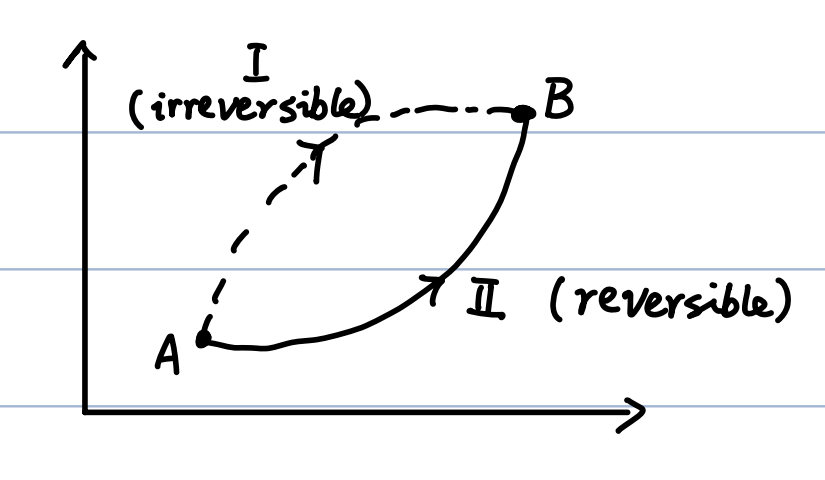
By analyzing a cycle consisting of an irreversible path (\(A \xrightarrow{I} B\)) and a reversible return path (\(B \xrightarrow{II} A\)), we apply the Clausius inequality:
Since the return path is reversible, \(\int_{B(II)}^A \frac{\delta Q}{T} = S_A - S_B\). Substituting this yields the general relation for any path from A to B:
-
Application to Isolated Systems: An isolated system exchanges no matter or energy (heat) with its surroundings, meaning \(\delta Q = 0\) (adiabatic). Therefore:
\[ \Delta S \geq 0 \] -
The Second Law: The entropy of an isolated system never decreases.
-
\(\Delta S = 0 \Leftrightarrow\) Reversible process
-
\(\Delta S > 0 \Leftrightarrow\) Irreversible process
-
Consequently, the entropy of the universe is always increasing: \(\Delta S_{\text{Universe}} > 0\).
-
Note: The entropy of a specific non-isolated part of a system can decrease, as long as the total entropy of the isolated whole increases.
-
-
Consistency with Clausius Statement: If heat \(Q\) spontaneously flowed from a cold reservoir (\(T_L\)) to a hot reservoir (\(T_H\)) without work, the entropy change would be \(\Delta S = \frac{Q}{T_H} - \frac{Q}{T_L}\). Since \(T_H > T_L\), this results in \(\Delta S < 0\), which violates the entropy statement.
3. Calculating Entropy Changes
Because entropy is a state function, \(\Delta S\) for an irreversible process can be calculated by imagining a reversible quasi-static path between the same initial and final equilibrium states.
-
1. Ideal Gas:
-
First Law: \(dU = \delta Q - P dV \implies T dS - P dV\)
-
Rearranging for \(dS\): \(dS = \frac{1}{T}(dU + P dV)\)
-
Using \(dU = n C_V dT\) and \(P/T = nR/V\): \(dS = n C_V \frac{dT}{T} + nR \frac{dV}{V}\)
-
Integrating yields: \(S = S_0 + n C_V \ln\frac{T}{T_0} + nR \ln\frac{V}{V_0}\)
-
-
2. Adiabatic Free Expansion (Irreversible):
-
\(\Delta Q = 0\) and \(W = 0\), so \(\Delta U = 0 \implies T_i = T_f\).
-
Using the ideal gas formula: \(\Delta S = nR \ln\frac{V_f}{V_i}\). Since \(V_f > V_i\), \(\Delta S > 0\).
-
-
3. Heating Water:
-
Imagine a quasi-static heating process: \(\delta Q = m c_v dT\)
-
\(dS = m c_v \frac{dT}{T} \implies S = m c_v \ln T + \text{constant}\)
-
-
4. Mixing Water (Irreversible):
-
Mix mass \(m_A\) at \(T_A\) with mass \(m_B\) at \(T_B\) (\(T_A < T_B\)).
-
The final equilibrium temperature \(T\) is found via energy conservation (\(\Delta Q_A + \Delta Q_B = 0\)): \(T = \frac{m_A T_A + m_B T_B}{m_A + m_B}\).
-
Total entropy change: \(\Delta S = \Delta S_A + \Delta S_B = m_A c_v \ln\frac{T}{T_A} + m_B c_v \ln\frac{T}{T_B}\)
-
Special Case (\(m_A = m_B = m\)):
\[ \Delta S = m c_v \ln\left[ \frac{(T_A + T_B)^2}{4 T_A T_B} \right] \]Because \((T_A + T_B)^2 > 4 T_A T_B\) (for \(T_A \neq T_B\)), \(\Delta S > 0\), proving the process is irreversible.
-
4. T-S Diagrams and the Carnot Cycle
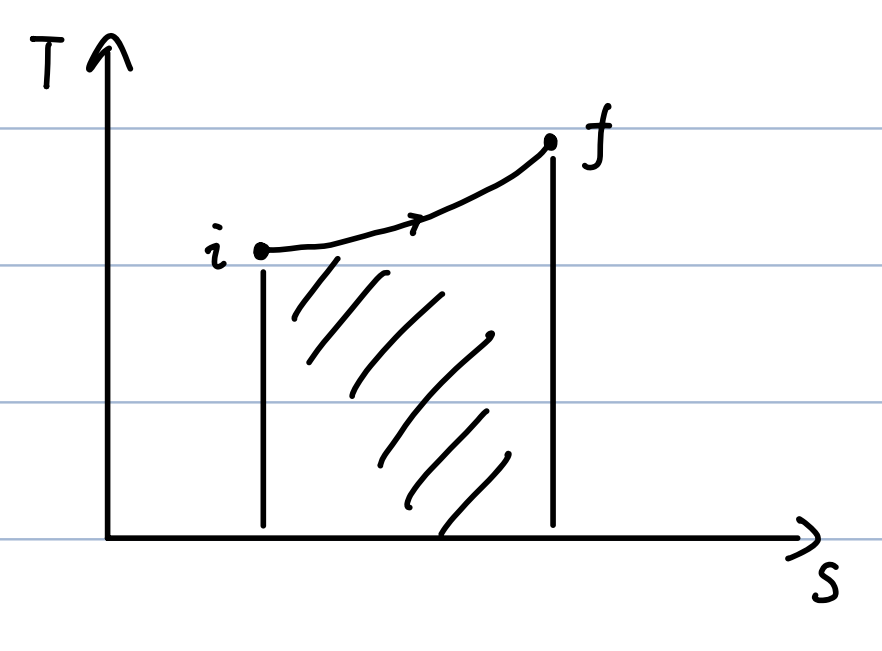
A Temperature-Entropy (T-S) diagram plots temperature \(T\) against entropy \(S\).
-
From \(dS = \frac{\delta Q}{T}\), we get \(\delta Q = T dS\).
-
Integrating gives the total heat transfer: \(Q = \int_i^f T dS\).
-
Key Concept: The area under the curve in a T-S diagram represents the heat transferred (\(Q\)).
The Carnot Cycle on a T-S Diagram:
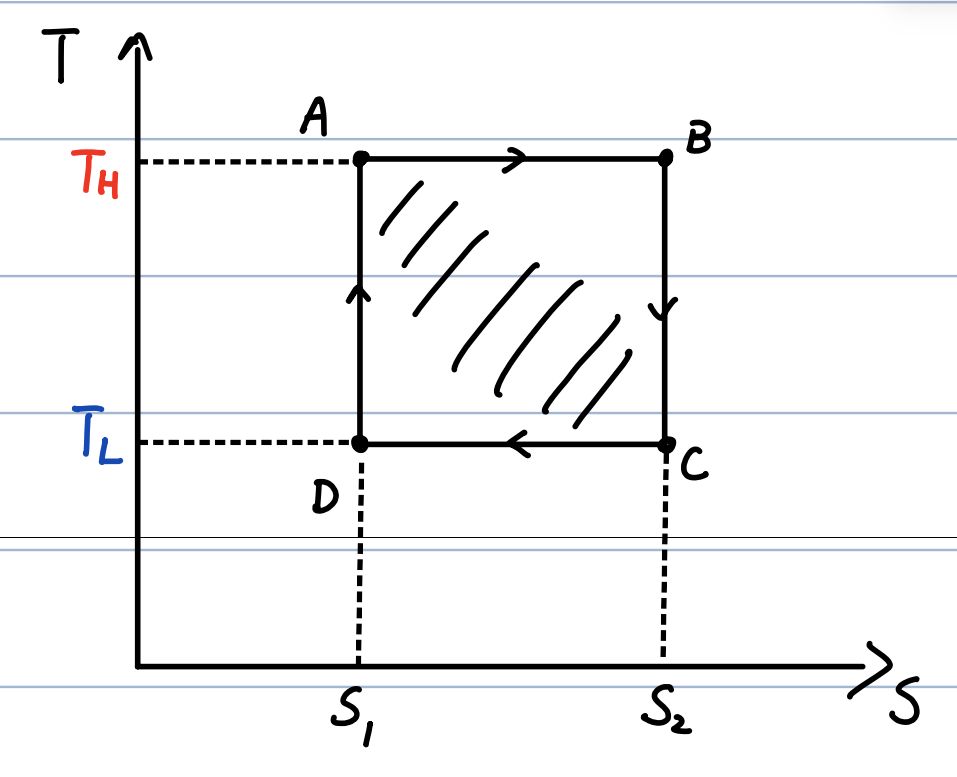
A Carnot cycle operates between \(T_H\) and \(T_L\). Because it consists of two isothermal processes (constant \(T\)) and two adiabatic processes (\(Q=0 \implies\) constant \(S\)), it forms a perfect rectangle on a T-S diagram bounded by \(T_H\), \(T_L\), \(S_1\), and \(S_2\).
-
Total work done equals net heat absorbed (the area of the rectangle): \(W = Q_{\text{net}} = \oint T dS = (T_H - T_L)(S_2 - S_1)\)
-
Heat absorbed from the hot reservoir: \(Q_H = T_H (S_2 - S_1)\)
-
Carnot Efficiency:
\[ \varepsilon_{\text{Carnot}} = \frac{W}{Q_H} = \frac{(T_H - T_L)(S_2 - S_1)}{T_H (S_2 - S_1)} = 1 - \frac{T_L}{T_H} \]