07_Gravity
Law of Gravity
1. Kepler's Laws
Kepler formulated three foundational laws describing planetary motion:
-
The Law of Orbits: All planets move in elliptical orbits, with the Sun at one focus.
- Geometry parameters: \(a\) (semimajor axis), \(b\) (semiminor axis), \(c\) (linear eccentricity).
-
The Law of Areas: A radial vector connecting the Sun and a planet sweeps out equal areas in equal time intervals.
-
\[\frac{dA}{dt} = C \quad (\text{constant})\]
-
-
The Law of Periods: The square of the orbital period is proportional to the cube of the semimajor axis.
-
\[T^2 \propto a^3\]
-
Deductions from Kepler's Laws:
-
Laws 1 & 2 imply the presence of a central force (which leads to the conservation of angular momentum).
-
Law 3 dictates the magnitude of this force.
-
Derivation (assuming a circular orbit where \(a = b = r\)):
Given \(T^2 \propto r^3\) and orbital velocity \(v = \frac{2\pi r}{T}\), we find \(v \propto \frac{1}{\sqrt{r}}\).
Centripetal acceleration is \(a = \frac{v^2}{r} \propto \frac{1}{r^2}\).
Therefore, force \(F = ma \propto \frac{m}{r^2}\).
-
2. Newton's Law of Universal Gravitation
Building upon these deductions, Newton proposed the universal law of gravitation:
- Gravitational Constant (\(G\)): \(G \approx 6.67 \times 10^{-11} \text{ N}\cdot\text{m}^2/\text{kg}^2\)
Gravity of Extended Bodies (The Earth)
The Principle of Superposition states that the net gravitational force is the vector sum of individual forces:
Treating the Earth as a finite-size sphere with uniform density \(\rho\) and radius \(R_E\):
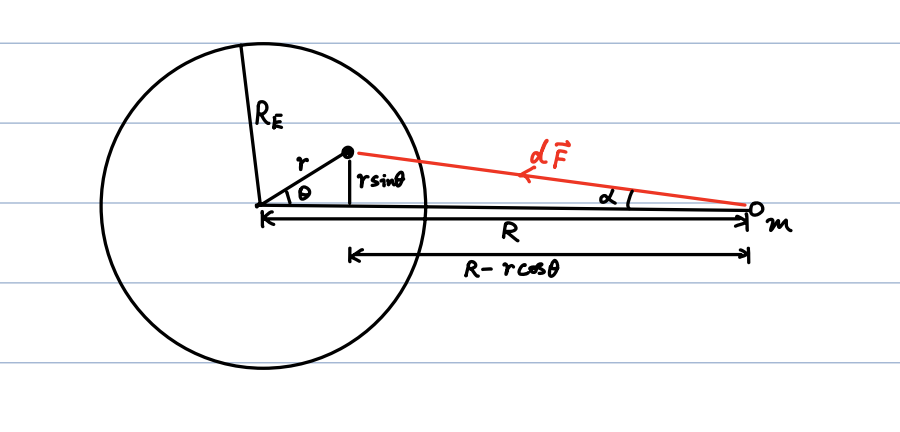
- schematic diagram from the hand-written notes of Mr. ztWang
Case 1: Outside the Earth (\(R > R_E\))
By integrating the force contributions \(dF\) from volume elements \(dV\) over the entire sphere:
(Where total mass \(M = \rho \cdot \frac{4}{3}\pi R_E^3\))
-
Conclusion: A spherically symmetric body affects external objects gravitationally as though all of its mass were concentrated at its central point.
-
Surface Gravity: At the surface, \(F = mg\), yielding \(g = \frac{GM}{R_E^2}\).
Case 2: Inside the Earth (\(R < R_E\))
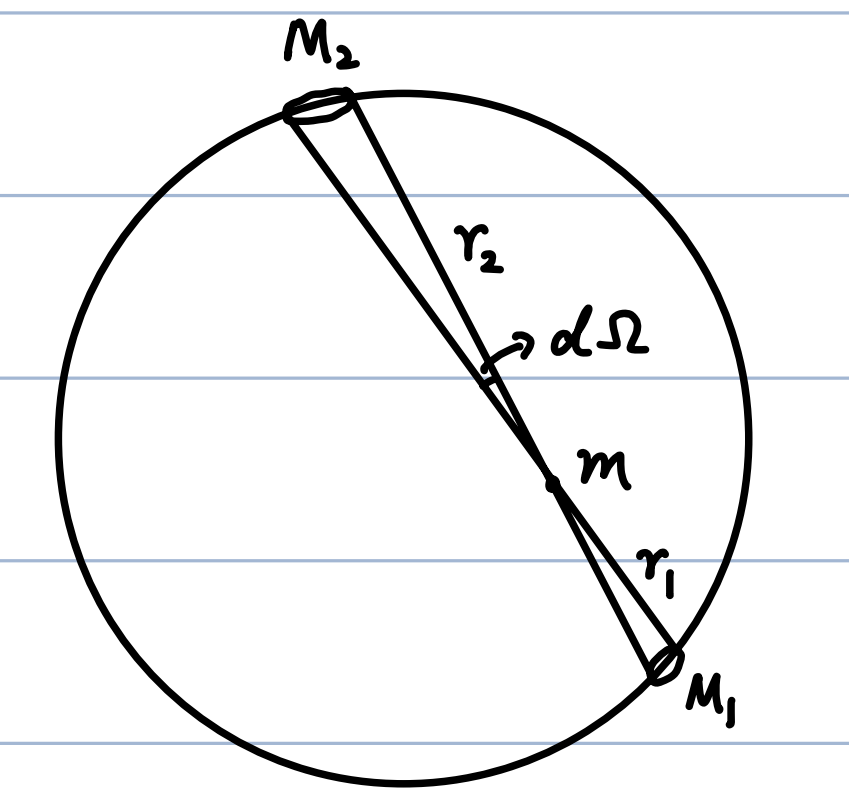
Applying the Shell Theorem using solid angles (\(d\Omega\)):
-
An empty spherical shell contributes zero net gravitational force to a point inside it. The forces from opposing sections cancel out (\(F_1 = F_2 = \lambda m d\Omega\)).
-
Therefore, for a mass \(m\) at radius \(R\) inside the Earth, only the inner sphere of radius \(R\) contributes to the force:
\[ M' = \rho \cdot \frac{4}{3}\pi R^3 = M \left(\frac{R}{R_E}\right)^3 \]\[ F = \frac{GM'm}{R^2} = \frac{GMm}{R_E^3} R \] -
Conclusion: Inside the Earth, gravity acts like a restoring spring force (\(F \propto R\)).
Empirical Verifications and Measurements
1. Prediction of "Universal" Gravitation
Relating Earth's surface gravity to the Moon's orbit:
Substituting and using \(v_M = \frac{2\pi r_M}{T}\) yields the theoretical relationship:
Verification using known values:
-
\(g \approx 9.8 \text{ m/s}^2\)
-
\(R_E \approx 6.4 \times 10^6 \text{ m}\)
-
\(T \approx 27.32 \text{ days} \approx 2.361 \times 10^6 \text{ s}\)
-
\(r_M \approx 3.84 \times 10^8 \text{ m}\)
Left-hand side: \(r_M^3 \approx 5.66 \times 10^{25} \text{ m}^3\)
Right-hand side: \(\approx 5.67 \times 10^{25} \text{ m}^3\) (The prediction holds).
2. Measurement of \(G\) and Earth's Density
-
Cavendish Experiment: Henry Cavendish used a torsion balance to measure the gravitational constant, obtaining \(G \approx 6.754 \times 10^{-11} \text{ m}^3/(\text{kg}\cdot\text{s}^2)\).
-
Calculating Earth's Density:
\[ M_E = \frac{g R_E^2}{G} \approx 6.02 \times 10^{24} \text{ kg} \]\[ V_E = \frac{4}{3}\pi R_E^3 \approx 1.10 \times 10^{21} \text{ m}^3 \]\[ \rho_E = \frac{M_E}{V_E} \approx 5.5 \times 10^3 \text{ kg/m}^3 \]Comparing this to surface materials (coal: 1.1-1.4, marble: 2.4-2.7, iron: 7.9) suggests a high-density core.
Gravitational Energy and Orbital Mechanics
Modification of Gravity Near Earth's Surface
For an altitude \(h\) where \(h \ll R_E\): (when \(x\) is sufficiently small,\((1 + x)^n \approx 1 + nx\))
Gravitational Potential Energy
By convention, setting \(C = 0\) at infinity:
(Check: \(-\frac{dU}{dr} = - \frac{GMm}{r^2} = F(r)\))
Energy of a Satellite
For a satellite in circular orbit at radius \(r\):
-
Centripetal force constraint: \(\frac{G M_E m}{r^2} = m \frac{v^2}{r} \Rightarrow v^2 = \frac{G M_E}{r}\)
-
Total Mechanical Energy (\(E = K + U\)):
\[ E = \frac{1}{2}mv^2 - \frac{GMm}{r} = - \frac{G M_E m}{2r} \]
Example: Geosynchronous Orbit
Given \(T = 1 \text{ day} = 86400 \text{ s}\).
Cosmic Velocities
-
First Cosmic Velocity (Circular Orbit Velocity):
$$\frac{1}{2}mv^2 - \frac{G M_E m}{R_E} = - \frac{G M_E m}{2R_E} \Rightarrow v = \sqrt{\frac{G M_E}{R_E}} \approx 7.9 \text{ km/s} $$
-
Second Cosmic Velocity (Escape Velocity of Earth):
$$\frac{1}{2}mv^2 - \frac{G M_E m}{R_E} = 0 \Rightarrow v = \sqrt{\frac{2G M_E}{R_E}} \approx 11.2 \text{ km/s} $$
-
Third Cosmic Velocity: Escape velocity of the Sun.
Rocket Propulsion
1. Momentum Conservation (Without Gravity)
Assume a rocket of mass \(M\) travels at velocity \(v\). It ejects a mass differential \(dm\) (where \(dm = -dM\)) at a relative exhaust velocity \(v_e\).
Applying conservation of momentum:
Integrating from initial to final states:
- Note: A larger mass ratio (\(\frac{M_i}{M_f}\)) yields a larger velocity change (\(\Delta v\)). This acts as the reverse process of a perfectly inelastic collision (mechanical energy increases).
2. Propulsion with Gravity
Factoring in the impulse from gravity (\(-Mg\Delta t\)):
Integrating yields:
3. Rocket Thrust
Thrust is the force exerted on the rocket by the ejected exhausted gas: