04_1st-law
1. The First Law of Thermodynamics
-
Quasi-static process: A process that occurs slowly enough that the system remains in thermal equilibrium at all times.
-
Work (\(W\)):
-
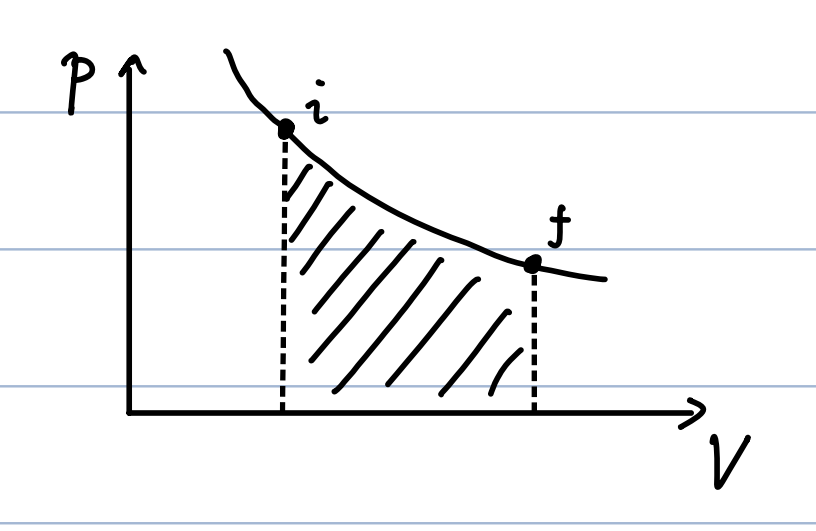
Defined as the integral of pressure over volume: \(dW = F ds = P A ds = P dV \implies W = \int P dV\)
-
Geometrically, work is the area under the curve on a \(P\)-\(V\) diagram.
-
Sign Convention:
-
Work done by the gas: \(dW = P dV\)
-
Work done to the gas: \(dW = -P dV\)
-
-
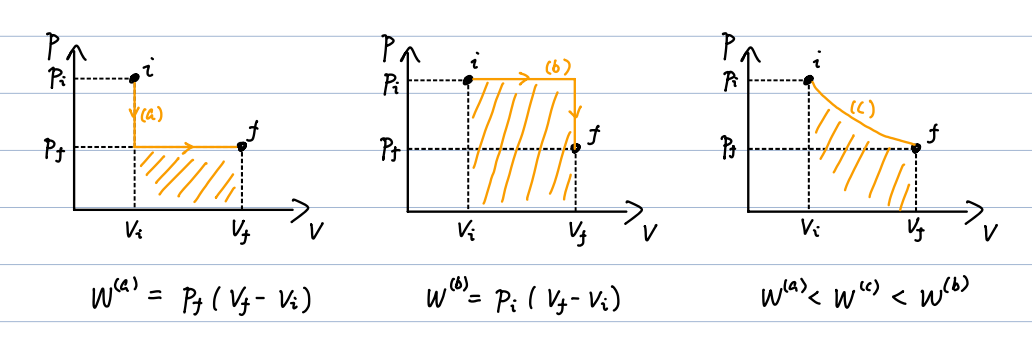
Path Dependence: The amount of work done depends on the path taken from the initial state (\(i\)) to the final state (\(f\)). For example, expanding at a constant high pressure yields more work than dropping the pressure first and then expanding (\(W^{(a)} < W^{(c)} < W^{(b)}\)).
-
-
The First Law of Thermodynamics:
- Formula: \(\Delta U = \Delta Q - W\)
(Where \(\Delta Q\) is heat absorbed, and \(W\) is work done by the system).
-
Differential form: \(dU = \delta Q - \delta W\)
(Note: The symbol \(\delta\) indicates an inexact, path-dependent differential).
2. Differentials and Thermodynamic Processes
Inexact / Imperfect Differentials
-
The integral of an inexact differential is path-dependent.
-
Example: \(\delta g = dx + \frac{x}{y} dy\) (inexact)
-
Evaluating from \(A(1,1)\) to \(B(2,2)\) via Path 1 (\(A \rightarrow C(2,1) \rightarrow B\)) yields: \(1 + 2\ln2\).
-
Evaluating via Path 2 (\(A \rightarrow D(1,2) \rightarrow B\)) yields: \(\ln2 + 1\).
-
-
Contrast (Exact): \(df = \frac{dx}{x} + \frac{dy}{y}\) is exact. Both paths yield \(2\ln2\).
Different Processes (Not necessarily quasi-static)
-
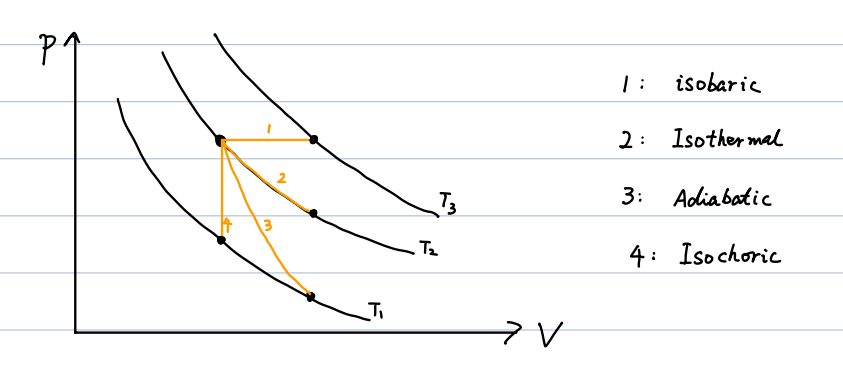
Isobaric: Pressure (\(P\)) is fixed.
-
Isochoric (Isovolumetric): Volume (\(V\)) is fixed.
-
Isothermal: Temperature (\(T\)) is fixed.
-
Adiabatic: \(Q = 0\) (No heat transfer).
3. Work in Specific Quasi-Static Processes
Quasi-Static Isothermal Expansion
Work done by the gas:
Quasi-Static Adiabatic Process
Governing equation: \(P V^\gamma = \text{constant}\) (where \(\gamma \equiv \frac{C_P}{C_V}\))
-
Proof:
-
First law for adiabatic: \(dU = 0 - P dV = -P dV\)
-
Using \(U = n C_V T \implies n C_V dT = -P dV\)
-
Ideal gas law differential: \(P dV + V dP = nR dT\)
-
Substitute (2) into (3): \(-\frac{P}{C_V} dV = \frac{P}{R} dV + \frac{V}{R} dP\)
-
Rearrange: \(P\left(\frac{1}{R} + \frac{1}{C_V}\right) dV + \frac{V}{R} dP = 0\)
-
Multiply by \(R\) and use \(C_P = C_V + R\): \(\frac{C_P}{C_V} \frac{dV}{V} + \frac{dP}{P} = 0\)
-
Integrate (\(\gamma = \frac{C_P}{C_V}\)): \(\gamma \ln V + \ln P = \text{constant} \implies P V^\gamma = \text{constant}\).
-
Adiabatic Free Expansion
-
\(\Delta Q = 0\) (Adiabatic) and \(W = 0\) (Free expansion into a vacuum).
-
It is not quasi-static (the system is out of equilibrium except for the initial and final states).
-
Since \(\Delta U = 0 \implies U_i = U_f\), the temperature remains constant (\(T_i = T_f\)).
4. Heat Engines and Thermal Efficiency
-
Definition: A cyclic device that extracts energy (heat) from the environment and does work (e.g., steam engine, gasoline engine).
-
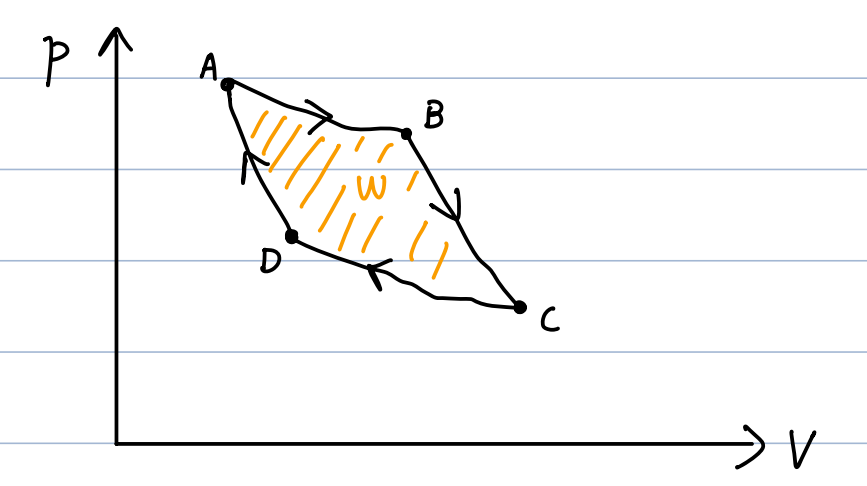
Cyclic Process:
-
The net change in internal energy over one cycle is zero (\(\Delta U = 0\)).
-
Work done per cycle: \(W = \oint P dV\)
-
Net heat absorbed: \(\Delta Q = W = \oint P dV\)
-
-
Thermal Efficiency (\(\varepsilon\)):
\[ \varepsilon \equiv \frac{W}{Q_H} \]Since \(W = Q_H - Q_L\) (\(Q_H\): heat from high-T reservoir, \(Q_L\): heat to low-T reservoir):
\[ \varepsilon = 1 - \frac{Q_L}{Q_H} \]
5. Engine Cycles
A. Otto Cycle (1876, Nicolaus Otto)
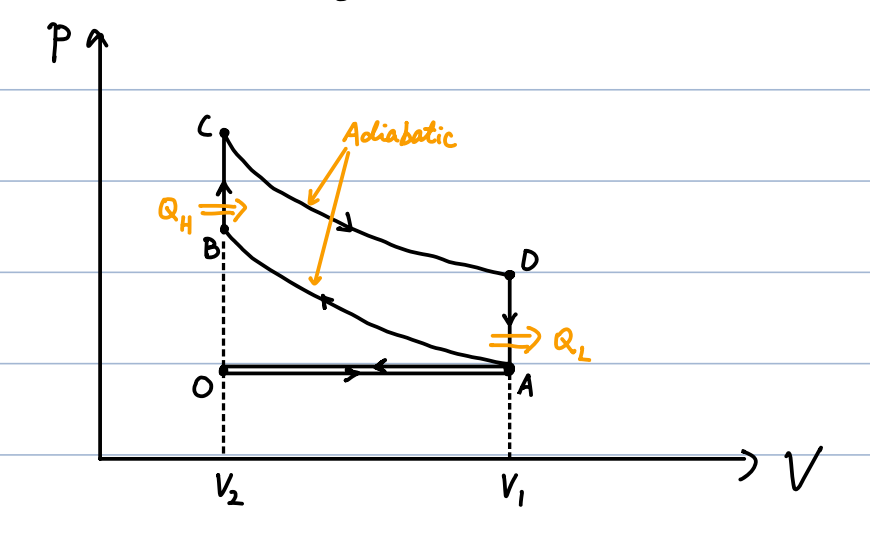
Commonly used in petrol engines.
-
Four Strokes:
-
\(O \rightarrow A\): Intake (often omitted in schematic drawings)
-
\(A \rightarrow B\): Adiabatic Compression
-
\(B \rightarrow C \rightarrow D\): Combustion/Ignition/Power (\(B \rightarrow C\) is isochoric heat absorption \(Q_H\); \(C \rightarrow D\) is adiabatic expansion)
-
\(D \rightarrow A (\rightarrow O)\): Exhaust (\(D \rightarrow A\) is isochoric heat rejection \(Q_L\))
-
-
Efficiency Derivation:
-
\(Q_L = n C_V (T_D - T_A)\) and \(Q_H = n C_V (T_C - T_B)\)
-
\(\varepsilon_{\text{Otto}} = 1 - \frac{T_D - T_A}{T_C - T_B}\)
-
Applying \(T V^{\gamma-1} = \text{constant}\) to the adiabatic steps (\(A \rightarrow B\) and \(C \rightarrow D\)):
\[ \left(\frac{V_2}{V_1}\right)^{\gamma-1} = \frac{T_A}{T_B} = \frac{T_D}{T_C} \] -
Final Otto Efficiency: \(\varepsilon_{\text{Otto}} = 1 - \left(\frac{V_2}{V_1}\right)^{\gamma-1}\)
-
B. Diesel Cycle
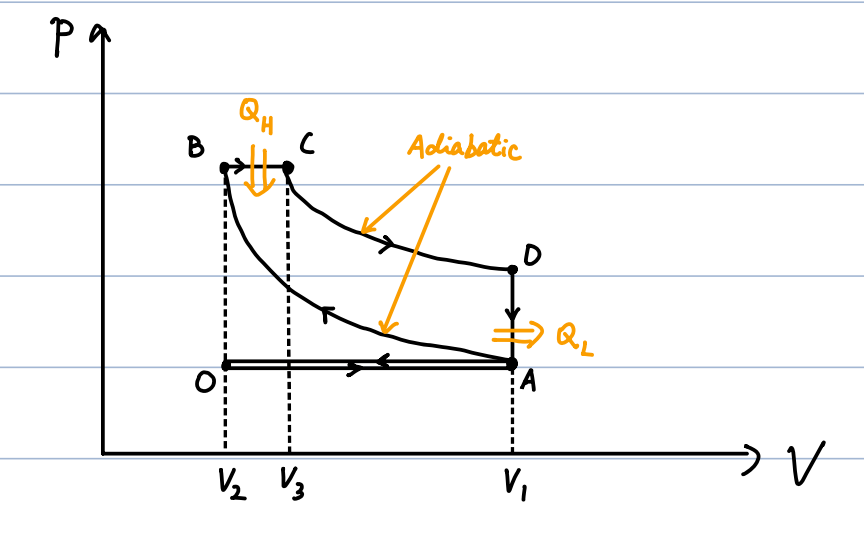
Commonly used in diesel engines.
-
Key Difference: Heat absorption (\(Q_H\)) occurs via an isobaric process (\(B \rightarrow C\)), while heat rejection (\(Q_L\)) remains isochoric (\(D \rightarrow A\)).
-
Efficiency Derivation:
-
\(T_B = \left(\frac{V_1}{V_2}\right)^{\gamma-1} T_A\) (from adiabatic \(A \rightarrow B\))
-
\(T_C = \frac{V_3}{V_2} T_B = \frac{V_3}{V_2} \left(\frac{V_1}{V_2}\right)^{\gamma-1} T_A\) (from isobaric \(B \rightarrow C\))
-
\(T_D = \left(\frac{V_3}{V_1}\right)^{\gamma-1} T_C = \left(\frac{V_3}{V_2}\right)^\gamma T_A\) (from adiabatic \(C \rightarrow D\))
-
\(Q_H = n C_P (T_C - T_B)\) and \(Q_L = n C_V (T_D - T_A)\)
-
Final Diesel Efficiency:
\[ \varepsilon_{\text{diesel}} = 1 - \frac{C_V (T_D - T_A)}{C_P (T_C - T_B)} = 1 - \frac{1}{\gamma} \frac{(V_3/V_2)^\gamma - 1}{(V_3/V_2) - 1} \left(\frac{V_2}{V_1}\right)^{\gamma-1} \]
-
C. Dual Cycle
Commonly used in ship engines.
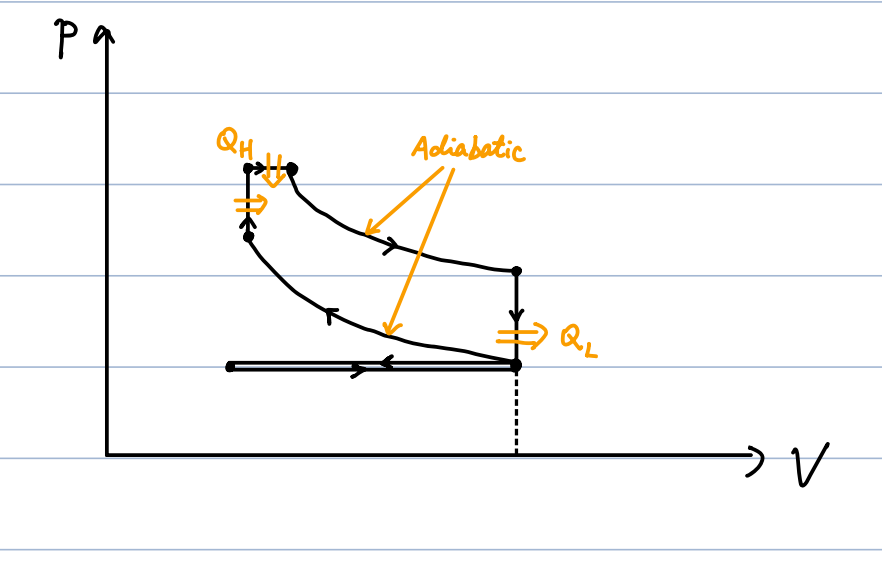
- Cycle structure: Heat addition is split into two sequential steps—an isochoric process followed by an isobaric process—bridged by adiabatic expansion and compression, concluding with an isochoric heat rejection.