05_Oscillatory Motion
1. Applications of Oscillatory Motion
Simple Pendulum
A point mass \(m\) attached to a massless string of length \(L\).
-
Torque equation: \(\tau = I\alpha \Rightarrow -mg\sin\theta \cdot L = mL^2 \frac{d^2\theta}{dt^2}\)
-
Equation of motion: \(\frac{d^2\theta}{dt^2} = -\frac{g}{L}\sin\theta\)
-
Small-angle approximation (\(\theta \ll 1 \Rightarrow \sin\theta \approx \theta\)):
\[ \frac{d^2\theta}{dt^2} = -\frac{g}{L}\theta \quad \text{(Simple Harmonic Oscillation)} \] -
Solution: \(\theta = \theta_{max}\cos(\omega t + \phi)\)
-
Angular frequency and Period:
\[ \omega = \sqrt{\frac{g}{L}}, \quad T = \frac{2\pi}{\omega} = 2\pi\sqrt{\frac{L}{g}} \]
Physical Pendulum
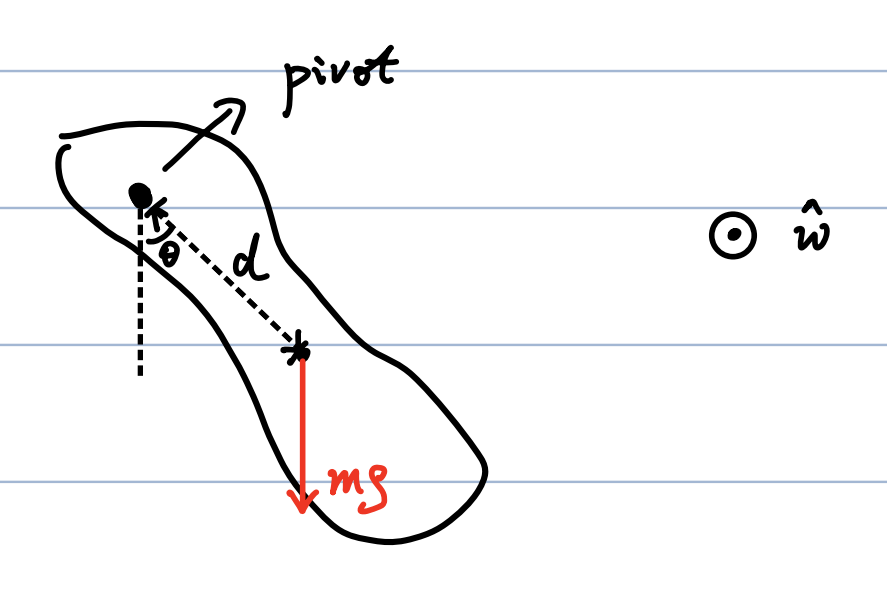
An extended rigid body oscillating about a pivot point at a distance \(d\) from its center of mass.
-
schematic diagram from the hand-written notes of Mr. ztWang
-
Torque equation: \(\tau = I\alpha \Rightarrow -mgd\sin\theta = I\frac{d^2\theta}{dt^2}\)
-
Equation of motion: \(\frac{d^2\theta}{dt^2} = -\frac{mgd}{I}\sin\theta\)
-
Solution (for small angles): \(\theta = \theta_{max}\cos(\omega t + \phi)\)
-
Angular frequency: \(\omega = \sqrt{\frac{mgd}{I}}\)
Torsion Pendulum
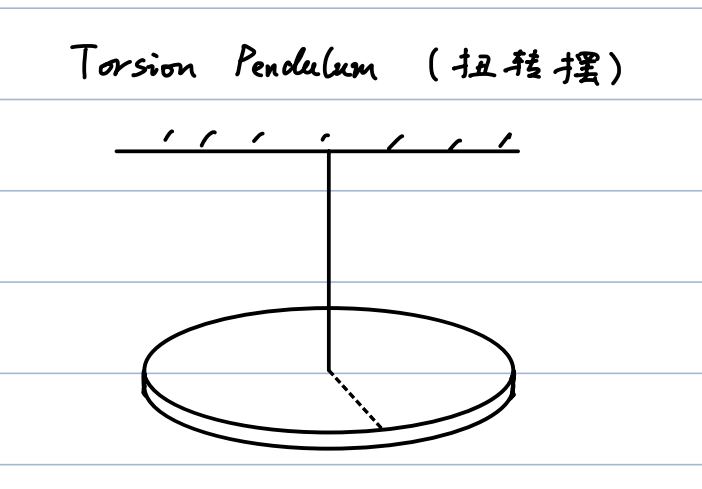
A disc suspended by a wire that twists.
-
Torque equation: \(\tau = -k\theta = I\ddot{\theta}\)
-
Solution: \(\theta = \theta_{max}\cos(\omega t + \phi)\)
-
Angular frequency: \(\omega = \sqrt{\frac{k}{I}}\)
2. Simple Harmonic Motion (SHM) and Uniform Circular Motion
-
Projecting uniform circular motion of a point \(P'\) onto the x-axis yields:
\[ x = A\cos(\omega t + \phi) \rightarrow \text{Simple Harmonic Motion} \] -
Projecting onto the y-axis yields:
\[ y = A\sin(\omega t + \phi) \] -
Notes:
-
Projection of uniform circular motion \(\iff\) Simple harmonic motion.
-
Uniform circular motion \(\iff\) Combination of two orthogonal simple harmonic motions.
-
3. Damped Oscillator
Motion reduced by an external force (e.g., fluid resistance).
-
Fluid resistance (Low speed): \(F_d = -bv\), where \(b\) is the damping constant.
-
Equation of motion:
\[ F_{net} = -kx - bv = ma \Rightarrow m\frac{d^2x}{dt^2} + b\frac{dx}{dt} + kx = 0 \]
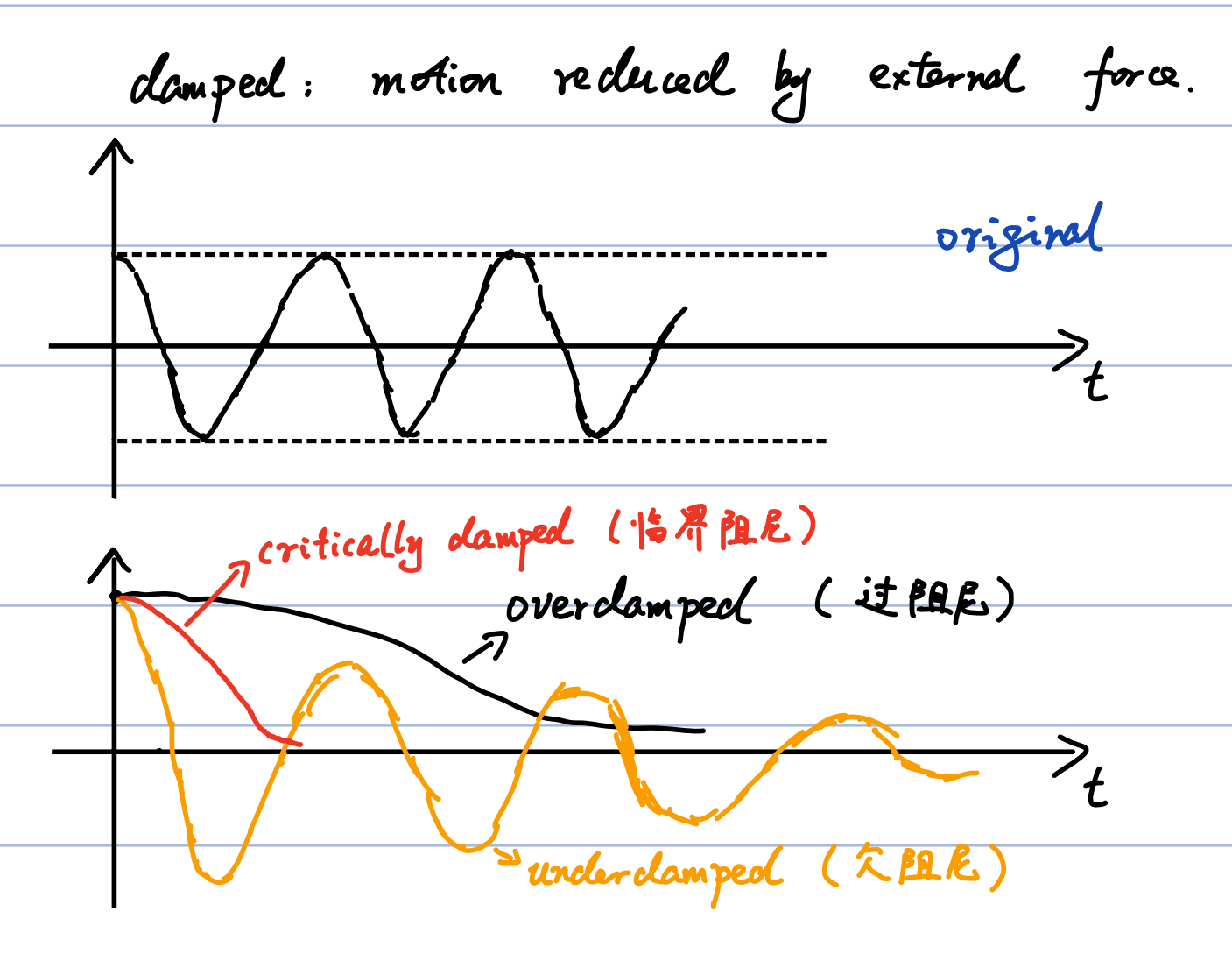
Damping Regimes
-
Underdamped (\(\frac{b}{2m} < \sqrt{\frac{k}{m}}\)):
- Solution: $x = Ae^{-\frac{b}{2m}t}\cos(\omega' t + \phi)$

- Damped frequency: $\omega' \equiv \sqrt{\frac{k}{m} - \left(\frac{b}{2m}\right)^2}$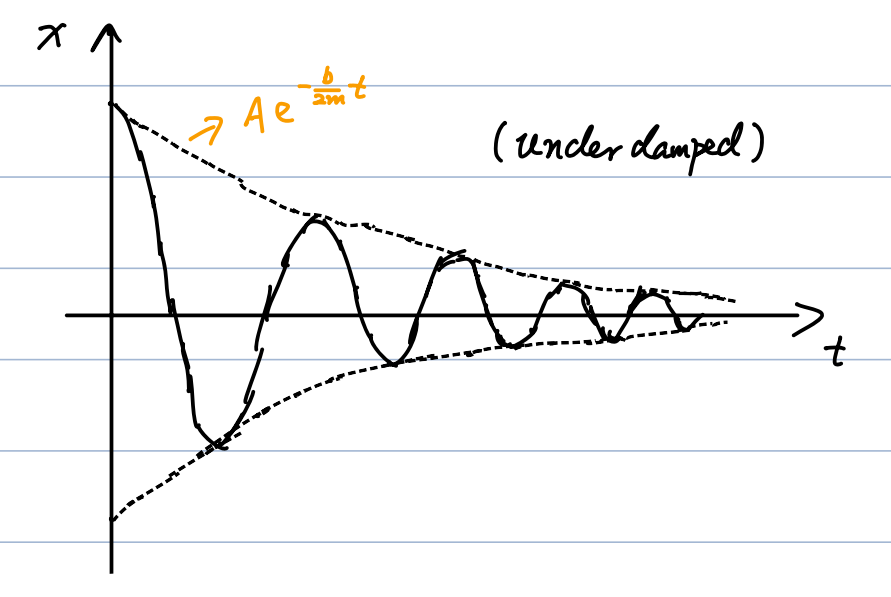
-
Overdamped (\(\frac{b}{2m} > \sqrt{\frac{k}{m}}\)):
- Solution: \(x = A_1\exp\left[\left(-\frac{b}{2m} + \sqrt{\left(\frac{b}{2m}\right)^2 - \omega_0^2}\right)t\right] + A_2\exp\left[\left(-\frac{b}{2m} - \sqrt{\left(\frac{b}{2m}\right)^2 - \omega_0^2}\right)t\right]\)
-
Critically Damped (\(\frac{b}{2m} = \sqrt{\frac{k}{m}}\)):
-
\(\omega' = 0\)
-
Solution: \(x = (A_1 + A_2 t)e^{-\frac{b}{2m}t}\)
-
Note: Critical damping is the fastest way to restore the system to its equilibrium position, making it ideal for devices such as ammeters.
-
4. Forced Oscillation (Driven Oscillation)
Oscillator driven by an external sinusoidal force.
-
Equation of motion:
\[ F = -kx - bv + F_{ext}\cos(\omega t) = ma \Rightarrow \ddot{x} + \frac{b}{m}\dot{x} + \frac{k}{m}x = \frac{F_{ext}}{m}\cos(\omega t) \] -
General Solution:
\[ x = \underbrace{A'e^{-\frac{b}{2m}t}\cos(\omega' t + \phi')}_{\text{Transient solution}} + \underbrace{A\cos(\omega t - \phi)}_{\text{Steady solution}} \] -
Steady State Parameters:
-
Amplitude: \(A = \frac{F_{ext}/m}{\sqrt{(\omega_0^2 - \omega^2)^2 + (b\omega/m)^2}}\)
-
Phase angle: \(\tan\phi = \frac{b\omega/m}{\omega_0^2 - \omega^2}\)
-
-
Notes:
-
For \(t \gg 1\), only the steady solution survives.
-
\(\omega\) is the frequency of the external force.
-
\(\phi\) is the relative phase with respect to \(F_{ext}\).
-
Driving Frequency Behaviors
-
Slow drive (\(\omega \ll \omega_0\)):
-
\(A \approx \frac{F_{ext}/m}{\omega_0^2} = \frac{F_{ext}}{k}\)
-
\(\phi \approx 0\) (Same phase as \(F_{ext}\))
-
-
Fast drive (\(\omega \gg \omega_0\)):
-
\(A \approx 0\)
-
\(\phi \approx \pi\) (Opposite phase as \(F_{ext}\))
-
-
Resonance (\(\omega = \omega_0\)):
-
\(\tan\phi = \infty \Rightarrow \phi = \frac{\pi}{2}\)
-
Amplitude \(A\) peaks. As \(b \to 0\), \(A(\omega = \omega_0) \to \infty\).
-
5. Lennard-Jones Potential (Example)
Potential energy for a pair of neutral atoms or molecules:
-
Equilibrium position (\(x_0\)):
\[ \left.\frac{dU}{dx}\right|_{x_0} = 0 \Rightarrow x_0 = 2^{1/6}\sigma \approx 1.122\sigma \] -
Effective spring constant (\(k\)):
\[ k = \left.\frac{d^2U}{dx^2}\right|_{x_0} = \frac{72\epsilon}{x_0^2} \] -
Angular frequency:
\[ \omega = \sqrt{\frac{k}{\mu}} = \sqrt{\frac{72\epsilon}{\mu x_0^2}} \quad \text{($\mu$: effective mass)} \]
6. Coupled Harmonic Oscillators
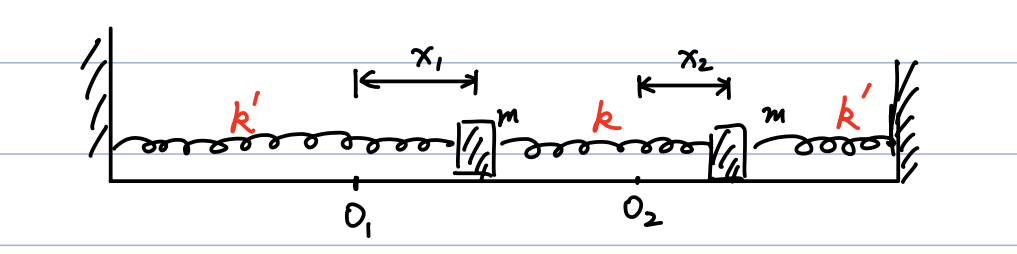
Two masses \(m\) connected by a central spring \(k\) and bound to walls by springs \(k'\).
-
Equations of motion:
\[ \begin{cases} m\ddot{x}_1 = -k'x_1 - k(x_1 - x_2) \\ m\ddot{x}_2 = -k'x_2 + k(x_1 - x_2) \end{cases} \] -
Normal modes: Frequency \(\omega\) is the same for all oscillators, with a fixed relative phase.
Trying \(x_1 = A_1\cos(\omega t + \phi_0)\) and \(x_2 = A_2\cos(\omega t + \phi_0)\) yields the eigenvalue problem:
\[ \begin{pmatrix} k+k' & -k \\ -k & k+k' \end{pmatrix} \begin{pmatrix} A_1 \\ A_2 \end{pmatrix} = m\omega^2 \begin{pmatrix} A_1 \\ A_2 \end{pmatrix} \]
Solutions for Normal Modes
-
Solution 1: Translational mode
-
Eigenvalue constraint checks out when \(A_1 = A_2\).
-
\(\omega = \sqrt{\frac{k'}{m}}\)
-
-
Solution 2: Vibrational mode
-
Eigenvalue constraint checks out when \(A_1 = -A_2\).
-
\(\omega = \sqrt{\frac{2k+k'}{m}}\)
-
Method 2 (Decoupling)
Adding and subtracting the differential equations:
-
\(m\frac{d^2}{dt^2}(x_1+x_2) = -k'(x_1+x_2) \Rightarrow x_1+x_2 = C_1\cos(\sqrt{\frac{k'}{m}}t + \phi_1)\)
-
\(m\frac{d^2}{dt^2}(x_1-x_2) = -(2k+k')(x_1-x_2) \Rightarrow x_1-x_2 = C_2\cos(\sqrt{\frac{2k+k'}{m}}t + \phi_2)\)
-
Overall motion: The linear combination of the normal modes. Setting \(C_2 = 0\) isolates the translational mode, while \(C_1 = 0\) isolates the vibrational mode.
7. Mode Counting for N-atom Molecules
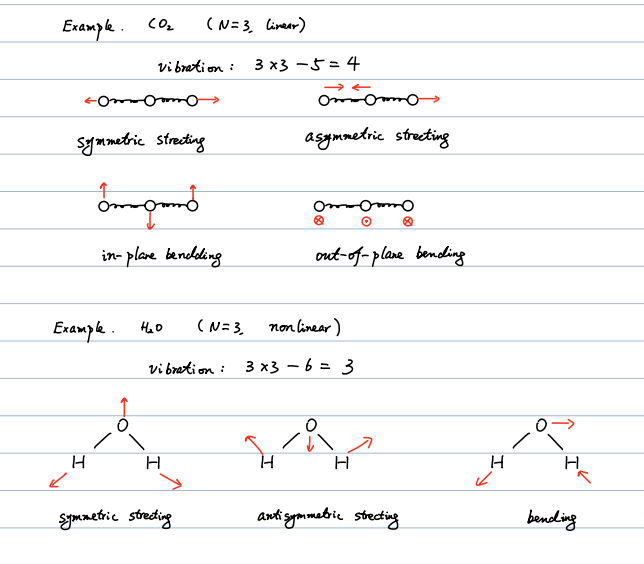
A molecule with \(N\) atoms has a total of \(3N\) degrees of freedom (modes).
-
Linear molecule:
-
Translation: 3 (\(x, y, z\))
-
Rotation: 2 (\(\theta, \phi\))
-
Vibration: \(3N - 5\)
-
-
Non-linear molecule:
-
Translation: 3
-
Rotation: 3 (Euler angles \(\alpha, \beta, \gamma\))
-
Vibration: \(3N - 6\)
-
Examples