11 · Faraday's Law and Electromagnetic Induction
Course index · Previous · Next
1. Magnetic flux and Faraday's law(法拉第电磁感应定律)
The experiments establish two ways to induce an emf: move a magnet relative to a loop, or change a nearby circuit's current while both circuits remain stationary. The common variable is the magnetic flux through the loop:
Choose the loop direction and surface normal together by the right-hand rule. Then
For \(N\) turns all linking the same flux, \(\mathcal E=-N\,d\Phi_B/dt\). More generally, differentiate the total flux linkage(磁通链) \(\Lambda=\sum_j\Phi_{B,j}\).
Flux can change through a change in \(B\), enclosed area, orientation, or the fraction of the circuit lying in the field. For a rigid flat loop in uniform \(\mathbf B\), \(\Phi_B=BA\cos\theta\), where \(\theta\) is between the field and the area normal.
2. Lenz's law and direction(楞次定律)
The induced current's magnetic response opposes the change in flux that produces it. It need not oppose the existing field.
| External flux | Induced magnetic response |
|---|---|
| Increasing in \(+\hat{\mathbf n}\) direction | Toward \(-\hat{\mathbf n}\) |
| Decreasing in \(+\hat{\mathbf n}\) direction | Toward \(+\hat{\mathbf n}\) |
Determine the external flux change first, infer the induced-field direction, then use the current-loop right-hand rule. Reversing the chosen normal changes both flux and signed emf, leaving the physical answer unchanged.
An approaching magnet induces a response resisting approach; moving it away reverses the current. The external work can become Joule heat. Otherwise induction would generate energy while reinforcing its own cause.
An induced emf can exist without a closed conducting path. A current additionally requires an electrical response path; for a resistive quasistatic loop with negligible self-inductance, \(i=\mathcal E/R\).
3. Motional emf and mechanical energy
For a conductor moving at bulk velocity \(\mathbf u\) through a magnetic field, carriers experience \(q\mathbf u\times\mathbf B\). A perpendicular rod of length \(\ell\) moving at speed \(u\) has emf magnitude
For an open rod, charge separation builds a balancing electric field; for a closed resistive circuit it can drive current.
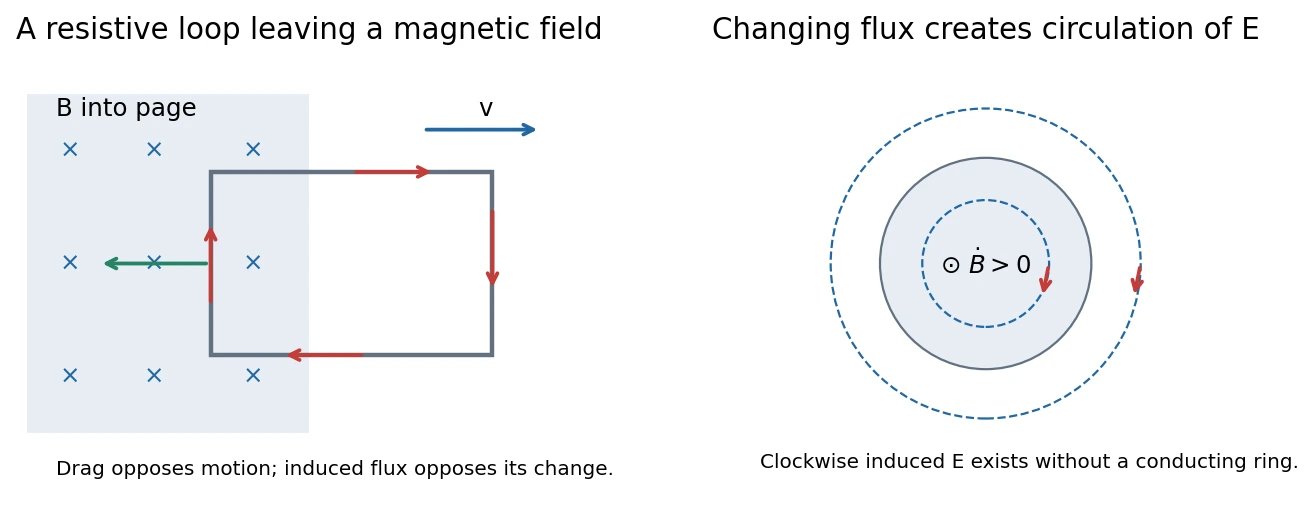
Consider a rectangular loop being pulled out of a uniform field. While its overlap length is \(x\), \(|\Phi_B|=B\ell x\). With constant speed \(u\),
The forces on the two transverse connecting sides cancel; the remaining force opposes extraction. The required mechanical power is
The external agent supplies the dissipated energy. If self-inductance is significant, part of the input initially changes magnetic energy and \(i=\mathcal E/R\) is insufficient.
Eddy currents(涡流) extend the same mechanism to bulk conductors: induction can produce magnetic damping or heating. Applications discussed in class include suppressing unwanted vibration and induction heating. Their effectiveness depends on the actual field and conductor geometry.
4. Induced electric field: no conductor required
Removing the wire does not remove the electric field produced by changing magnetic flux. For a fixed closed contour,
Stokes's theorem gives the differential form. The time derivative is partial because the field may vary with position as well as time.
Circular-field example
In a quasistatic model, an axial field \(B(t)\hat{\mathbf z}\) fills a cylindrical region of radius \(a\). Rotational symmetry makes the induced field azimuthal. A circle of radius \(r\) gives
The outside field is nonzero although the local prescribed \(B\) is zero there: the loop still encloses changing flux. The sign is clockwise for increasing \(+z\) flux. The formula is continuous at \(a\) and does not require an actual conducting ring.
5. Moving versus fixed contours
For a material loop moving at local velocity \(\mathbf u\), the general circuit emf is
The first term includes induced electric field; the second describes motional force. For a fixed loop, \(\mathbf u=0\). For a moving loop in a time-independent magnetic field, the changing flux can come entirely from the motion. Thus one must not replace the total flux derivative for a moving circuit by an integral of only \(\partial\mathbf B/\partial t\).
中文提示:“磁场随时间变”与“回路在磁场中移动”都能改变磁通;前者对应感生电场,后者还必须计入 \(\mathbf u\times\mathbf B\)。
6. What changes about electric potential?
Electrostatic fields obey \(\oint\mathbf E\cdot d\boldsymbol\ell=0\) and can be written \(-\nabla V\). Induced fields can have nonzero circulation, so a single scalar potential cannot represent the entire electric field or define every two-point voltage independently of path.
This does not make all scalar potentials meaningless. In the more general description,
The vector-potential term supplies the nonconservative part. In practical lumped circuits, terminal voltages remain useful when the measurement paths and regions of changing flux are treated consistently, as in class 12.
7. Electric and magnetic fields in different frames
The latter part of class 11 explains why “electric” and “magnetic” are frame-dependent parts of one electromagnetic field. Charge is invariant, but charge density, current density, and field components can change under a boost.
Let \(S'\) move with velocity \(\mathbf u\) relative to \(S\), and resolve components parallel/perpendicular to \(\mathbf u\). In vacuum,
At \(u\ll c\), this reduces to \(\mathbf E'\simeq\mathbf E+\mathbf u\times\mathbf B\) and \(\mathbf B'\simeq\mathbf B-\mathbf u\times\mathbf E/c^2\).
For stationary oppositely charged sheets, a parallel boost changes transverse charge spacing and hence the surface density by \(\gamma\). It gives \(E'_\perp=\gamma E_\perp\) and a magnetic field from the now-moving sheets. A field parallel to the boost remains unchanged. For a purely magnetic laboratory field, a moving observer instead sees \(\mathbf E'_\perp=\gamma\mathbf u\times\mathbf B\).
The same induction experiment can therefore have different electric/magnetic force decompositions in different frames. One must transform fields, velocities, geometry, and time consistently; emf is not generally a frame-invariant scalar. The six field components transform together rather than forming an ordinary four-vector.
Related homework(知识点应用)
- Ch. 11, Ex. 1 · Loop moving away from a wire.
- Ch. 11, Ex. 3 · Sinusoidal pickup-loop emf.
- Ch. 11, Ex. 4 · Induced field and constrained particle.
- Ch. 11, Ex. 7 · Faraday disk and moving flux path.
- Ch. 14, Ex. 4 · Induction torque on charged shells.
Sources and checks
Lecture 11 pp. 5–20: flux induction and energy transfer; pp. 21–26: induced field and potential limitation; pp. 29–38 and the classroom's latter half: inertial frames and field transformations. Check whether the contour moves, distinguish emf from current, and oppose the flux change rather than automatically opposing the field.