13 · LC Oscillations, Damped RLC Circuits, and AC Response
Course index · Previous · Next
1. Ideal LC oscillations
Choose signed capacitor charge \(q\) and current \(i=dq/dt\). The ideal circuit's energy is
Energy conservation, or the loop equation directly, gives
The loop equation remains valid at instants when \(i=0\); an energy derivation should not divide by zero there. The general solution is
Initial charge and initial current determine both constants:
Current and charge are a quarter cycle apart. When charge is maximal, current is zero; when charge is zero, current magnitude is maximal. The energy exchange is
| Mechanical oscillator | LC circuit |
|---|---|
| Displacement \(x\) | Charge \(q\) |
| Velocity \(\dot x\) | Current \(i\) |
| Mass \(m\) | Inductance \(L\) |
| Spring constant \(k\) | Inverse capacitance \(1/C\) |
| \(m\ddot x+kx=0\) | \(L\ddot q+q/C=0\) |
The scale \(\sqrt{LC}\) is \(1/\omega_0\), not the full oscillation period.
2. Free damped RLC response(阻尼振荡)
A series resistor removes energy at rate \(i^2R\):
Define \(\beta=R/(2L)\) and try \(q\propto e^{st}\). The characteristic roots are
| Regime | Condition | Charge response |
|---|---|---|
| Underdamped(欠阻尼) | \(\beta<\omega_0\) | \(q=Ae^{-\beta t}\cos(\omega_dt+\alpha)\), \(\omega_d=\sqrt{\omega_0^2-\beta^2}\) |
| Critical(临界阻尼) | \(\beta=\omega_0\) | \(q=(A+Bt)e^{-\beta t}\) |
| Overdamped(过阻尼) | \(\beta>\omega_0\) | \(q=Ae^{s_+t}+Be^{s_-t}\); both roots real and negative |
The critical resistance is \(R_c=2\sqrt{L/C}\). Critical damping gives the boundary between oscillatory and nonoscillatory relaxation and the fastest nonoscillatory settling in the standard comparison with the same initial displacement and zero velocity.
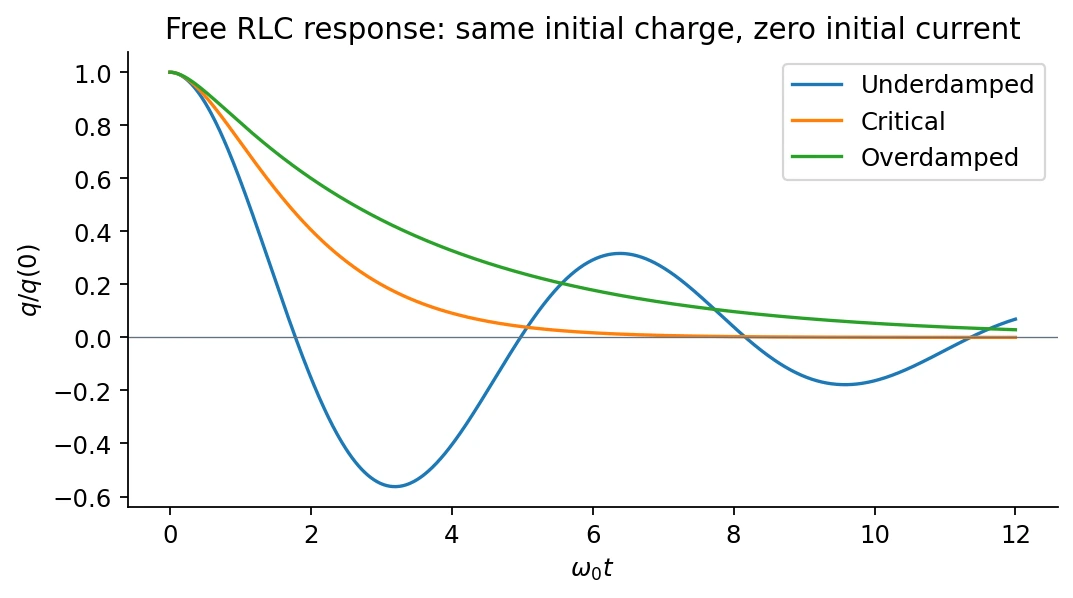
The underdamped amplitude decays on time \(1/\beta=2L/R\), different from the RL time constant \(L/R\). In weak damping, the cycle-averaged energy envelope falls approximately as \(e^{-2\beta t}\); the exact instantaneous statement is \(\dot U=-Ri^2\).
The slides also use complex frequency: with \(q=\operatorname{Re}(\widetilde q e^{j\widetilde\omega t})\) and \(j^2=-1\), decay requires \(\widetilde\omega=\omega_d+j\beta\). This sign depends on the chosen exponential convention.
3. Driven oscillations and phasors(相量)
A rotating \(N\)-turn coil in a uniform field has \(\Lambda=NBA\cos\Omega t\), hence generator emf \(\mathcal E=NBA\Omega\sin\Omega t\). Choosing a shifted time origin gives the cosine drive below; its frequency is imposed by the generator.
For a source \(\mathcal E(t)=\mathcal E_m\cos\Omega t\),
The full solution is a decaying free transient plus a forced solution. For \(R>0\), the long-time response oscillates at the drive frequency \(\Omega\), not at the free damped frequency \(\omega_d\).
Represent sinusoidal signals by
Differentiation becomes multiplication by \(j\Omega\). The complex impedance combines magnitude and phase:
| Element | Impedance | Current relative to its voltage |
|---|---|---|
| Resistor | \(R\) | In phase |
| Inductor | \(j\Omega L\) | Lags by \(\pi/2\) |
| Capacitor | \(1/(j\Omega C)=-j/(\Omega C)\) | Leads by \(\pi/2\) |
Series impedances add; parallel admittances add:
Add the complex values, not their magnitudes. These relations assume lumped elements and negligible unmodeled mutual coupling.
4. Series RLC impedance and phase
Let \(\phi=\arg\widetilde Z\), so \(\tan\phi=(\Omega L-1/(\Omega C))/R\) for \(R>0\). With the source phase set to zero,
- \(\Omega<\omega_0\): capacitive response; \(\phi<0\), current leads.
- \(\Omega>\omega_0\): inductive response; \(\phi>0\), current lags.
- \(\Omega=\omega_0\): reactive contributions cancel; voltage and current are in phase.
中文提示:本页把 \(\phi\) 定义为“电压相位减电流相位”,所以电流写成 \(\cos(\Omega t-\phi)\)。若改写为加号,那个相位变量就应当换成 \(-\phi\),不能混用两套定义。
5. Resonance and selectivity(共振与选频)
For a fixed-amplitude voltage drive and constant \(R\),
This is current resonance in the series circuit. Other observables, such as capacitor-voltage amplitude, need not peak at exactly the same frequency when damping is appreciable. Ideal \(R=0\) at resonance has no finite steady-state current amplitude; the resonant response grows rather than being described by division by zero.
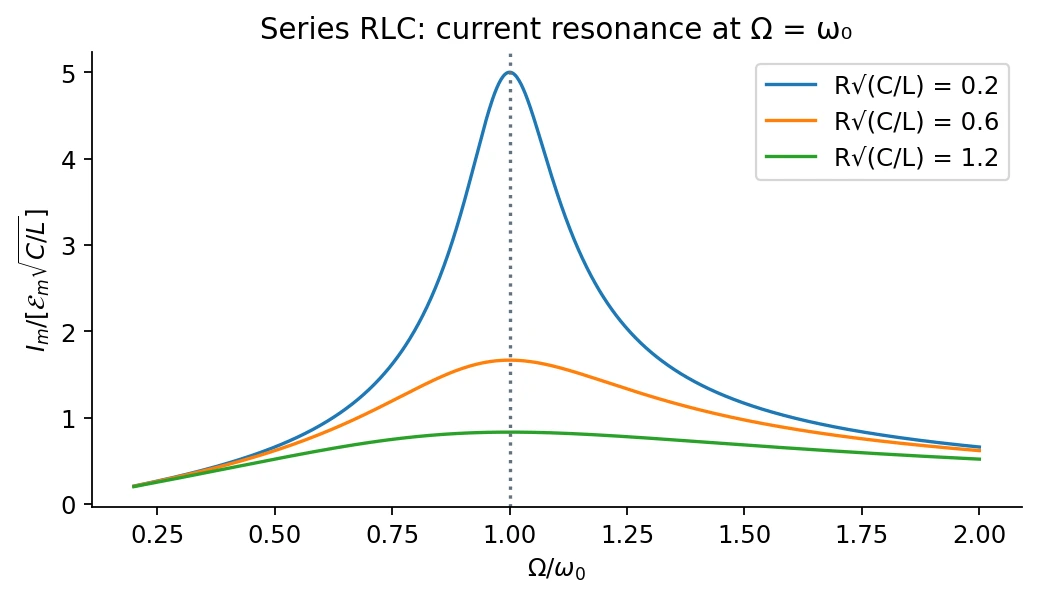
The start of class 14 adds a resonance-width interpretation. Define the quality factor and half-power width by
At the two half-power frequencies, \(I_m=I_{m,\max}/\sqrt2\), not \(I_{m,\max}/2\). Small resistance gives high \(\mathcal Q\) and a narrow peak, useful for selecting a frequency. The formula uses angular-frequency width; frequency width in hertz is \(\Delta f=\Delta\Omega/(2\pi)\).
Power accounting
For sinusoidal steady state,
Ideal inductors and capacitors exchange energy with the circuit but absorb zero net energy over a full cycle. This energy check also explains the half-power width. Mechanical resonance, frequency selection, and resonant electromagnetic absorption are the classroom's qualitative applications; detailed MRI or quantum-transition theory is not developed here.
Related homework(知识点应用)
- Ch. 13, Ex. 2 · Series–parallel AC network.
- Ch. 13, Ex. 4 · Coupled RLC normal modes.
- Ch. 13, Ex. 5 · LC switching and peak voltage.
Sources and checks
Lecture 13 pp. 3–14: LC dynamics and analogy; pp. 15–20: complex form and damping; pp. 21–28: AC impedance and resonance. Class 14's first approximately ten minutes supplies quality factor/selectivity. Keep \(\omega_0\), \(\omega_d\), and \(\Omega\) distinct; check phase conventions and distinguish amplitude decay, energy decay, and half-power width.