Homework 6 · Inductance, LC Oscillations, and AC Networks
All assignments · Previous · Next.
Ch. 12, Ex. 5 · Reversing a solenoid current
Problem. A long air-core solenoid has length \(\ell\), area \(S\), \(n\) turns per unit length, axis \(z\), and negligible resistance. Positive current enters terminal \(A\), leaves \(B\), and circulates counterclockwise seen from \(+z\). A current source imposes \(i(t)=I_0(1-2t/T)\), \(0\leq t\leq T\), with \(I_0,T>0\). (a) Find its self-induced emf (positive along the positive winding sense), \(V_A-V_B\), and which terminal is higher, including when \(i\) crosses zero. (b) Find stored energies at \(0,T/2,T\) and source work in each half-interval.
Method: Self-inductance, terminal voltage, and magnetic energy.
Solution. (a) The flux linkage is \(\Lambda=(n\ell)(\mu_0ni)S\), hence
Terminal \(B\) stays at the higher potential throughout the ramp. Its polarity does not reverse when \(i=0\) at \(T/2\): it depends on \(\dot i\), not \(i\).
(b) The energy and power delivered to the solenoid are
Thus
The source first absorbs the old field energy and then supplies the reversed field's energy; its net work is zero. 电流反向不等于电压反向。
Ch. 12, Ex. 7 · Coaxial cable: energy and flux linkage
Problem. A long coaxial cable has a solid inner conductor of radius \(a\) carrying uniform current \(I>0\) along \(+z\), and a thin cylindrical shell at radius \(b>a\) carrying \(-I\). Both are nonmagnetic, so \(u_B=B^2/(2\mu_0)\) holds inside the metal too. Ignore ends and consider length \(\ell\). (a) Find \(\mathbf B\) in all three regions and the magnetic energies inside the inner conductor and between conductors. (b) Find the self-inductance from energy. (c) Compute the naive flux through an axial rectangle extending from \(r=0\) to \(b\), divide by \(I\), and explain why that is not the inductance.
Method: Ampère's law, energy density, and flux linkage.
Solution. (a) Circular symmetry gives \(2\pi rB_\phi=\mu_0I_{\rm enc}\):
Integrate over cylindrical volume elements \(dV=2\pi r\ell\,dr\):
(b) From \(U_{\rm inner}+U_{\rm gap}=LI^2/2\),
The first term is the internal inductance for the stated uniform inner current; it would change if current were confined to the surface.
(c) The unweighted rectangle gives
Its internal term is twice too large. The distributed inner current is not a single filament on the axis: flux at radius \(r<a\) links only the fraction \(I_{\rm enc}(r)/I=r^2/a^2\) of its current paths. The correct internal linkage is
电感取决于磁通链,而不是随意选一个矩形面的磁通。
Ch. 12, Ex. 9 · Mutual inductance and source-work bookkeeping
Problem. Two fixed long coaxial vacuum solenoids have common length \(\ell\), radii \(a<b\), and turn densities \(n_1,n_2\). Ignore ends and winding resistance. Positive currents produce fields along \(+z\); ideal sources can vary either current slowly while holding the other fixed. (a) Find \(L_1,L_2,M_{12},M_{21}\). (b) Bring the currents from zero to \(I_1,I_2>0\) in either order and find each source's work, including the source holding a fixed current. (c) Independently integrate field energy in \(r<a\) and \(a<r<b\).
Method: Mutual flux linkage and magnetic energy.
Solution. (a) Only the inner cross-section links both fields:
(b) The source voltages and work increments are
| Charging order and stage | Source 1 work | Source 2 work |
|---|---|---|
| First \(i_1:0\to I_1\), hold \(i_2=0\) | \(L_1I_1^2/2\) | \(0\) |
| Then \(i_2:0\to I_2\), hold \(i_1=I_1\) | \(MI_1I_2\) | \(L_2I_2^2/2\) |
| Alternatively first \(i_2:0\to I_2\), hold \(i_1=0\) | \(0\) | \(L_2I_2^2/2\) |
| Then \(i_1:0\to I_1\), hold \(i_2=I_2\) | \(L_1I_1^2/2\) | \(MI_1I_2\) |
Both routes give
A nonzero held current still requires source work against the other coil's induced emf. “电流不变”不等于“电源不做功”。
(c) The final field is \(\mu_0(n_1I_1+n_2I_2)\hat{\mathbf z}\) inside \(a\), \(\mu_0n_2I_2\hat{\mathbf z}\) between \(a,b\), and zero outside. Therefore
The cross term occurs once as \(MI_1I_2\), consistent with the work table.
Ch. 13, Ex. 2 · Series–parallel AC network
Problem. In Fig. 13.2 a sinusoidal source has peak emf \(\mathcal E_m=150\ \mathrm V\) and frequency \(60\ \mathrm{Hz}\). A \(3\ \mu\mathrm F\) capacitor and \(0.2\ \mathrm H\) inductor are in series with a parallel pair consisting of a \(1\ \mathrm H\) inductor and \(100\ \Omega\) resistor. Find the steady-state amplitude of current through the resistor.
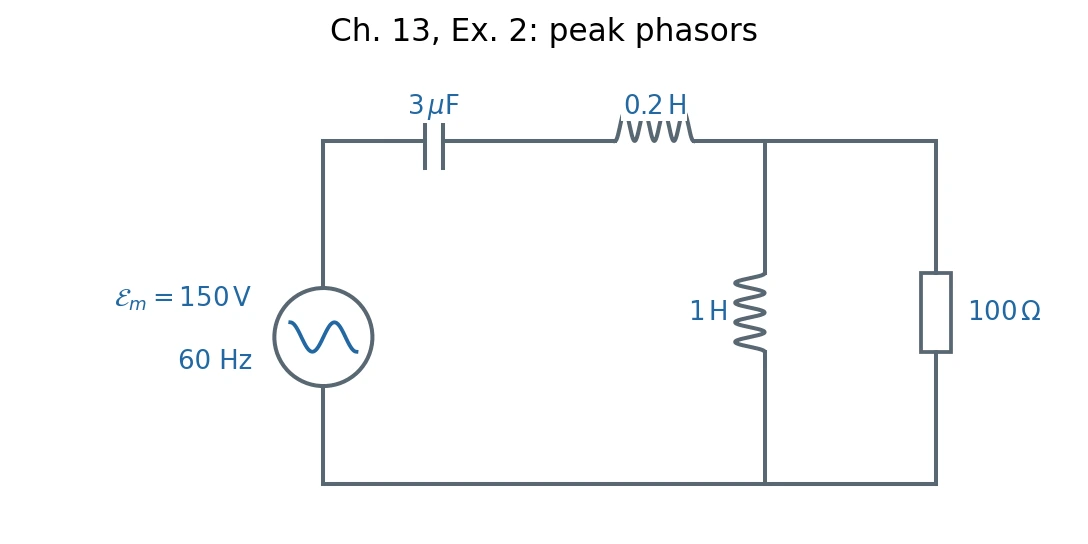
Redrawn from chap13.pdf, Fig. 13.2, PDF p. 8 (printed p. 122); figure record.
Method: Phasors and complex impedance, with series/parallel combination.
Solution. Use peak phasors with \(e^{j\omega t}\) and \(\omega=120\pi\ \mathrm{rad/s}\). The series and parallel impedances are
The parallel pair's voltage is \(\widetilde V_p=150Z_p/(Z_s+Z_p)\), so the resistor current is
The source's \(150\ \mathrm V\) label is \(\mathcal E_m\), not RMS, so no \(\sqrt2\) conversion is needed. 电阻电流是并联支路电压除以 \(100\ \Omega\),不是整个电路的总电流。
Ch. 13, Ex. 4 · Two coupled RLC oscillators
Problem. Two identical RLC circuits have inductance \(L\), capacitance \(C\), resistance \(R\), and mutual inductance \(M\), with \(|M|<L\). Choose charge/current senses making \(M>0\). (a) Write the coupled charge equations for \(q_1,q_2\). (b) Use \(q_\pm=q_1\pm q_2\) to decouple them. (c) For \(R=0\), find both normal frequencies and explain why the symmetric mode is slower.
Method: Mutual-induced voltage and RLC equation.
Solution. (a) The loop equations, including the other circuit's induced voltage, are
(b) Add and subtract to obtain
These are independent damped oscillators with effective inductances \(L\pm M>0\). Recover the original charges using \(q_1=(q_++q_-)/2\), \(q_2=(q_+-q_-)/2\).
(c) When \(R=0\),
For \(M>0\), \(\omega_+<\omega_-\). In the symmetric mode \(q_1=q_2\) the linked fields reinforce, increasing effective inductance and slowing the oscillation. They oppose in the antisymmetric mode.
Ch. 13, Ex. 5 · Disconnecting a battery from an LC pair
Problem. A battery of emf \(\mathcal E>0\), resistor \(r>0\), and switch form a series branch between \(A,B\), with the battery's positive terminal toward \(A\). An ideal inductor \(L\) and capacitor \(C\) are each connected across \(A,B\). The switch has been closed for a long time and opens at \(t=0\), leaving an isolated LC loop. Let \(i_L\) be positive from \(A\) to \(B\), and \(q\) be the charge on the capacitor plate at \(A\). (a) Find \(i_L,q,V_A-V_B\) just before opening. (b) Find their subsequent evolution and express \(q=Q\cos(\omega_0t+\phi)\), \(Q>0\). (c) Find the largest \(|V_A-V_B|\), its first occurrence, and which terminal is higher. Evaluate this voltage and its ratio to \(\mathcal E\) for \(\mathcal E=12\ \mathrm V\), \(r=6.0\ \Omega\), \(L=0.20\ \mathrm H\), \(C=0.50\ \mu\mathrm F\); check energy conservation.
Method: LC initial conditions and energy exchange.
Solution. (a) In DC steady state the ideal inductor shorts the pair:
Inductor current and capacitor voltage are continuous at opening, so these give the \(0^+\) values as well.
(b) At node \(A\), \(\dot q=-i_L\); with the specified inductor current, \(V_A-V_B=L\dot i_L=q/C\). Therefore \(\ddot q+q/(LC)=0\), with \(q(0)=0\) and \(\dot q(0)=-I_0\). Thus
The requested amplitude/phase form has \(\boxed{Q=I_0\sqrt{LC},\ \phi=\pi/2}\) modulo \(2\pi\). 注意此处 \(i_L=-\dot q\),由节点定义决定符号。
(c)
At that first maximum, \(V_A-V_B=-V_{\max}\), so \(B\) is higher. Numerically,
The energy check is \(\tfrac12LI_0^2=0.400\ \mathrm J=\tfrac12CV_{\max}^2\). The large voltage comes from the previously stored magnetic energy transferred to a small capacitance; the source is disconnected during the oscillation.