Homework 1 · Electric Fields and Gauss's Law
All assignments · Next. Here \(k=1/(4\pi\epsilon_0)\).
Ch. 1, Ex. 3 · Force between two dipoles
Problem. Dipole \(\mathbf p_2\) is at displacement \(\mathbf r\) from \(\mathbf p_1\), with \(r\) much larger than either dipole's size. Find the force on \(\mathbf p_2\) by representing it as charges \(\pm q_2\) at \(\mathbf r\pm\mathbf d_2/2\) and expanding to first order.
Method: Dipole field and Taylor expansion.
Solution. With \(\mathbf n=\mathbf r/r\) and \(\mathbf p_2=q_2\mathbf d_2\),
Set \(a=\mathbf p_1\cdot\mathbf n\), \(b=\mathbf p_2\cdot\mathbf n\). Since \(\nabla(\mathbf p\cdot\mathbf n)=[\mathbf p-(\mathbf p\cdot\mathbf n)\mathbf n]/r\), differentiation gives
Equivalently, \(\mathbf F=-\nabla U\) for \(U=k[\mathbf p_1\cdot\mathbf p_2-3ab]/r^3\), holding both moments fixed. As a sign check, two parallel moments pointing along \(\mathbf n\) attract: \(\mathbf F=-6kp_1p_2\mathbf n/r^4\).
Ch. 1, Ex. 7 · Semi-infinite charged rod
Problem. A rod occupies \(z\geq0\), with uniform line density \(\lambda>0\). Point \(P\) is in \(z=0\), distance \(d>0\) from its end. (a) Find the perpendicular and signed \(+z\) field components; show the field makes an acute angle \(45^\circ\) with the rod axis. (b) Obtain the infinite-rod field without another integral.
Method: Coulomb integral and superposition.
Solution. Choose \(P=(d,0,0)\). A source element at \((0,0,z)\) produces
(a) Integrating from \(0\) to \(\infty\),
Thus \(\mathbf E=(k\lambda/d)(\hat{\mathbf x}-\hat{\mathbf z})\) and \(|\mathbf E|=\sqrt2k\lambda/d\). Equal component magnitudes give \(45^\circ\) to the unoriented axis, or \(135^\circ\) to \(+\hat{\mathbf z}\)(注意轴线与正轴方向的区别).
(b) Reflect the rod into \(z\leq0\): parallel components cancel and perpendicular components add. Therefore
Ch. 1, Ex. 10 · Electric force, gravity, and neutrality
Problem. Use \(e=1.60\times10^{-19}\ \mathrm C\), \(k=8.99\times10^9\ \mathrm{N\,m^2/C^2}\), \(G=6.67\times10^{-11}\ \mathrm{N\,m^2/kg^2}\), \(m_e=9.11\times10^{-31}\ \mathrm{kg}\), \(m_p=1.673\times10^{-27}\ \mathrm{kg}\), and \(m_H=1.674\times10^{-27}\ \mathrm{kg}\). (a) Find the electric/gravitational force ratio for an electron–proton pair. (b) If the electron charge were \(-e(1+\delta)\), find \(|\delta|\) for which two hydrogen atoms' electric repulsion balances their gravitational attraction. Explain the separation independence in both parts.
Method: Coulomb's inverse-square law.
Solution. (a) Compare magnitudes:
(b) Each atom would have charge \(-\delta e\). Balance requires
Both ratios are independent of \(r\) because both forces scale as \(r^{-2}\). 电荷的极小相对不平衡,就足以与原子间引力相比。
Ch. 2, Ex. 4 · Two concentric charged shells
Problem. Two uniformly charged thin spherical shells have radii \(R_1<R_2\). The outer shell has surface density \(+\sigma\), with \(\sigma>0\), and the field vanishes everywhere outside it. Find (a) the inner shell's surface density, (b) the field magnitude between shells, and (c) the field magnitude inside the inner shell.
Method: Spherical symmetry and Gauss's law.
Solution. (a) An exterior Gaussian sphere has zero flux, so
(b) Between shells, only \(Q_1\) is enclosed:
(c) For \(r<R_1\), \(Q_{\rm enc}=0\) and spherical symmetry gives \(\boxed{E=0}\). Zero enclosed charge alone would not suffice without the symmetry.
Ch. 2, Ex. 6 · Flux through a cube
Problem. A charge \(q>0\) and a cube of side \(a\) are given; all face normals point outward. Find the flux through each face when the charge is (a) at the center and (b) at a corner.
Method: Flux and Gauss's law.
Solution. (a) Six equivalent faces share the total flux:
(b) Assemble eight such cubes about the charged corner. The resulting cube of side \(2a\) has the charge at its center. Each of its six faces has flux \(q/(6\epsilon_0)\), shared equally by four small squares. Consequently,
On a face containing the corner the field is tangent except at the singular point; the face flux is defined by excluding that point and taking the limit. Total flux for the small cube is \(q/(8\epsilon_0)\). 电荷在边界上时,不能直接把它当作完整的内部电荷代入高斯定律;这里用八分之一立体角的极限。
Ch. 2, Ex. 9 · Planar p–n junction model
Problem. Infinite layers in \(x,y\) have \(\rho(z)=-\rho_0\) for \(-a<z<0\), \(+\rho_0\) for \(0<z<a\), and zero for \(|z|>a\), with \(\rho_0>0\). There is no other charge. (a) Superpose thin-sheet fields to show the exterior field is zero; explain why a pillbox symmetric about \(z=0\) gives no field magnitude. (b) Use a pillbox with one end below \(-a\) to find the interior field and its maximum magnitude.
Method: Planar Gaussian surfaces.
Solution. (a) A sheet at \(z'\) contributes \(dE_z=\rho(z')\,dz'\operatorname{sgn}(z-z')/(2\epsilon_0)\). For \(z>a\) or \(z<-a\), the sign is constant across all sheets and \(\int_{-a}^a\rho(z')\,dz'=0\), hence \(\mathbf E=0\). The distribution gives \(E_z(-z)=E_z(z)\). A symmetric pillbox therefore has both zero enclosed charge and zero net flux, \(A[E_z(z)-E_z(-z)]=0\); it gives no magnitude.
(b) Place the lower face in the zero-field region. Gauss's law gives \(E_z(z)=\epsilon_0^{-1}\int_{-a}^z\rho(z')\,dz'\), so
The field points from the positive layer to the negative layer. It is continuous and has maximum magnitude \(\boxed{E_{\max}=\rho_0a/\epsilon_0}\) at \(z=0\).
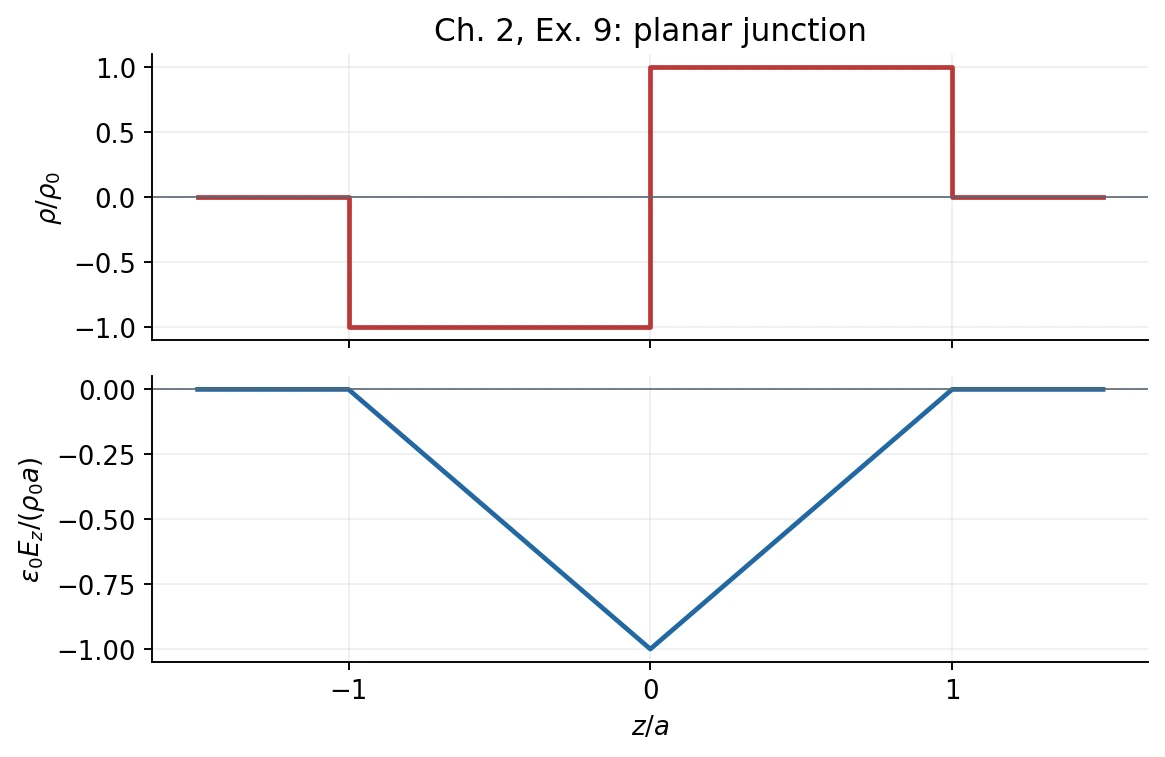
Original computed plot for this exercise; figure record.