Homework 4 · Magnetic Force and Current-Generated Fields
All assignments · Previous · Next.
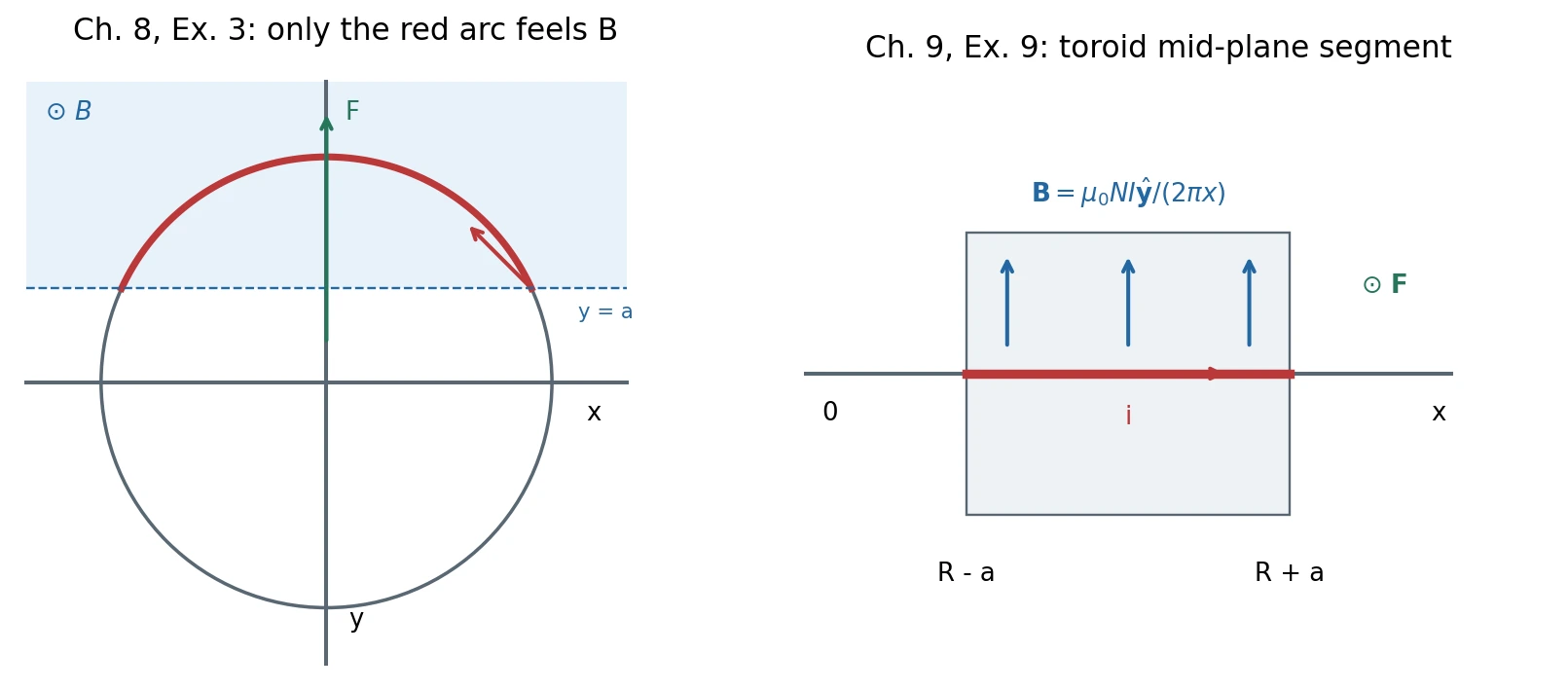
New geometry diagrams for Ch. 8, Ex. 3 (left), and Ch. 9, Ex. 9 (right), from the supplied exercises; figure record.
Ch. 8, Ex. 3 · A loop partly in a magnetic field
Problem. A field \(\mathbf B=B\hat{\mathbf z}\) exists only in the region \(y\geq a\) of the \(xy\) plane. A circular loop of radius \(R\), centered at the origin, carries current \(I\) counterclockwise seen from \(+z\), with \(0\leq a<R\). Find its net force.
Method: Force on a current element.
Solution. Only the upper arc is in the field. Parameterize it by \(\mathbf r=R(\cos\theta,\sin\theta,0)\), with \(\alpha=\arcsin(a/R)\) and \(\alpha\leq\theta\leq\pi-\alpha\). Since \(\mathbf B\) is constant on that arc,
The displacement along the current is \(-2\sqrt{R^2-a^2}\hat{\mathbf x}\), so
It reduces to \(2IBR\hat{\mathbf y}\) for the upper semicircle (\(a=0\)), and vanishes as \(a\to R\). 不能把整圆代入 \(I\oint d\boldsymbol\ell=0\);下半部分没有磁场。
Ch. 8, Ex. 4 · Torque on a rotating charged disk
Problem. A plastic disk of radius \(R\) has uniform surface charge density \(\sigma\) and rotates about its axis with angular velocity \(\boldsymbol\omega\). A uniform field \(\mathbf B\) is perpendicular to the rotation axis. Find the torque magnitude.
Method: Current-loop moment and torque.
Solution. Split the disk into rings. For \(\omega=|\boldsymbol\omega|\),
Integrating gives the signed vector moment
The moment follows \(\boldsymbol\omega\) for positive charge and opposes it for negative charge. The disk is insulating: charges rotate with the material rather than redistributing as on a conductor.
Ch. 8, Ex. 7 · Motion from rest in crossed fields
Problem. Uniform fields are \(\mathbf E=E\hat{\mathbf x}\) and \(\mathbf B=B\hat{\mathbf z}\), \(E,B>0\). A particle of mass \(m\) and charge \(q\ne0\) starts at rest at the origin. Ignore gravity. (a) Find the mean velocity over one cyclotron period \(T=2\pi m/(|q|B)\) and show it is independent of \(q,m\). (b) Find the largest \(|x|\) and the sign of \(q\) for which the particle moves toward \(+x\).
Method: Lorentz force and crossed fields.
Solution. (a) First derive the motion using the signed frequency \(\omega_s=qB/m\). The equations are
With zero initial velocity, the shifted vector \((v_x,v_y+E/B)\) rotates uniformly:
Integrating with \(\mathbf r(0)=0\),
The positive period and drift are
The drift does not depend on \(q\) or \(m\), although the cyclotron motion does.
(b) Since \(0\leq1-\cos\omega_st\leq2\),
Positive charges stay on the \(x\geq0\) side; negative charges stay on \(x\leq0\). 漂移方向对两种电荷相同,横向偏转方向相反。
Ch. 9, Ex. 2 · Field of a rotating charged spherical shell
Problem. A spherical surface of radius \(R\) carries uniformly distributed total charge \(Q\). It rotates about \(z\) with angular speed \(\omega\), counterclockwise seen from \(+z\). Find the magnetic field magnitude on the axis at \((0,0,z)\) for \(|z|<R\) and \(|z|>R\).
Method: Biot–Savart superposition and circular-loop axial field.
Solution. Write \(\sigma=Q/(4\pi R^2)\) and build the shell from rings at polar angle \(\theta\). Each ring has radius \(R\sin\theta\), height \(R\cos\theta\), and current
Its axial field contribution gives
To evaluate, set \(s=|z|\), \(u=\cos\theta\), \(A=R^2+s^2\), \(D=2Rs\). For \(s>0\),
where \(w=\sqrt{A-Du}\). At \(s=0\) the same result follows directly from \(\int_0^\pi\sin^3\theta\,d\theta=4/3\). Thus
For the requested magnitude replace \(Q\) by \(|Q|\). The interior axial field is constant. The exterior result agrees with a dipole \(\mu=Q\omega R^2/3\). This is a surface charge distribution, not a uniformly charged solid ball.
Ch. 9, Ex. 7 · Ampère paths with winding numbers
Problem. Wire \(A\) carries \(i_1>0\) out of the page; wire \(B\) carries \(i_2>0\) into it. Find \(\oint\mathbf B\cdot d\boldsymbol\ell\) for (a) a path winding twice counterclockwise around \(A\), never around \(B\); (b) a figure-eight whose side-by-side lobes meet at one genuine crossing, with the lobe about \(A\) traversed counterclockwise and the other surrounding \(B\).
Method: Ampère's law and orientation.
Solution. For an oriented planar path,
where \(n_j\) is its signed winding number and \(I_{j,z}\) is positive out of the page.
(a) \(n_A=2,n_B=0\), hence \(\boxed{\oint\mathbf B\cdot d\boldsymbol\ell=2\mu_0i_1}\).
(b) A genuine crossing makes the other lobe clockwise, so \(n_A=1,n_B=-1\), while \(I_{B,z}=-i_2\). Therefore
The two signs for the second lobe cancel. 自交环路按各叶片的有向绕数计算,不能只看几何上圈住了哪些电流。
Ch. 9, Ex. 9 · Force across a toroid's finite width
Problem. A toroid has \(N\) turns, current \(I\), major radius \(R\), and circular cross-section radius \(a<R\). Its mid-plane is \(xy\) and its internal field circulates counterclockwise seen from \(+z\). A straight test wire runs along the positive \(x\) axis from \(R-a\) to \(R+a\), carrying current \(i\) toward \(+x\). (a) Find the force on this segment. (b) Compare its magnitude with \(2aiB_0\), where \(B_0=\mu_0NI/(2\pi R)\); show which is larger.
Method: Toroid field and wire force.
Solution. (a) At \(x>0\), \(\mathbf B(x)=\mu_0NI\hat{\mathbf y}/(2\pi x)\). Thus
(b) Put \(u=a/R\in(0,1)\). Then
Hence \(\boxed{F>2aiB_0}\). The center-field approximation underestimates the force, tending to equality only as \(a/R\to0\).