2023 Midterm · Question Paper
Midterm index · Formula sheet · Worked solutions
Four questions, 25 points each. Text follows the supplied images, with mathematical notation typeset consistently. Figures are redrawn from the corresponding question pages. No exam duration was included in the supplied pages.
1. A point charge in front of a conducting sphere · 25 points
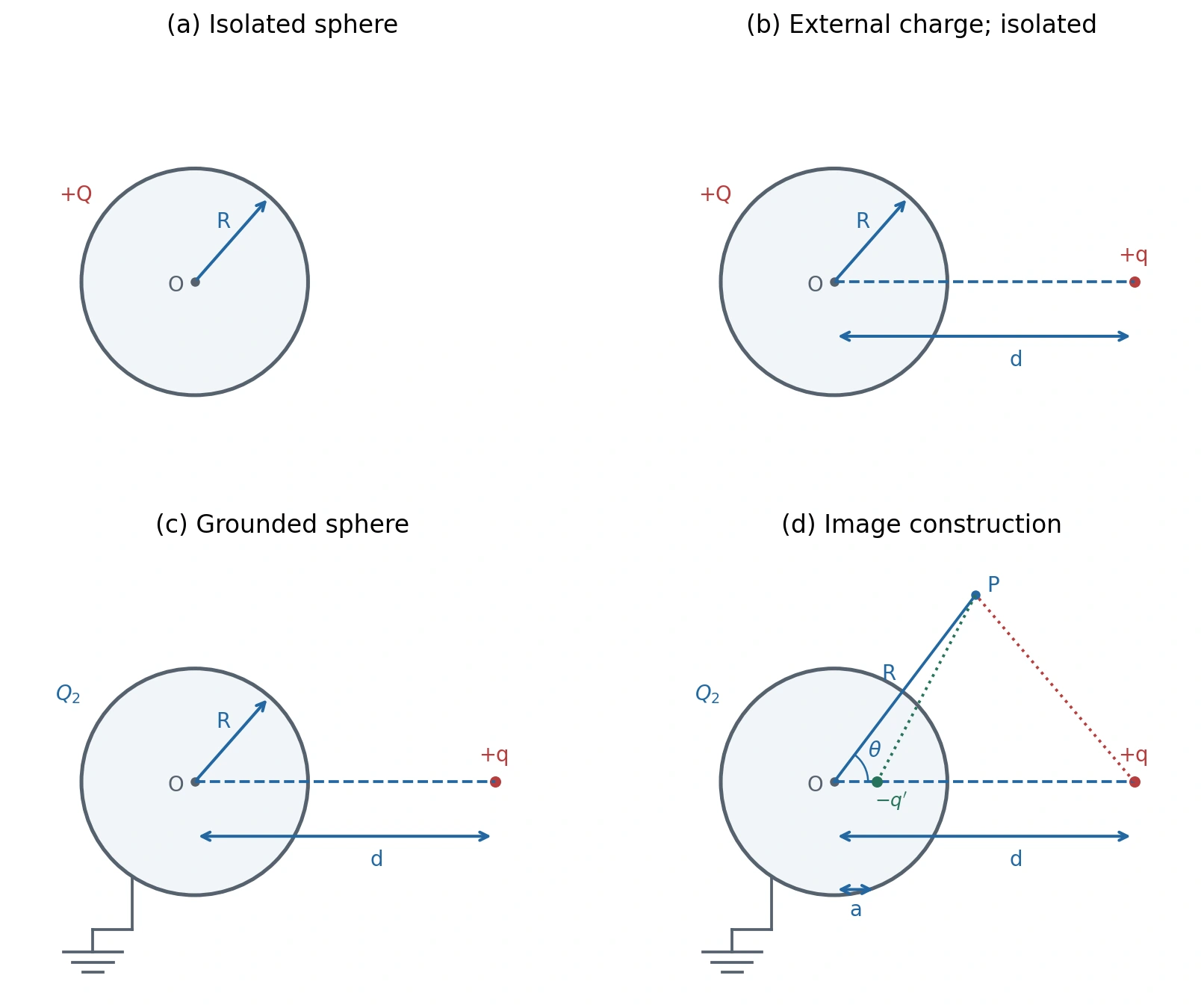
Redrawn from the 2023 paper, Fig. 1, printed p. 3; figure record.
(a) A conducting sphere has radius \(R\) and charge \(+Q\) uniformly distributed on its surface. Evaluate the electric field \(\mathbf E_1\) and potential \(V_1\) inside and outside the sphere.
(b) A point charge \(+q\) is newly located at distance \(d\) from the center of the conducting sphere, \(d>R\). This redistributes the sphere's surface charge. Evaluate the electric field \(\mathbf E_2\) and potential \(V_2\) at the center of the sphere.
(c) The conducting sphere is now grounded, allowing charge to flow between it and the ground. Its residual charge is \(Q_2\). Evaluate the total signed charge flowing from the sphere into the ground, \(Q-Q_2\).
(d) With the sphere grounded, the original text states that “the charges \(Q_2\) are uniformly distributed on the surface.” Apply the method of images to evaluate the exterior potential \(V_3\) at point \(P\).
Hint: Place a negative image charge \(-q'\) on the line \(Oq\), at distance \(a\) from \(O\). The combined potential due to \(q\) and \(-q'\) must vanish on the sphere. In the figure, \(\theta\) is measured from the direction \(Oq\).
The quoted distribution statement in (d) needs correction; see solution 1(d). The image construction in the hint determines the intended boundary-value problem.
2. Lossy spherical capacitor · 25 points
A spherical capacitor has inner radius \(a\) and outer radius \(b\). The space between its electrodes is filled with a lossy dielectric of relative permittivity \(\epsilon_r\) and conductivity \(\sigma\). At \(t=0\) the capacitor charge is \(Q_0\), with \(+Q_0\) on the inner electrode and \(-Q_0\) on the outer one.
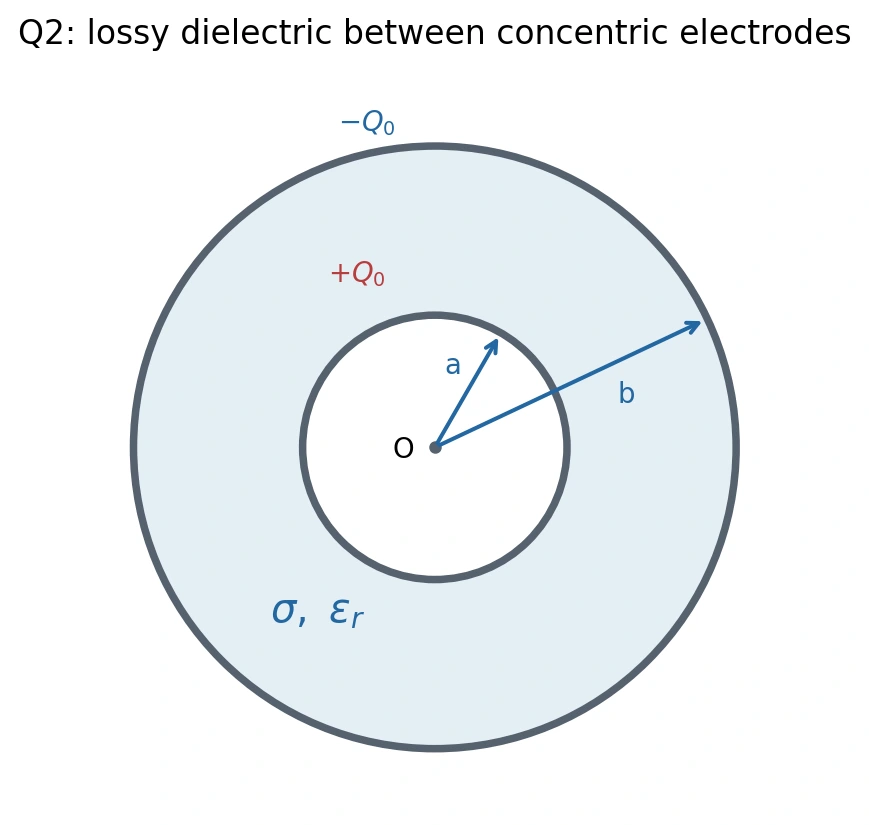
Redrawn from the 2023 paper, Fig. 2, printed p. 5; figure record.
(a) Evaluate the capacitance \(C\) and resistance \(R\) between the two electrodes.
(b) Evaluate the time-dependent plate charge \(Q(t)\).
(c) Evaluate the power dissipated by Joule heating inside the capacitor.
3. Magnetic field of a rotating conducting sphere with charge \(Q\) · 25 points
A conducting sphere has radius \(R\) and total charge \(+Q\) uniformly distributed over its surface. It rotates about its central \(z\) axis at angular velocity \(\omega\). Assume the charge distribution does not change; its circulation produces a magnetic field.
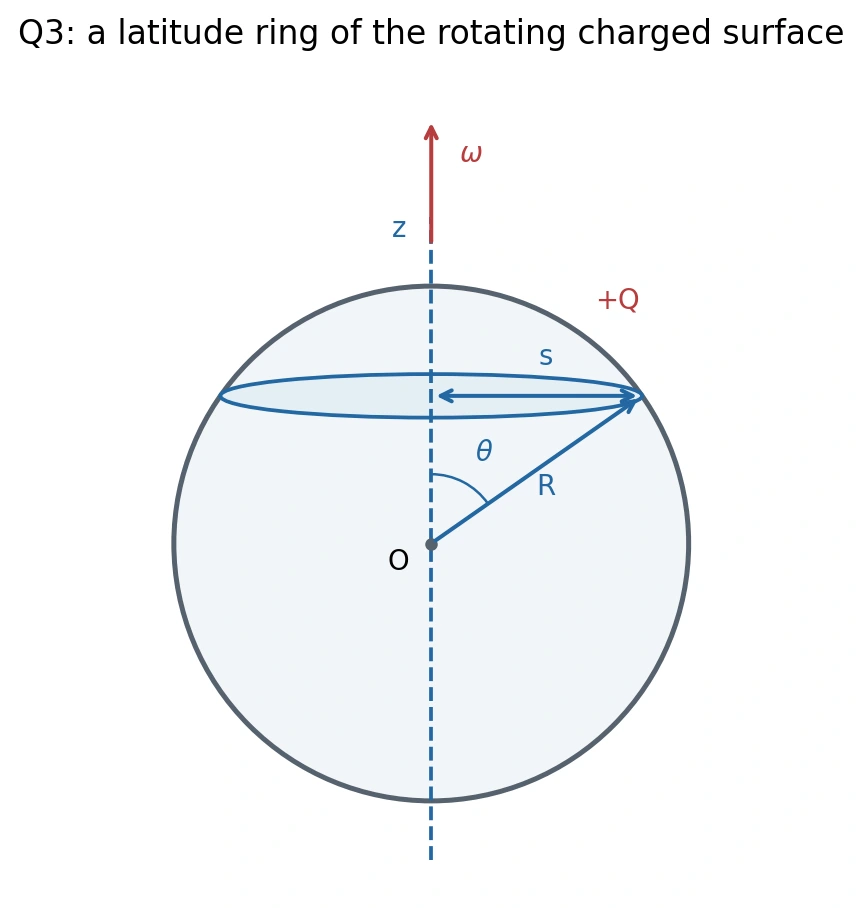
Redrawn from the 2023 paper, Fig. 3, printed p. 7; figure record.
(a) Calculate \(\sigma(\theta)=dq(\theta)/d\theta\), the charge per unit polar angle of the ring between \(\theta\) and \(\theta+d\theta\), and \(J(\theta)=\sigma(\theta)/\Delta T\), where \(\theta\) is measured from the north pole and \(\Delta T=2\pi/\omega\).
(b) Calculate the magnetic dipole moment \(\boldsymbol\mu\). For a ring of area \(A(\theta)\), its contribution is \(d\mu=J(\theta)A(\theta)d\theta\).
(c) Apply the Biot–Savart law to evaluate \(\mathbf B\) at the sphere's center \(O\).
Here the symbols \(\sigma(\theta)\) and \(J(\theta)\) follow the paper. Their meanings differ from the usual surface charge density and volume current density.
4. Faraday disk · 25 points
A perfectly conducting disk of radius \(a\) and thickness \(h\ll a\) rotates at constant angular velocity \(\boldsymbol\omega\) in a uniform, constant magnetic field \(\mathbf B\) parallel to \(\boldsymbol\omega\).
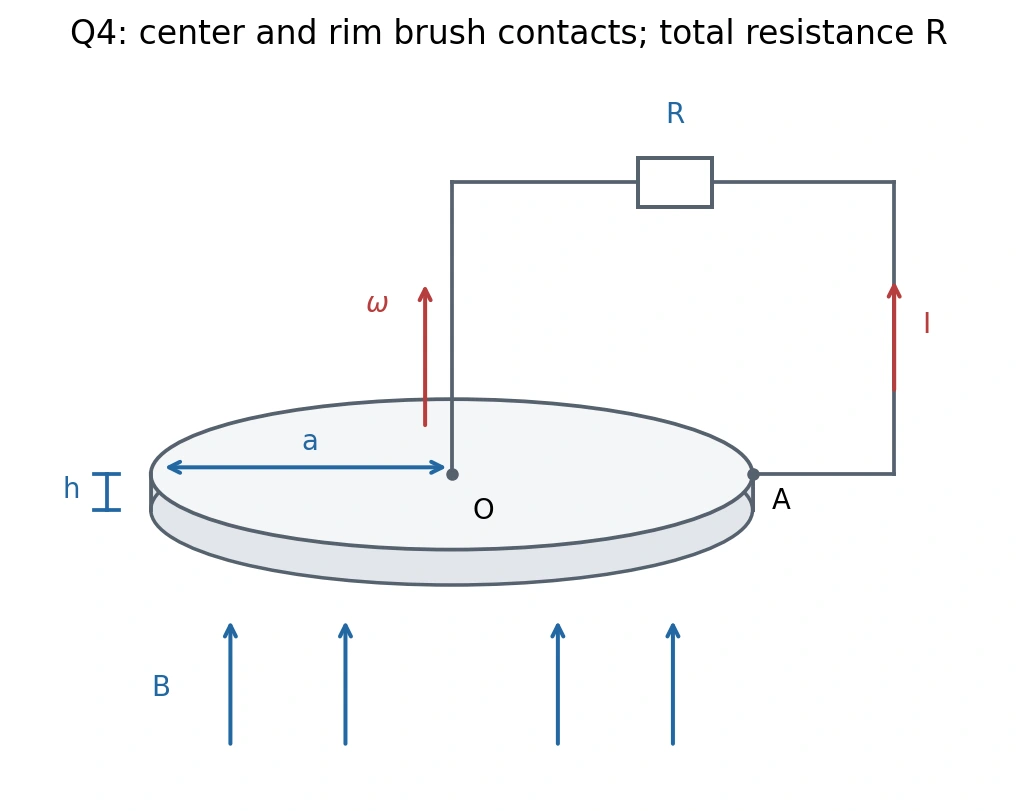
Redrawn from the 2023 paper, Fig. 4, printed p. 9; figure record.
(a) With the external circuit disconnected, evaluate the steady electric field \(\mathbf E\) in the disk and the potential difference between its center and rim.
(b) Connect its center to a point on the circumference through brush contacts, as shown. Let \(R\) be the total circuit resistance. Calculate the external torque required to maintain constant angular speed.
(c) Remove the applied torque at \(t=0\), when the disk rotates at \(\omega_0\). Evaluate \(\omega(t)\).